
"Here I stand. I can do no other."
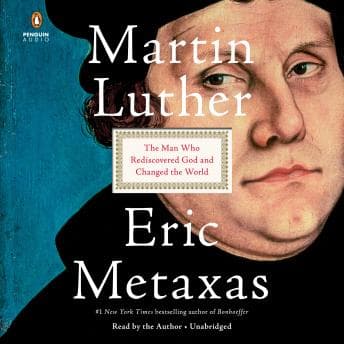
That quote—whether Luther actually said it or not—pretty much captures why I spent 20 hours with this audiobook during a brutal consulting engagement in Houston last month. There's something about a guy who looked at the most powerful institution in medieval Europe and said "nah, you're wrong" that speaks to me. My parents did something similar when they opened their dry cleaning shop in Koreatown against everyone's advice. Different stakes, same energy.
Bottom line: This is a solid investment of your time if you're interested in understanding how one stubborn monk accidentally invented the modern world. It's not a quick read—we're talking 20+ hours here—but Metaxas keeps things moving. At 2.0x, I got through it in about 10 hours, and honestly, that felt about right.
When the Author Becomes the Voice
Here's the thing about author-narrated audiobooks—they're a gamble. Sometimes you get someone who wrote a brilliant book but sounds like they're reading a grocery list. Metaxas? He's actually pretty good. Enthusiastic, clear, genuinely seems to care about what he's saying. His tone is a bit unconventional—kind of like listening to that one professor who really, really wants you to understand why this matters. Some people find that grating. I found it kept me awake during a 6 AM flight to Dallas. Bossypants had that same conversational energy—Tina Fey narrating her own story with the exact right mix of self-awareness and enthusiasm.
The pacing is what Metaxas does well. He knows when to speed through the theological weeds and when to slow down for the dramatic moments. Luther burning the papal bull? That section had me actually looking up from my spreadsheets. The Diet of Worms confrontation? Genuinely gripping stuff. (And yes, I still chuckle at "Diet of Worms" like a twelve-year-old. Jenny would be disappointed.)
What Metaxas Gets Right (And What He Skips)
Look, I've read maybe a dozen business books that reference the Reformation as this pivotal moment for individual liberty, entrepreneurship, the whole Protestant work ethic thing. Most of them get it wrong or oversimplify it into some LinkedIn-ready soundbite. Metaxas actually does the work. He traces how Luther's ideas about individual conscience and direct access to God laid the groundwork for concepts we take for granted now—personal accountability, questioning authority, the idea that institutions can be wrong.
This is what my parents did instinctively. Now it has a TED talk. They never waited for permission to build something. They just did it. That kind of stubborn conviction shows up in unexpected places—even in Tower Lord, where characters constantly choose principle over pragmatism, consequences be damned.
But—and this is important—Metaxas is clearly sympathetic to Luther. Like, really sympathetic. If you're looking for a critical scholarly analysis of Luther's more problematic views (and there were some ugly ones, particularly regarding Jewish people), you won't find deep engagement here. Metaxas mentions them but doesn't dwell. That's a choice. Whether it's the right choice depends on what you're looking for.
I've seen this approach fail at three different companies—the hagiographic biography that ignores the founder's flaws. It makes for a better story but a worse education. Metaxas doesn't completely fall into this trap, but he's definitely standing at the edge.
The ROI Calculation
So here's my math: 20 hours is a significant investment. Is it worth it?
If you're in business, understanding the Reformation isn't just historical trivia. It's understanding where our ideas about individual rights, contracts, and the legitimacy of challenging institutional authority came from. Every startup founder who's ever said "we're disrupting X" is basically doing a secular version of what Luther did. Knowing the original helps you understand the pattern.
About 13 hours of this are genuinely valuable. The other 7? Not so much. There are sections in the middle—the theological debates with Zwingli, some of the political maneuvering with German princes—where even at 2.0x I found myself zoning out. Skip to chapter 5 if you're losing steam around hour 12. Thank me later.
For commuters doing long hauls, this is actually ideal. The chapters are well-structured, Metaxas recaps enough that you won't be lost if you miss a section, and the narrative arc is clear enough that you always know where you are in the story.
Who Gets Value Here (And Who Doesn't)
If you want a readable, engaging introduction to Luther and why he matters, this delivers. If you want academic rigor and critical analysis, look elsewhere. If you're a business person trying to understand the intellectual roots of Western capitalism and individualism, this is actually more useful than most business books that try to cover the same territory. Skip it if you need scholarly balance on Luther's darker views—Metaxas isn't your guy for that.
Jenny would say I'm being harsh about the length. Jenny is right. But 20 hours is 20 hours, and Metaxas could have trimmed some of the theological deep cuts without losing the narrative power.
The Bottom of the Spreadsheet
My parents never read Luther. They never needed to. They lived the principles—question authority, work hard, trust your own judgment. But understanding where those ideas came from? That's worth something. Even at 20 hours.







![Steve Jobs [unabridged audiobook] audiobook cover](/_next/image?url=https%3A%2F%2Fcovers.audiobooks.com%2Fimages%2Fcovers%2Ffull%2F9788499923406.jpg&w=1920&q=75)