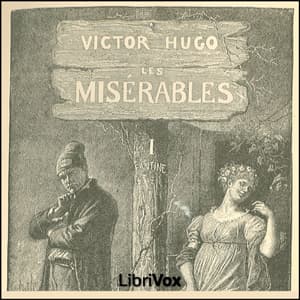

Look, let's just address the elephant in the room. Or rather, the 1,500-page brick in the room. Les Misérables.
My students know it as "that musical where everyone dies singing." My mom knows it as the book she uses to prop open the sunroom door. But for us—the people who actually care about the ink on the page—it's the summit. The Everest of 19th-century literature.
I decided to tackle Tome 1 in the original French because, apparently, twenty years of teaching The Great Gatsby wasn't enough punishment for one lifetime. (And yes, I did this while grading sophomore essays on Lord of the Flies. The thematic overlap of human misery was... palpable.)
Here's the thing about this specific recording, though. It's not a performance. It's a documentation.
The Voice in the Void
We need to talk about Didier.
I couldn't find much about him online, but my gut—honed by listening to hundreds of hours of amateur recordings—says this is a labor of love, likely a volunteer effort. And I respect that. Seriously, I do. Reading Hugo aloud for 14 hours is an athletic feat.
But.
Didier reads with the emotional variance of a metronome. It is clear. It is precise. It is incredibly, relentlessly straightforward. If you're a French student trying to nail your pronunciation or follow along with the text, this is actually gold. He doesn't speed up, he doesn't mumble, and he doesn't do weird voices for the innkeeper.
If you're looking for the heartbreak of Fantine, though? The simmering rage of Jean Valjean? You're not really gonna find it here. The delivery is flat. It reminds me of those faculty meetings where the vice principal reads the safety manual verbatim. You get the information, sure. But you don't feel the fire.
When Philosophy Meets the Monotone
Victor Hugo didn't just write a story; he wrote a social manifesto and interrupted it occasionally with plot. Tome 1 is heavy on the setup—the Bishop of Digne, the backstory of Fantine, the introduction of Valjean.
Because the narration is so unembellished, the philosophical digressions (and Lord, are there digressions) actually fare better than the dialogue. When Hugo is lecturing us on society's failure, Didier's dry style fits. It feels like a lecture.
But when we get to the gut-wrenching poverty, the desperation? That's where I struggled. I found myself zoning out during what should have been tear-jerker moments. I was walking the lakefront, freezing my face off in the Chicago wind, and I should've been weeping for Fantine. Instead, I was wondering if I remembered to defrost the chicken for dinner. I Know Why the Caged Bird Sings had me crying on that same lakefront—proof that when the narration clicks, even the wind can't distract you from the heartbreak.
That's the danger of a monotone delivery on a text this dense. It turns poetry into data.
Who's This For (And Who Should Keep Walking)
French language learners? This is your pronunciation companion—clear, unhurried, faithful to the text. Purists who believe the author's words should stand entirely on their own without an actor getting in the way? You might actually appreciate this stripped-down approach.
But if you want the drama Hugo intended—the Romantic with a capital R who deserves a narrator willing to shout, whisper, or cry—keep looking. Didier is a faithful guide, but he kept us on the sidewalk when I wanted to be in the barricades. (Okay, the barricades are later, but you get the metaphor.)
Grading This One on a Curve
I'm glad I listened, mostly to say I did. But I think for Tome 2, I'm going to need to find someone who brings a little more grease and grime to the microphone.