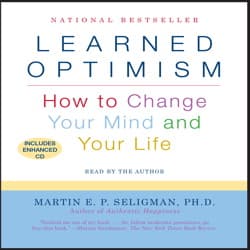

I listened to this during a 2AM insomnia spiral after a production outage. Which, now that I think about it, is probably the ideal conditions for absorbing a book about learned helplessness - I was actively experiencing it.
The Science Is the Product Here
TL;DR: Worth your commute. But only if you're ready to actually pay attention.
Seligman's core framework - explanatory style, the three P's (Permanent, Pervasive, Personal) - is genuinely one of those mental models that rewires how you debug your own thinking. And I mean that in the most literal engineer sense. He's basically describing a logging system for your brain's failure attribution. Did you blame the outage on permanent infrastructure rot, or a specific misconfigured timeout? That distinction matters. Same with your life.
The research backbone is real. This isn't "think positive thoughts and manifest your dreams" energy. Seligman ran actual controlled studies - the dogs, the electric shocks, the learned helplessness experiments that would absolutely not pass an ethics board today but produced genuinely illuminating data. The same rigorous, data-first approach to human longevity shows up in Lifespan, where David Sinclair leans hard on his own lab results too - though his narration has considerably more charisma than Seligman's. He built the CAVE (Content Analysis of Verbatim Explanations) system to analyze explanatory style at scale. The science actually holds up, and he's not shy about showing his work.
At 1h 30m, this is basically a really good academic paper with better pacing. Could've been a blog post? Honestly, borderline. But it's a dense 90 minutes. I caught myself rewinding sections twice, which I almost never do at 1.5x.
The Author Narrating Himself Problem
Okay. So. Seligman narrating his own book.
One listener review I came across said he "comes off like an alien trying and failing to demonstrate human emotions" and I cannot improve on that sentence. It's not wrong. There's an authoritative clarity to his delivery - you never doubt you're getting the information correctly - but warmth is not in his vocal toolkit. At all.
This isn't Ray Porter. This is a brilliant professor reading his own lecture notes into a microphone in what I assume was a very beige recording studio in the early 2000s. No music, no production flourishes, nothing to catch your ear if your attention drifts. On a 6AM train with someone's shoulder in my face and a delayed departure at Millbrae, I lost the thread twice and had to rewind.
The pacing compounds this. Academic style means he'll build a point methodically, which is great for comprehension and brutal for passive listening. This is not a gym book. This is not a background commute book. This is a "sit down, open the Notes app, and actually engage" book - which, for 90 minutes, I think is a fair ask.
I'd bump it to 1.25x max. Going faster on Seligman's own narration starts to feel weirdly aggressive, like you're rushing him through his own research.
Who's Getting ROI Here
The ROI on this audiobook is high if you're the right person. Specifically: if you've ever caught yourself thinking "I always screw up technical interviews" or "our team is just bad at shipping" and accepted that as permanent fact rather than a specific, fixable thing - this book is debugging your cognitive error handling.
If you're coming from a positive psychology rabbit hole (Csikszentmihalyi, Duckworth, the whole UPenn crew), Seligman is the source node. Read this first, or read it to understand where the downstream stuff came from.
Skip the audio version if: you're a passive listener, you need a narrator who makes you feel something, or you want this as background noise while coding. The content is too dense and the delivery too flat for that to work.
Get the audio version if: you're disciplined, you're commuting somewhere you can actually focus (not a packed Caltrain at rush hour, learned that the hard way), and you want the experience of hearing the researcher explain his own framework. There's something to that. He knows exactly what he means.
Ninety minutes is a small investment for a mental model that genuinely changes how you attribute failure. Just don't expect to absorb it while half-asleep.