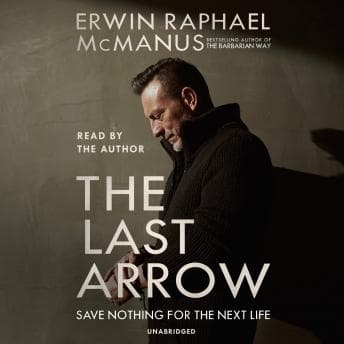

Quick Verdict: Worth your commute if you need a kick in the pants about actually doing the thing you've been putting off. Skip if you want tactical steps.
I started this one at 5:47 AM on a Tuesday, packed into a Caltrain car that smelled like someone's sad breakfast burrito. Perfect timing, actually. There's something about being surrounded by half-asleep tech workers scrolling LinkedIn that makes a book screaming "STOP WASTING YOUR LIFE" hit different.
Erwin McManus is basically your friend's cool pastor uncle who actually lived an interesting life before finding his calling. And he narrates his own book, which—look, author-narrated can go either way. This one works. His voice has this urgent, almost breathless quality that matches the content. You can tell he's not reading words; he's preaching them. Whether that's a feature or a bug depends entirely on your tolerance for motivational intensity at 6 AM.
The Optimization Problem Nobody Asked For
Here's the thing about self-help books that could've been blog posts: this one couldn't have been. McManus isn't giving you a system or a framework. There's no 7-step process, no acronym to remember, no worksheet in the companion PDF. What he's doing is more like... debugging your internal narrative about risk. Power of Now does something similar with presence, though Tolle's approach is way more zen and way less "shoot your shot."
The central metaphor—you've got a quiver full of arrows, and most people die with arrows still in the quiver—is simple enough that my sleep-deprived brain could track it. But he keeps returning to it from different angles. What are you saving those arrows for? What's the worst that happens if you miss? Why do we treat our potential like a finite resource we need to hoard?
I found myself thinking about the side project I've been "planning" for two years. The one with the perfect README and zero shipped features. Classic.
When the Preacher Energy Actually Works
McManus has this thing where he'll drop into these almost poetic rhythms—short sentences, repetition, building momentum. It's very much a sermon delivery style. On the page, I think this would annoy me. In audio, especially with him delivering it? It creates these moments where you're just... nodding along on a crowded train like a weirdo.
The man clearly believes every word he's saying. That authenticity carries the book through sections that might otherwise feel like motivational poster territory. When he talks about people who "break the gravitational pull of mediocrity," he's not being abstract—he's pulling from what sounds like decades of watching people either take the shot or talk themselves out of it.
I finished this in 3 commutes, which felt about right. At 6 hours, it doesn't overstay its welcome. I bumped it to 1.25x for the more repetitive sections, but honestly his natural pacing is pretty good.
The ROI Calculation (Because I Can't Help Myself)
Here's where I have to be honest: the ROI on this audiobook is entirely dependent on where you're at mentally. If you're already executing on your goals and just need tactical advice? Skip this. Go listen to a business book about systems and processes.
But if you're stuck in analysis paralysis, if you've got a thing you know you should do but keep finding reasons not to—this is basically a 6-hour intervention. McManus doesn't care about your excuses. He's heard them all. He's more interested in what happens when you stop treating your life like a dress rehearsal.
The religious framework is there—this is published by WaterBrook, he's a pastor—but it's not heavy-handed. The core message (stop hoarding your potential, take the risk, live with intention) translates regardless of your spiritual situation. Year of Yes tackles the same "stop saying no to your life" energy from a completely different angle—Shonda Rhimes with Hollywood stories instead of McManus with sermon cadence.
Who Gets Value Here (And Who Doesn't)
This is not a book for deep work listening. You want to be somewhat present for it. Commute works great. Gym works great. Don't put this on while debugging a production outage (learned that one the hard way with a different book).
If you're the type who needs data and frameworks, you'll find this frustrating. If you respond to passionate conviction delivered by someone who clearly walks their talk, this might be exactly the thing.
Shipping Status: Pending
I texted Kevin about it after I finished. He said, "So you're finally going to ship that side project?" Reader, I have opened VS Code twice since then. Progress.
McManus isn't Ray Porter—nobody is—but he's got presence. And sometimes that's what you need at 6 AM on a packed train, surrounded by people who all look like they're saving their arrows for some mythical future that never comes.