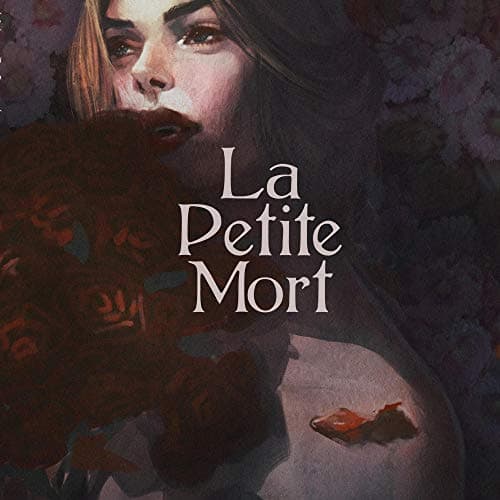

Olivie Blake wrote a novella that feels like a one-night stand with the supernatural — brief, intense, and over before you've decided how you feel about it.
La Petite Mort landed on my phone during a rainy Saturday, and I pressed play intending to get through the first chapter before running errands. Four hours later I was still on the couch, shoes half-on, completely derailed. That's the kind of pull this story has. It's short enough to be dangerous — you tell yourself you'll just sample it, and then suddenly Marisa Marrero is inheriting a haunted French Quarter house from a grandmother she barely knew, and an alchemist named Jack St. Germaine is being entirely too charming about it, and a vampire named Elisabeth Clavier is making you question every assumption you've built in the first half.
Here's what surprised me as I sat with this one afterward: it's not really a love triangle. I went in expecting the standard "pick between the brooding immortal and the mysterious mortal" setup, and Blake sidesteps that entirely. The real question driving this story is about Marisa's own power — where it came from, what it's becoming, and who benefits from her staying ignorant about it. Jack offers answers wrapped in warmth and reassurance. Elisabeth offers danger wrapped in honesty. The tension isn't romantic competition; it's about who's actually telling Marisa the truth about herself.
The title does a lot of quiet work. La Petite Mort — the little death — is operating on at least three levels simultaneously: the literal mortal danger of living next door to vampires and demons, the sexual charge between characters who probably shouldn't trust each other, and the slow death of the person Marisa was before she accepted this inheritance. Blake doesn't hammer any of these readings. She just lets them coexist, which is more unsettling than if she'd spelled it out.
I found that same faith in implication, rather than explanation, in Blake's One for My Enemy.
Naomi Rose-Mock's narration caught me off guard in the best way. She plays Marisa with this wary, slightly exhausted skepticism that made me immediately trust her as a protagonist — like someone who knows she's being manipulated but hasn't figured out by whom yet. Her Jack has this specific quality where the warmth in his voice sits just slightly on top of something colder, and you can hear the gap between what he's saying and what he means. That's hard to pull off in audio without overdoing it. Her Elisabeth is the real standout, though — there's a stillness to the delivery that makes every line feel like a predator deciding whether to strike. The contrast between how safe Jack sounds and how dangerous Elisabeth sounds is doing half the storytelling work.
Now — and I need to be straight about this — the worldbuilding is thin. You get alchemists, vampires, demons, inherited magical lineages, and a supernatural New Orleans ecosystem that's clearly vast, but Blake treats it all with a hand-wave confidence that works in the moment and frustrates you later. Elisabeth Clavier is the kind of character who should have her own trilogy. Instead she gets maybe ninety minutes of story time, and some of her best scenes feel compressed into single exchanges that could have been entire chapters. The demon subplot arrives, creates a sharp spike of tension, and resolves so quickly I actually checked if I'd accidentally skipped ahead.
This is the trade-off with a four-and-a-half-hour listen. The atmosphere is thick — Blake's prose has that arch, loaded quality where every sentence seems to know something you don't — but the story can't afford to linger anywhere. Emotional beats that should simmer get boiled fast. The shift in Marisa's trust from Jack toward Elisabeth, which should feel like a slow erosion, happens more like a sudden crack. It still works emotionally, mostly because Rose-Mock sells the confusion in Marisa's voice, but I felt the compression.
The adult content is earned rather than decorative. The violence has real stakes, the sexual tension is woven into the power dynamics rather than existing separately from them, and the language fits characters who are navigating genuinely dangerous situations. It reminded me of the way Book of Night handles its darker material — with enough restraint that when things do get intense, you feel the shift.
What I keep coming back to is the mood. This story has a specific temperature — warm and heavy and slightly suffocating, like summer air before a storm. Blake captures something about desire that's uncomfortable: the way wanting someone who might destroy you can feel indistinguishable from wanting someone who might set you free. That ambiguity is the heart of the book, and it's the thing that makes it stick even after the plot details start to blur.
Who Should Listen (And Who Should Skip)
If you love atmospheric supernatural romance with moral gray areas and you want something you can finish in a single evening — this is your listen. If you need deep worldbuilding or a fully realized love triangle, the brevity here will leave you more frustrated than satisfied.
It's not Blake's most ambitious work. It doesn't try to be. But as a single-sitting supernatural romance that trusts you to sit with moral ambiguity and doesn't need three hundred pages of lore to make you feel something? It does exactly what it sets out to do, and it does it with style.