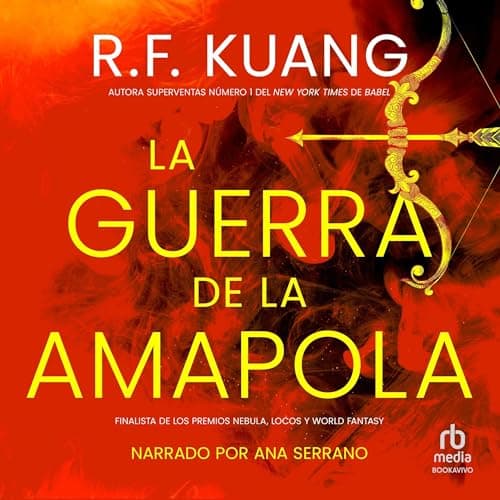

Most people come to The Poppy War already knowing it's a modern fantasy classic — Hugo finalist, Nebula finalist, Time magazine's best-of lists, the whole parade. My written notes on the English original are collected in my review of The Poppy War, where I found the prose itself doing the work that Serrano now does with her voice. So when I started the Spanish audiobook version, I expected a polished product coasting on the novel's reputation. What I got instead was a genuinely strong adaptation that made me reconsider how much a good narrator can reshape a story I thought I already knew.
Let me be upfront: La guerra de la amapola is not an easy listen. R.F. Kuang wrote a book that starts like a magical school story and then takes a hard turn into wartime atrocity territory inspired by real historical events — specifically the Second Sino-Japanese War and the Nanjing Massacre. If you've only read the blurb about an orphan girl passing an exam and attending a military academy, you're getting maybe thirty percent of the picture. The back half of this novel is brutal, unflinching, and deliberately uncomfortable. Content warnings for violence, abuse, and graphic depictions of war are absolutely warranted.
Rin is a protagonist who earns your loyalty the hard way. She's not likable in the traditional sense — she's desperate, ruthless, and increasingly willing to cross moral lines that the story doesn't let you look away from. What makes her work is that Kuang never lets you forget what's driving her. Every choice Rin makes comes from somewhere real: poverty, discrimination, rage, and a bone-deep refusal to be powerless ever again. Ana Serrano captures this arc with real skill. Her Rin starts scrappy and defiant, then gradually takes on a harder edge as the story darkens. The transition feels organic rather than performed.
Serrano's narration deserves specific praise for how she handles the tonal whiplash this book demands. The academy sections have an almost YA energy — rivalries, training montages, moments of dark humor between classmates. Then the war begins and the entire atmosphere shifts. Serrano doesn't oversell the horror; she lets Kuang's writing do the heavy lifting while keeping her delivery grounded and controlled. One listener put it simply: she makes the story better. I agree with that assessment. There's a restraint to her performance during the most difficult scenes that actually makes them hit harder than if she'd gone for full emotional pyrotechnics.
The worldbuilding here is one of the novel's great strengths in audio format. Nikan is essentially a fantasy China, and the political structures, military hierarchies, and shamanic magic system all get enough exposition to feel real without bogging down the pacing. At eighteen and a half hours, this is a substantial listen, and the first third — focused on Rin's time at Sinegard — does move at a slower pace than the rest. Some listeners might feel impatient during the academy chapters, but Kuang is laying groundwork that pays off devastatingly later. The slower buildup is intentional, and in audio it works better than you'd expect because Serrano keeps the interpersonal dynamics engaging even when the plot isn't racing.
Where this audiobook truly distinguishes itself is in how it handles the novel's central tension: the cost of power. Rin's shamanic abilities connect her to the Phoenix, a god of fire and vengeance, and the question of whether using that power will destroy her humanity runs through the entire book. In print, you can skim past Rin's internal wrestling. In audio, you sit with it. You hear the doubt and the anger and the gradual hardening, and it changes the listening experience in ways I wasn't expecting.
The Spanish translation reads well in audio — the prose flows naturally and doesn't feel like a translation artifact. Military terminology and proper nouns from the Chinese-inspired setting are handled consistently, which matters a lot over eighteen hours. I never found myself confused about who was who or where we were geographically.
A few honest caveats. This book earns its content warnings several times over. The depictions of wartime violence, including sexual violence, are explicit and meant to disturb. Kuang based key events on real atrocities, and she doesn't soften them. If you're listening during a commute or with kids in earshot, be aware of what you're getting into. The pacing criticism is also fair — the academy section runs long, and some readers who came for the war and the shamanism will find themselves waiting.
Who Should Listen (And Who Should Skip)
If you're a Spanish-language listener drawn to grimdark fantasy that refuses to flinch — or if you loved the English text and want to hear how Serrano reframes it — this is well worth your eighteen hours. Skip it if you need your fantasy to stay on the lighter side, or if graphic depictions of wartime atrocity are a hard boundary for you.
Those are the trade-offs for a book that refuses to treat war as adventure or power as consequence-free. La guerra de la amapola is fantasy that's willing to be genuinely uncomfortable, and Ana Serrano's narration ensures that discomfort lands exactly where Kuang intended it.









![El Familiar [The Familiar] audiobook cover](/_next/image?url=https%3A%2F%2Fm.media-amazon.com%2Fimages%2FI%2F41KsfvZ36iL._SL1200_.jpg&w=1920&q=75)