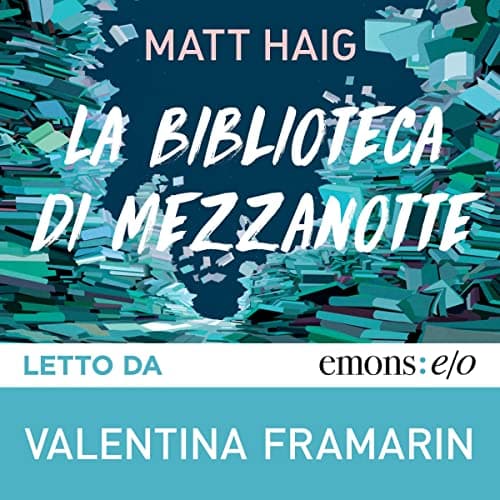

La biblioteca di mezzanotte takes about an hour to become the book it actually wants to be, and that first hour is a slog.
I say this as someone who started listening while folding laundry on a Tuesday evening, fully expecting the kind of breezy literary fantasy that would carry me through a pile of fitted sheets. Instead, I got forty-five minutes of Nora Seed's life falling apart in every conceivable direction — dead cat, lost job, dissolved friendships, fractured family ties — and Valentina Framarin narrating all of it in roughly the same emotional register. I nearly switched to a podcast. I'm glad I didn't.
Once Matt Haig drops Nora into the Midnight Library itself, the premise locks in and earns its reputation. The library exists in the liminal space between life and death, presided over by Mrs. Elm, Nora's childhood librarian. Every book on its infinite shelves contains a complete alternate life — the version of Nora's existence that would have unfolded if she'd made one different choice. Married her ex-fiancé Dan? There's a book. Stayed with her band and become a rock star? There's a book. Pursued Olympic swimming? Moved to Australia? Became a glaciologist? All there, all fully realized, all available to be lived until the moment Nora's dissatisfaction causes the life to dissolve and drop her back among the shelves.
It's a premise that taps into something deeply human — that persistent itch of "what if" — and when Haig lets Nora leap between lives, the minutes genuinely fly. Some alternate lives last chapters; others collapse in pages. The pacing becomes almost episodic, which works surprisingly well in audio. Each new life is a self-contained story with its own texture, and the cumulative effect is Nora slowly learning that perfection isn't hiding behind any single decision she failed to make.
Paola Novarese's Italian translation handles the philosophical passages without making them feel stilted, though Haig's tendency toward aphoristic wisdom occasionally lands closer to inspirational-poster territory regardless of the language. That's a source-material issue, not a translation one.
Now, the narration. Valentina Framarin has a pleasant, calm voice that genuinely suits the book's reflective sections. The problem is that this book isn't only reflective. It's about suicide, panic, grief, creeping dread, and eventual catharsis — and Framarin's delivery doesn't shift gears enough to distinguish between Nora browsing shelves and Nora watching an alternate life collapse around her. Character differentiation is minimal. Conversations between Nora and Mrs. Elm, which should carry warmth and quiet tension, feel flattened. Compare this to Carey Mulligan's English-language narration, where her tonal shifts between lives give each alternate Nora a distinct emotional signature — Framarin's version feels like a single sustained note where the story demands a chord progression.
I felt this most acutely during a scene where Nora lands in a life where she's happily married with a daughter, only to realize she doesn't recognize the child's face. In print, that moment has real gut-punch potential. In this audio, it slid past me. I rewound, confirmed I hadn't missed dialogue, and realized the narration simply hadn't flagged the emotional weight. That's the core issue: Framarin doesn't ruin the experience, but she consistently undersells it.
At 9 hours and 16 minutes, this is a manageable listen. Bumping to 1.25x speed actually helped — it injected energy into the delivery and compressed the slower early chapters without sacrificing comprehension. I'd suggest trying it from the start.
The content warnings matter here and I want to be direct about them: the book opens with a suicide attempt and deals extensively with depression throughout. Haig, who has written about his own mental health in Ragioni per continuare a vivere, treats these themes with genuine care and ultimately with hope. Notes on a Nervous Planet covers similar ground in essay form and is arguably a gentler entry point if the fictional framing here feels too raw. But the opening chapters dwell in very dark territory before the fantasy premise kicks in. If you're in a fragile headspace around these topics, consider reading in print where you control the pace, or approach the audio with awareness.
What surprised me as I worked through listener reactions is how neatly they split. People who connected with the premise and forgave the narration's flatness called it smooth and entertaining. People who needed the performance to carry them through the slower stretches bounced off entirely. I land between those camps. The book's central insight — that the best life isn't the one scrubbed clean of regret but the one you actually choose to inhabit — lands with real emotional force by the final chapters, even when Haig pushes it a little too hard. The audiobook format should amplify that intimacy. In stretches, it does. In others, you're doing the emotional work yourself while the narration coasts.
Who Should Listen (And Who Should Skip): If you're an Italian-language listener drawn to the premise and patient enough to push past a flat opening hour, the story does the heavy lifting even when the performance doesn't. Skip this version if you need a narrator to carry you emotionally — if you have access to the English narration by Mulligan or can read it in print, you'll get closer to what Haig intended. This edition is fine. It's just not the version that makes you forget you're listening to an audiobook.
On that note, the English-language audiobook I keep circling back to when I need a narrator who genuinely disappears into the material is We Are All the Same in the Dark — the performance there does exactly what Framarin's doesn't, and the subject matter is similarly heavy.