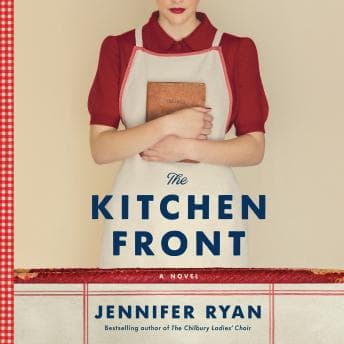

What would your grandmother have made of a woman hiding her Cockney accent to survive in a world that judged her by the way she talked? I kept thinking about that while I sketched logos at my desk with Frida draped across my keyboard, Jasmine Blackborow's voice filling my apartment like something warm and complicated and a little bit heartbreaking.
Abuela would have understood every single woman in this book. The desperation. The pride. The way you bend yourself into shapes that hurt just to keep a roof over your kids' heads. She would have clutched her rosary and said mija, these women and then gone quiet in the way she did when something hit too close.
Four Women, One BBC Microphone, and Way Too Many Feelings
The premise sounds almost cozy - a wartime cooking competition on BBC radio, Britain rationing everything, four women competing for a job as the first-ever female co-host. And it is cozy, sometimes. There's something genuinely delicious about a novel where the stakes involve both Nazi U-boats cutting off food supplies AND whether someone's blancmange holds its shape. Jennifer Ryan knows exactly how to make the domestic feel enormous.
But here's the thing: this book earns its emotional weight because each woman's reason for entering the contest is a different flavor of survival. The young widow trying to keep her children from losing their home. The kitchen maid who wants to stop being invisible. The manor lady whose wealthy husband has become something darker than she lets on. The trained chef - and this is the one who wrecked me - who's spent her whole career being dismissed by men who have half her talent.
I ugly-cried during the chef's scenes. Multiple times. The specific humiliation of being brilliant at something and having that brilliance treated like a curiosity or a threat - yeah. That one landed.
Jasmine Blackborow and the Cockney She Hides on Purpose
Okay so here's where this audiobook becomes something special. Blackborow does something technically fascinating with the London chef character: she gives her a Cockney accent that the character herself suppresses in certain scenes. You can actually hear the character code-switching - the accent thickening when she's off-guard, then pulling back, tightening, when she's performing for people who'd judge her for it.
That's not just good character differentiation. That's acting. That's understanding why a character does what she does and building it into the voice itself. I sat there with my stylus frozen over my tablet thinking wait, did she just— and then I rewound to make sure I'd heard it right. I had.
The four women never blur together, which matters enormously in a book that cuts between them constantly. The manor lady has a particular kind of careful diction - not quite stiff, but controlled in a way that starts to feel like armor once you understand what she's hiding at home. Women hiding things at home behind careful performances — Fear Thy Neighbor goes somewhere darker with that same premise, though the domestic dread there is considerably less subtle. The kitchen maid sounds younger than her years in a way that's almost painful. Blackborow's not doing party tricks here. She's doing character work.
My one honest note: this is a 13-hour listen, and there are sections in the middle - the competition logistics, some of the community-building scenes - where the pacing softens and you feel the length. Not enough to make me check how much time was left. But enough that I noticed.
This One's for Everyone Who's Ever Had to Be Smaller Than They Are
Here's who I'd hand this to without hesitation: anyone who loved The Chilbury Ladies' Choir and wants that same feeling of women holding each other up in impossible circumstances. Anyone who thinks historical fiction is dry and needs proof that it absolutely doesn't have to be. Anyone who wants a listen that feels like a Sunday afternoon that somehow sneaks up and punches you in the chest.
If you need your historical fiction to be primarily plot-driven with military precision and high-stakes action, this might frustrate you. Ryan is interested in the kitchen table, not the battlefield. The competition is the spine, but the relationships are the whole body.
This is a rainy Sunday book with teeth. The vibes are warm and the heartbreak is real and Blackborow's voice carries all of it with something that feels like genuine investment in these women's lives. I listened at 1.0x because I wasn't about to rush a single Cockney syllable.
Abuela would have loved this one. She would have rooted loudly for every single one of them and been scandalized by the manor husband and made me listen to the recipes at the end twice. Miss you.