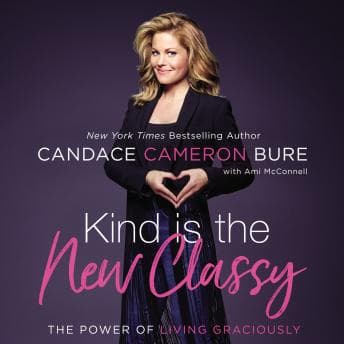

I expected to hate this book. Not because of Candace Cameron Bure herself, but because the self-help genre has a particular pattern I've studied extensively: promise transformation, deliver platitudes. I was chopping onions for a dal that would feed me for three days when I started this audiobook, fully prepared to mentally catalog every cognitive distortion masquerading as wisdom.
And then... I didn't hate it. Which is its own kind of problem.
The Psychology of Being Nice (Without Being a Doormat)
What makes this book interesting—psychologically speaking—is that Bure is essentially describing a behavioral framework without calling it that. She's talking about emotional regulation, boundary-setting, and what we in the field would call "response flexibility." The research actually shows that people who can pause between stimulus and response report higher life satisfaction. Bure doesn't cite the studies (why would she?), but she's describing the same phenomenon through her faith lens.
Here's where my academic brain got genuinely curious: she's navigating what I call the "niceness trap"—that particularly gendered expectation that women should be agreeable at all costs. But instead of rejecting niceness entirely (the typical feminist response, and a valid one), she's trying to reclaim it as a power move. Kindness as strategy rather than submission. It's a fascinating case study in how conservative women negotiate agency within traditional frameworks.
Do I agree with all her conclusions? Absolutely not. Some of her advice about responding to criticism felt like it conflated "turning the other cheek" with "accepting treatment you shouldn't accept." My therapist would have thoughts about this. The line between authenticity and performance gets blurry when you've been on camera since childhood.
When the Author Is the Narrator (And That's The Point)
The audiobook format is actually essential here. Bure's voice carries something the text alone couldn't—you hear her genuineness. Whether you find that endearing or slightly performative depends entirely on your priors about her. I found myself asking: why does someone with her platform feel the need to defend her niceness so thoroughly? What criticism is she really responding to?
Her narration is competent but not exceptional. Conversational, warm, the kind of voice that makes you feel like you're getting coffee with a friend who happens to be famous. No vocal fireworks, no character differentiation needed since it's memoir-adjacent. She sounds exactly like you'd expect from her Hallmark movie energy—which is either a feature or a bug depending on your tolerance for earnestness.
The faith elements are woven throughout, not confined to specific chapters. If Christian frameworks aren't your thing, you'll notice them. If they are, you'll probably find them comforting. I'm neither—I approach religion as a psychologist would, observing how belief systems function as meaning-making structures. From that angle, her faith provides what we'd call "cognitive anchoring"—a stable reference point from which to evaluate external pressures.
Memoir With Motivational Frosting
This isn't a rigorous self-help book with actionable frameworks. It's closer to a memoir with motivational elements. Bure shares anecdotes from her career—navigating The View, handling online criticism, balancing family with fame—and extracts lessons about graciousness. Some of these land. Some feel like they only work if you have her specific resources and support system.
She exhibits classic external locus of control disguised as internal—crediting God for her composure rather than her own emotional labor. Psychologically, this doesn't track as a sustainable strategy for everyone. But for her audience? It probably works beautifully.
At 5 hours 34 minutes, it's a quick listen. I finished it over two cooking sessions and a particularly restless night when sleep wasn't happening. (My therapist says I should address the insomnia. I say I should finish my audiobook queue first.)
Who Should Queue This Up—And Who Should Pass
You'll love this if: you're already a Candace Cameron Bure fan, you appreciate faith-based personal development, or you're genuinely struggling with how to be kind without being walked over and want a gentle, non-academic approach.
Skip it if: you want research-backed strategies, you're allergic to Christian frameworks, or you're looking for something that challenges rather than affirms existing beliefs.
Clinical Assessment: Incomplete Data, Genuine Subject
I can't give this book a high rating because it doesn't do what good self-help should do—provide tools that work regardless of your belief system. But I also can't dismiss it entirely because Bure is clearly sincere, and for her intended audience, sincerity might be exactly what's needed.
She's not a psychologist. She's not pretending to be one. She's a woman who figured out how to survive Hollywood with her values intact, and she's sharing what worked for her. I found myself thinking about Maya Angelou's work—specifically the BBC dramatisation of I Know Why the Caged Bird Sings—where surviving on your own terms is the whole point, and the personal testimony carries more weight than any framework ever could. That's worth something—just not a full credit.