
Look, I'm going to be honest - I have a chip on my shoulder about murder mystery dinner parties. Denise dragged me to one for her friend's birthday two years ago, and I spent the whole evening being told I was "overthinking it" because I kept pointing out the logical inconsistencies in the host's homemade mystery scenario. So when Pip Fitz-Amobi shows up reluctantly to a 1920s-themed Krimidinner in a Federboa and evening dress, already annoyed about not working on her school project? I felt that in my bones.
I finished this one during a Saturday morning walk along the lakefront - Denise had run ahead because she's training for a half marathon and I'm training for retirement - and at under three hours, it was done before I'd even circled back to the car.
A Prequel That Knows It's a Prequel
Here's what Holly Jackson does right: she doesn't pretend this is a full novel. Kill Joy is the origin story for Pip's detective obsession, and it wears that label honestly. The setup - a group of friends playing a murder mystery game where someone has "killed" the fictional Reginald Remy - is deliberately contained. It's a bottle episode. A literary appetizer. And for what it is, it works.
But let's talk about what it isn't. This is not A Good Girl's Guide to Murder. It doesn't have that book's slow-building dread or its genuinely unsettling revelations. What it has instead is the moment Pip realizes she actually likes puzzling through clues, that her brain lights up when she's chasing down inconsistencies - and that closing beat where the fictional murder starts bleeding into something more real, something she can't shake? That's the hook. Jackson is showing you the match being struck before the whole series catches fire. I reviewed A Good Girl's Guide to Murder a while back, and that slow-building dread is exactly what makes this prequel's lighter touch feel so intentional by comparison.
The sarcasm between the friend group carries the middle section. There's a specific dynamic where the characters' snootiness during the roleplay clashes with their actual personalities - humble kids playing aristocrats badly - and it's genuinely funny. My students would probably relate to the social awkwardness of being forced into costume character more than they'd ever admit.
Miriam Kaufmann and the Art of German Suspense
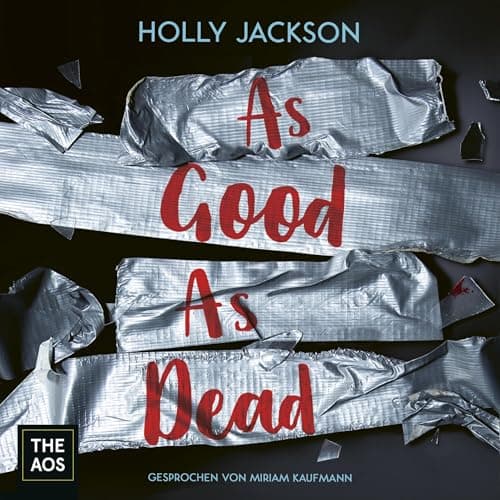
This is the German edition, which means Miriam Kaufmann is doing the heavy lifting in translation, and she handles it with a light touch that suits the material. Her tone shifts are the real star - she knows when the mystery game is still playful and exactly when to darken things, pulling you from party banter into genuine unease. She understands that pause is punctuation, and she uses silence well in the moments where Pip starts taking the game too seriously.
Her character work captures personality types more than distinct voices - the snooty characters sound appropriately self-important, the nervous ones rush their lines - which is the right call for a short piece with a large-ish cast. You're not going to get a showcase in vocal range here. But you don't need one. At 2 hours and 46 minutes, you need clarity and momentum, and she delivers both.
I will say: if you're listening in German as a second language (as I was, partly as an exercise since I minored in German approximately a century ago), Kaufmann's pacing is forgiving. Not slow, just clean.
Who Gets an Invitation (And Who Gets Turned Away at the Door)
If you've already read or listened to the main AGGGTM series, this is a fun little origin piece - like finding an old photograph of someone you know well. If you haven't read the series, this is a low-commitment way to test whether Jackson's style clicks with you before investing in the full trilogy.
But if you're expecting a standalone mystery with real stakes and a full investigation? You'll be frustrated. The mystery here is deliberately artificial - it's a game within the story - and the emotional payoff is about Pip's self-discovery, not about whodunit. Skip this if you need a proper crime plot with teeth; it's not trying to be that. The real question isn't "who killed Reginald Remy" but "why can't Pip stop thinking about murder?"
Which, as questions go, is pretty good.
Worth Pausing the Faculty Meeting For?
At under three hours, this is barely longer than one of Principal Martinez's budget presentations. (Sorry, Principal Martinez.) It's a snack, not a meal. A well-made snack - Jackson's writing is sharp even in miniature, and Kaufmann's narration keeps it moving. But it's priced and structured as a companion piece, and that's exactly how you should approach it. Don't spend a full credit. Catch it on a streaming service or borrow it, save the credit for the main trilogy, and enjoy this for what it is: the moment a teenager discovers she's good at something dangerous.