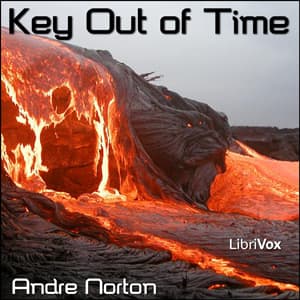

So I was up at 2 AM, supposedly debugging a procedural terrain generation algorithm that kept producing landscapes that looked like angry pancakes. Headphones on, code open, brain anywhere but my thesis. I figured I'd throw on something classic - Andre Norton's Key Out of Time, the fourth Time Traders book - because sometimes you want that old-school sci-fi comfort food while you pretend to be productive. And look, the Norton stuff delivered exactly what I expected. The audio production? That's a different story.
Dolphins, Time Displacement, and That D&D Campaign Energy
Let me be clear about what this book actually is, because the premise is genuinely cool. Ross Murdock and Arthur Ashe - the Time Traders crew - end up on Hawaika, an alien world, and they're working with Polynesian-descended settlers to figure out why the planet doesn't match the data tapes they brought. Something happened between the recorded past and the present, and they need to figure out what. Oh, and there's Karara, who has two trained dolphins named Tino-rau and Taua. Trained. Dolphins. On an alien planet.
This is exactly the kind of setup my old D&D group would've cooked up in the back of the Wilcox County library at age 14. Time displacement as a mystery mechanic, alien world exploration, animal companions with actual tactical utility - Norton was doing this in 1963, decades before half the tropes she pioneered became standard fantasy/sci-fi fare. The world-building has that mid-century density where every chapter drops another piece of the ecological and cultural puzzle. If you don't like info-dumps, this isn't for you (but you're wrong).
At 6 hours and 38 minutes, it's a lean listen. Norton didn't pad her books. The pacing clips along - you get the setup, you get the mystery of Hawaika's changed landscape, you get the payoff. No bloat. Compare that to modern sci-fi where a single book could be 30+ hours of someone describing faster-than-light travel mechanics. There's something refreshing about a story that trusts you to keep up and doesn't hold your hand through every revelation.
The Buzzing That Would Not Die
Okay. Here's where things get rough.
This is a LibriVox recording narrated by R. J. Davis, and the audio quality is... look, I need to be honest. There is a constant low buzz running through the entire recording. Not subtle. Not something you can tune out after a few minutes. It's there, humming away like someone left a fluorescent light on in the recording room. And on top of that, you can hear paper shifting. Pages turning. The actual physical mechanics of someone reading from a printed book into a microphone.
At 2 AM with headphones on, this was rough. The buzzing wormed its way into my brain until I wasn't sure if the sound was coming from the audiobook or from my own laptop fan. I actually pulled my headphones off twice to check. That's not a listening experience - that's an audio debugging session, which is ironic because I was supposed to be doing actual debugging.
R. J. Davis is clearly someone who cares about this material - they also wrote the summary description, which tells you this is a labor of love. And LibriVox is a volunteer project, so I'm not going to torch someone who gave their time for free. But I can't pretend the production doesn't affect the experience. There's no character voice differentiation that stood out to me, no dramatic shifts between Ross and Karara and Ashe. It reads more like a straightforward narration than a performance. Which is fine for what it is, but if you're coming from Steven Pacey (who walked so other narrators could run), the gap is going to feel enormous. I ran into a similar performance ceiling with Verses for the Dead - decent enough narration that still left me feeling like the source material deserved a more committed vocal performance.
Norton Deserves Better Audio (But This Is Free, So...)
Here's my real conflict. Andre Norton was a Grand Master of the SFWA. Life Achievement Award from the World Fantasy Convention. The woman basically invented half the tropes that modern sci-fi and fantasy run on - time travel espionage, alien world exploration, the intersection of human culture with alien ecology. The Time Traders series specifically has this incredible blend of Cold War thriller energy and far-future speculation that shouldn't work but absolutely does.
And the best widely available audiobook version has a persistent background buzz.
If you can get past the production issues - and some people genuinely can; I envy those people - there's a fun, tight sci-fi adventure here. The dolphins aren't gimmicky; they're genuinely integrated into the problem-solving. The Hawaika mystery has real stakes. Norton's prose is efficient and vivid in that classic way where a single paragraph establishes an alien biome that would take a modern author a whole chapter.
But I can't rate an audiobook without rating the audio.
Who's Rolling Initiative on This One
Grab this if: you're a Norton completist, you love classic sci-fi, you can tolerate rough audio for a free listen, or you're the kind of person who grew up reading battered paperbacks from the library sci-fi shelf and wants the nostalgia hit.
Skip the audio if: you're sensitive to background noise, you want a polished narrator performance, or you're new to Norton (start with the print version instead - seriously, you'll thank me).
I read this instead of writing my thesis. Dr. Patel would not approve. The dolphins, however, were worth it.