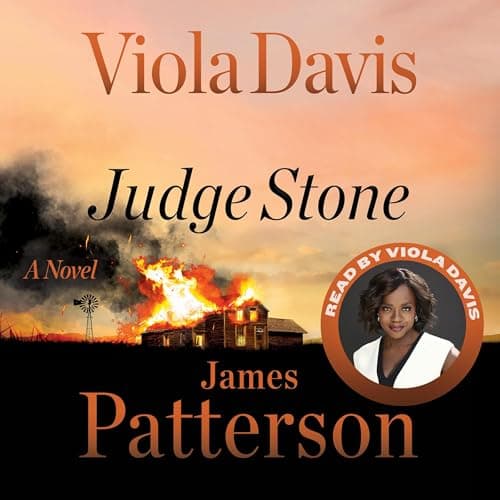

What happens when the law gives you one answer and your conscience gives you another?
That's the question sitting at the center of Judge Stone, and it's the reason I spent a full Saturday afternoon locked into this audiobook instead of doing anything productive. I had plans. The plans lost.
Here's the bottom line up front, because I know some of you are scanning this on your phone: If you want a courtroom drama soaked in moral tension and you can give it your undivided attention, this is worth every minute. If you're looking for a twist-heavy thriller you can half-listen to while folding laundry, this isn't that book. Save your credit for something else.
Now let me tell you why.
The Setup
Judge Mary Stone is the most respected person in Union Springs, Alabama — population 3,314, the kind of town where everybody knows your business before you do. She runs her family farm. She runs her courtroom. And when the most incendiary case in Southern memory lands on her bench, she has to make a decision that will satisfy no one and endanger everyone, herself included. The criminal case is open-and-shut. The ethical question is anything but. Life or death, no middle ground, no comfortable exit.
Patterson's fingerprints are all over the structure — short chapters, relentless forward momentum, cliffhangers tucked into every break. But Viola Davis's co-authorship adds a dimension that Patterson's solo legal thrillers often trade away for speed. Compare this to The #1 Lawyer or Judge & Jury, which are pure propulsion machines. Judge Stone has that same engine, but it also lets scenes breathe. Patterson's 20th Victim is another example of that pure-speed approach — propulsive, efficient, no fat on the bones — and it's fine for what it is, but it doesn't linger the way this one does. You feel the humidity of small-town Alabama. You sense decades of history between characters who've been circling each other their whole lives. The town itself becomes a pressure cooker.
If you loved A Time to Kill — that same feeling of a Southern courtroom where the legal question is really a moral one, where the community fractures around an impossible choice — this book lives in that same neighborhood. Different street, similar weight.
The Narration: Why This Audiobook Exists
Viola Davis reading a character she co-created is a fundamentally different experience than a hired narrator picking up a manuscript. She built Judge Stone from the inside out, and you can hear it in every scene.
The courtroom sequences are electric. There's a moment where Stone dresses down the DA that made me whisper "wow" to an empty room. Davis shifts between judicial authority and private vulnerability with the kind of precision that reminds you she didn't win an Oscar by accident. When the story demands fury, you get fury. When it calls for quiet devastation, she pulls back and lets the silence carry the weight. I got choked up more than once, and based on listener responses, I wasn't alone — people reported flat-out crying.
That said, there are scattered moments where the cadence hitches slightly, where the rhythm of a sentence doesn't land with the smoothness of the rest of the performance. It's minor. Most listeners won't even register it. But if you're someone who notices narrative flow at a granular level, you'll catch a hiccup here and there. It doesn't undermine the performance — more like a small scuff on an otherwise immaculate pair of shoes.
The Caveat on the Ending
Some listeners found the conclusion predictable. I'd frame it differently: it's inevitable. The story builds toward its ending with such clear moral logic that when it arrives, it feels earned rather than surprising. If you're expecting a last-act twist that yanks everything sideways, adjust those expectations now. This book isn't interested in gotcha moments. It's interested in what justice costs when the right answer makes everybody uncomfortable.
Who This Is For (And Who Should Pass)
This audiobook demands focus. The courtroom arguments require you to track motives, shifting allegiances, and the quiet politics of a small town where everyone has skin in the game. I listened at 1x and I'd suggest the same — rushing through Davis's delivery would be like skipping through a film score. You'd get the notes but miss the music.
Listen if: you want a courtroom drama with real moral stakes and you're willing to give it your full attention. Skip if: you need a twist-driven thriller you can half-listen to, or you want pure plot speed without the emotional weight.
Don't put this on while running errands. Don't try it as a sleep aid. Save it for a commute, a long drive, or a rainy afternoon where you can sit still and pay attention.
Patterson brings the architecture. Davis brings the emotional intelligence and the lived understanding of what it means to be a Black woman wielding authority in the Deep South. Davis narrating her own life in Finding Me: A Memoir hits different after you've heard her inhabit Judge Stone — the two performances together paint a fuller picture of what she brings to material that matters to her personally. The combination produces something that works as a legal thriller and as a story about what justice actually demands when comfort isn't an option.
The performance is why this audiobook format exists. Davis doesn't narrate Judge Stone. She becomes her.