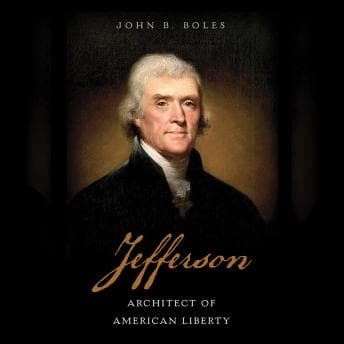

Twenty-four hours and fourteen minutes. That's longer than my last flight from Kuwait to Ramstein, and let me tell you, at least on that C-17 I could stretch my legs. This one kept me planted in my home office chair on a Saturday, pretending to update client security assessments while Ranger snored at my feet and Thomas Jefferson slowly took shape in my headphones.
Let me cut to the chase: John B. Boles has written a serious, thorough, occasionally frustrating biography that does something genuinely difficult — it treats Jefferson as a whole human being rather than a saint or a villain. The problem is that Boles sometimes leans so hard into defending Jefferson that he starts sounding less like a historian and more like Jefferson's defense attorney.
The Man Behind the Marble
Boles covers everything. And I mean everything. Jefferson the architect obsessing over Monticello's dome and oculus designs. Jefferson the paleontologist corresponding about mastodon bones to prove to European critics that the New World produced large, impressive creatures. Jefferson the gourmet importing pasta molds and olive oil from Italy. These details are where the book earns its keep — I had no idea the man was basically running an 18th-century artisanal food blog while simultaneously negotiating the Louisiana Purchase.
The political sections hit harder for me. Boles walks through Jefferson's philosophy about state sovereignty versus federal power with real precision, and you can draw a straight line from those debates to arguments happening in Austin right now. I've sat in rooms with state legislators who quote Jeffersonian principles without knowing the full context. This book provides that context — the messy, contradictory, sometimes self-serving context.
But here's where it gets complicated. The Sally Hemings sections feel like Boles is trying to thread a needle so carefully that he sometimes loses the thread entirely. He frames Jefferson as a "tragic figure" caught between his ideals about abolition and his reality as a slaveholder. Fine. Elizabeth Cady Stanton wrestled with a version of that same tension in Eighty Years and More — holding contradictory beliefs about equality while still being a product of her time and class, and her memoir doesn't let her off the hook any easier than I'm letting Boles off here. But there are moments where the framing tips from sympathetic to apologetic, and I found myself pushing back. You don't get to write "all men are created equal" and then own human beings and get called tragic. You get called a hypocrite. Boles knows this tension exists — he's too smart a scholar not to — but he doesn't always sit with the discomfort long enough.
Michael Johnson and the 24-Hour March
Michael Johnson's narration is... adequate. I'm not going to sugarcoat it. He's competent, clear, and occasionally lands an emotional beat — particularly during the passages about Jefferson's wife Martha dying and his apparent devastation afterward. Johnson lets those moments breathe, and I felt them.
But 24 hours is a long patrol with a narrator who doesn't vary his register much. At 1.25x speed (my standard operating tempo), it still clocked in at roughly 19 hours of listening. There were stretches — particularly through Jefferson's second presidential term and the endless embargo debates — where Johnson's delivery flattened out and I caught myself drifting. Not his fault entirely; the material itself gets dense. But a narrator like Scott Brick or Grover Gardner would've found ways to inject energy into those policy-heavy chapters.
No pronunciation issues that made me flinch, which counts for something in a biography stuffed with French names and 18th-century terminology. He handles "Monticello" correctly (mon-ti-CHEL-lo, the Italian way Jefferson preferred), which tells me someone did their homework on the production side.
The McCullough Problem
Some listeners have compared this unfavorably to David McCullough's Adams biography or Ron Chernow's Hamilton work. That's a fair comparison and an unfair one simultaneously. McCullough and Chernow are narrative storytellers first, historians second. They write scenes. They build tension. You feel the Battle of Trenton in Chernow's Washington.
Boles is a scholar first. His Jefferson reads more like an exceptionally well-written academic work than a thriller. That's not a flaw — it's a feature for a specific audience. If you want to actually understand Jefferson's political philosophy, his evolving positions on federal banking, his complicated relationship with John Adams, this is your book. If you want page-turner biography, go grab the Chernow.
I found myself appreciating it more than enjoying it, if that distinction makes sense. Like a thorough intelligence briefing versus a war story. Both valuable. Different missions.
Who Needs This Intel
History buffs who've already read the popular Founding Fathers biographies and want something with more scholarly depth — this is your next listen. Anyone interested in how Jefferson's political philosophy still shapes American governance will find genuine value here. But if you bounced off academic history before, 24 hours of Boles won't convert you.
Skip it if you need constant narrative momentum. This is a focused-listening book, not a background-while-doing-dishes book. I tried that once during the chapters on Jefferson's time as Minister to France and had to rewind 20 minutes.
Worth your time? Here's the debrief: it's a solid, comprehensive biography with real scholarly weight. The narration gets the job done without distinction. The pro-Jefferson lean occasionally crosses from sympathetic to sycophantic. But when Boles is at his best — connecting Jefferson's contradictions to the contradictions baked into America itself — this book earns its considerable runtime.
Ranger slept through most of it, but he perked up during the Lewis and Clark sections. Smart dog.








![Steve Jobs [unabridged audiobook] audiobook cover](/_next/image?url=https%3A%2F%2Fcovers.audiobooks.com%2Fimages%2Fcovers%2Ffull%2F9788499923406.jpg&w=1920&q=75)