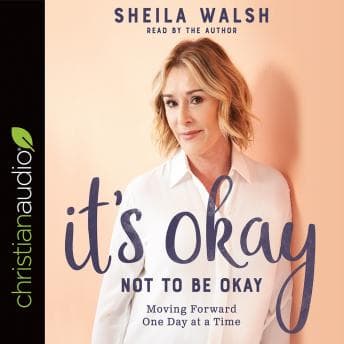

"I'm not good enough and I'm good with that."
That line hit me somewhere around hour two, while I was chopping onions for a dal that absolutely nobody asked me to make at 9 PM on a Tuesday. And I just... stopped. Knife in hand, Sheila Walsh's warm Scottish-American accent in my ears, thinking about how much psychological weight sits in that single sentence.
Look, here's the thing. I'm a researcher. I study why people do what they do, why we tell ourselves the stories we tell. And faith-based self-help isn't typically my lane. But Walsh does something interesting here—she's essentially doing narrative therapy without calling it that. She's reframing shame, which is basically what every good therapist tries to do, just wrapped in Scripture instead of clinical language.
The Psychology Behind the Comfort
What makes Walsh compelling—and yes, I'm treating her as a character because she's narrating her own memoir-style guidance book—is her willingness to sit in the mess. She doesn't do that toxic positivity thing where everything gets wrapped up with a bow. The woman has been hospitalized for depression. She talks about it. She doesn't spiritually bypass her own pain, and honestly? That's refreshing.
The research actually shows that self-compassion (which is what "I'm not good enough and I'm good with that" fundamentally is) correlates strongly with psychological resilience. I've seen similar practical frameworks in 12 Rules for Life: An Antidote to Chaos, though Peterson's approach is far more confrontational than Walsh's gentle pastoral style. Walsh probably doesn't know she's citing Kristin Neff's work, but she's living it. The daily strategies she offers—small, practical, not overwhelming—align with what we know about behavior change. Tiny steps. Manageable goals. Meeting yourself where you are.
Now. Does some of it feel like filler? Yes. There are moments where I found myself asking: why are we still on this point? The pacing drags in places, and some of the biblical weaving feels like she's padding the runtime rather than deepening the message. My therapist would have thoughts about the repetition—probably something about how some people need to hear things multiple ways before it lands. Fair enough. Just wasn't always for me.
When the Author IS the Narrator
This is where the audiobook format really earns its keep. Walsh narrating her own story creates an intimacy that a hired voice actor simply couldn't replicate. When she talks about her darkest moments, you hear the weight of lived experience. It's not performed emotion—it's remembered emotion. There's a difference, and your brain knows it even if you can't articulate why.
Her delivery is warm, clear, almost maternal without being condescending. One listener said it felt like "God was speaking to me through His Holy Spirit," and while that's not my framework, I understand the sentiment. Walsh has that quality some therapists have—the ability to make you feel seen through a recording. It's a skill. Not everyone has it.
The production is clean, no weird audio artifacts or background noise. Just Walsh's voice, steady and soothing, for about six hours. Good for what it is.
Who Needs This Permission Slip (And Who Won't)
Let me be real. This is a fascinating case study in targeted messaging. Walsh knows her audience—Christian women who are struggling, who feel like failures, who need permission to not be okay. If that's you, this book will probably feel like a warm blanket. The faith component isn't incidental; it's load-bearing. The entire framework assumes you believe God has a plan, that Scripture offers answers, that prayer matters.
If you're not in that headspace? This won't convert you. And that's fine. Not every book is for every person. Skip this if you need clinical rigor or secular frameworks—you'll spend the whole time wishing she'd cite her sources (I speak from experience).
Psychologically, this doesn't track as rigorous self-help in the secular sense. There's no CBT framework, no evidence-based interventions with citations. If you need something more clinically grounded, Driven to Distraction offers that evidence-based rigor I'm always looking for. This is more... pastoral counseling in audiobook form. Warm. Encouraging. Sometimes repetitive. Definitely slow-paced.
I listened during morning jogs and evening cooking sessions, and honestly? The pacing worked better as background than dedicated listening. At 1.25x speed, it felt more conversational and less like a sermon that's running long.
My Clinical Notes
If someone came to me struggling with shame and self-worth, and they were a person of faith? I'd mention this. Not as therapy—never as therapy—but as a companion piece. Something gentle for the commute. Walsh isn't trying to fix you in six hours. She's trying to sit with you in the mess and remind you that the mess doesn't define you.
That's not nothing. In a world of productivity optimization and "crushing it" culture, sometimes you just need someone to say: it's okay not to be okay.
Even if my academic brain wishes she'd cited her sources. (Old habits.)