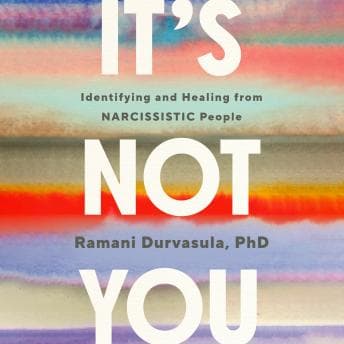

How many times have you left a conversation with someone and thought, "Wait, am I the crazy one here?" Because if you've asked yourself that question more than, say, twice with the same person, Dr. Ramani Durvasula has some thoughts for you.
I listened to this during my morning runs through Cambridge, and I'll be honest—there were moments I had to stop jogging because I was too busy mentally cataloging every relationship I've ever had. (My therapist would have thoughts about this character, and by "this character" I mean me.)
The Validation You Didn't Know You Needed
Look, here's the thing about narcissism as a topic: it's become almost trendy. Everyone's ex is a narcissist now, apparently. So I went into this with my academic skepticism fully engaged. But Dr. Ramani does something really smart—she doesn't just hand you a checklist to diagnose everyone in your life. She focuses on patterns. Behavioral patterns. The narcissist in your life sees themselves as the main character, and she maps exactly how that plays out in manipulation tactics you've probably experienced but couldn't name.
What makes this book compelling is that Dr. Ramani understands human nature in a way that feels clinical but never cold. She walks you through the mechanics of gaslighting, trauma bonding, and the slow erosion of self-esteem with the precision of someone who's sat across from thousands of survivors. The research actually shows that people in these relationships often spend years—YEARS—thinking they're the problem. And she just keeps saying, in different ways, with different examples: it's not you.
I found myself asking: why does validation hit so differently when it comes from someone with credentials? Maybe because we've been told our whole lives to see both sides, to take responsibility, to examine our own behavior. Which, sure, generally good advice. But not when you're dealing with someone who's weaponizing your self-reflection against you.
When the Psychologist Becomes the Narrator
Dr. Ramani narrating her own book is—and I mean this—exactly what this book needed. There's a warmth in her voice that you simply cannot fake. One listener described it as "the just-right hug I was waiting for," and honestly? That tracks. She sounds like the professor you wish you'd had, the one who makes you feel smart for asking questions instead of stupid. Though I can't say the same for Comic English Grammar, which made me feel like I was back in seventh grade detention.
The pacing is steady. Not rushed, not dragging. At eleven and a half hours, it's substantial, but it never felt like homework. Her delivery is professional without being sterile—she's clearly read this material a thousand times and still cares about every word. You can actually feel her compassion, which sounds cheesy but is psychologically significant. Survivors of narcissistic abuse have often had their reality denied for so long that hearing someone speak with genuine empathy can be almost disorienting.
That said—and this is where my academic brain kicks in—the healing tools section toward the end could use more depth. She's excellent at helping you identify what happened to you and why it wasn't your fault. But when it comes to the "okay, now what?" portion, it feels a bit lighter. Not bad. Just... you might want supplementary reading. (Yes, I know I said I'd stop buying more books, but here we are.)
Who This Is Actually For (And Who Should Skip It)
Dr. Ramani is very clear about her audience: survivors. Not people who are curious about narcissism as a concept. Not people who want to diagnose their mildly annoying coworker. This is for people who have been genuinely harmed by narcissistic relationships—romantic, familial, professional—and need someone to help them understand what happened. If you're looking for a deep therapeutic workbook with exercises and journaling prompts, this isn't quite that; it's more of a framework, and you might need to bring your own toolkit.
If you're in the thick of a narcissistic relationship right now, this might be hard to hear. There are content warnings for emotional abuse, gaslighting, and psychological manipulation throughout. But if you're on the other side, or trying to get there, this book feels like permission. Permission to stop trying to fix someone who doesn't want to be fixed. Permission to grieve a relationship that was never what you thought it was. Permission to trust your own perception again.
Psychologically, this tracks. The research on narcissistic abuse recovery consistently shows that validation—just having someone say "yes, that really happened, and no, it wasn't okay"—is foundational to healing.
The Clinical Assessment
Worth the credit? For the right listener—someone who's been through it, who needs to hear it wasn't their fault—absolutely. Dr. Ramani's voice in your ears for eleven hours might be the most validating thing you do for yourself this year.