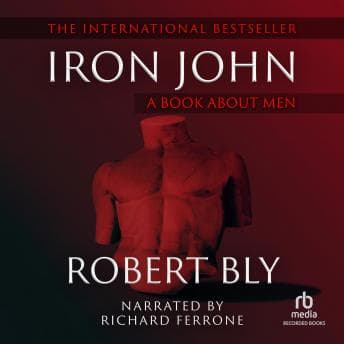

What happens when a poet tries to explain masculinity using an 800-year-old German fairy tale?
I started this one at 5:47 AM on a Tuesday, half-conscious on the Caltrain, surrounded by other tech workers scrolling LinkedIn. Twelve hours later, I'm still not sure if Robert Bly is a genius or if I just experienced the world's longest therapy session disguised as mythology lecture. Probably both.
This Is Basically Jung But For Your Dad Issues
Bottom Line: Iron John uses the Grimm fairy tale of a Wild Man living at the bottom of a pond to walk through eight stages of male psychological development. Bly argues that modern men are soft not because they're in touch with their feelings, but because they never properly separated from their mothers or connected with their fathers. The "Wild Man" isn't about toxic masculinity—it's about accessing a deeper, more grounded masculine energy that our culture has systematically dismantled.
The framework is surprisingly technical once you get past the poetry. Bly breaks down concepts like "the ashes" (a period of grief and descent every man must go through), "the wound" (how boys get initiated through suffering), and "the key under the mother's pillow" (the psychological separation required to become a man). As someone who debugs systems for a living, I appreciated the systematic approach. He's basically doing root cause analysis on why modern men feel disconnected.
But here's the thing—this book is from 1990. Some of the gender essentialism feels dated. The assumption that all boys need a specific type of male initiation, that fathers are inherently necessary in a particular way... it's not wrong exactly, but it's incomplete. I kept wanting to ask: what about single moms who raise emotionally healthy sons? What about non-traditional family structures? Bly doesn't really address edge cases.
Ferrone's Steady Hand (Maybe Too Steady)
Richard Ferrone has won Audies. He's narrated hundreds of books. And his delivery here is... polarizing.
Some listeners find his voice calming, almost meditative. I get that. There's something steady about how he reads Bly's poetic passages. But at 12+ hours, steady can tip into monotonous. I bumped it to 1.5x by hour three, and even then, certain sections felt like wading through honey.
The issue isn't Ferrone's voice—it's that Bly's writing oscillates wildly between accessible storytelling and dense mythological analysis. Ferrone reads both at the same pace. When Bly is quoting Rilke or diving into Greek mythology, you need a narrator who shifts energy to signal "pay attention, this is the dense part." Instead, everything lands at the same emotional register. I found myself rewinding sections I'd zoned out on. Not ideal when you're trying to follow along on a packed train.
That said, when Bly gets personal—talking about his own distant father, his grief, his failures as a man—Ferrone's steady tone actually works. It feels like a confession rather than a lecture.
Who This Is (And Isn't) For
This is not a commute book. I was wrong to try. Unlike Power of Concentration, which you can absorb in chunks between meetings, Iron John requires sustained focus.
You can't half-listen while answering Slack messages. The concepts build on each other, and Bly assumes you remember what the Wild Man represents, what the golden ball symbolizes, what stage of development he's discussing. Miss one section and the next three don't make sense.
Listen if: You're a man in your 30s or 40s trying to understand why your relationship with your father feels unresolved. Or if you're a woman trying to understand the men in your life. (Kevin actually borrowed my login to listen to parts of this, which led to a surprisingly good conversation about his dad.)
Skip if: You want actionable self-help—"do these 5 things to be a better man." Bly is a poet. He's giving you frameworks for understanding, not checklists for improvement. If you want the checklist version, Character Building delivers that in a more structured way, though it lacks the mythological depth.
Worth Your Credit? Here's My Math
Iron John is a foundational text in the men's movement, and Bly's core insights about father wounds, initiation, and the loss of mentorship in modern society still land. The fairy tale framework is surprisingly effective once you buy into it. But the audiobook format amplifies the book's weaknesses—the repetition, the tangents into obscure mythology, the occasionally dated gender assumptions.
Ferrone's narration is competent but not dynamic. For a 12-hour investment, I wanted more vocal variety, more energy shifts to help me track when Bly was making a key point versus when he was riffing on Yeats for the third time.
If you're specifically interested in Jungian masculinity, father-son dynamics, or the mythopoetic men's movement, this is essential listening. Just don't expect to absorb it passively. Treat it like a course, not a casual listen.
I finished this in about 8 commutes, plus one late-night insomnia session where the mythology stuff actually hit different at 2 AM. Could've been a tighter book at 8 hours. But the insights that land? They land hard.