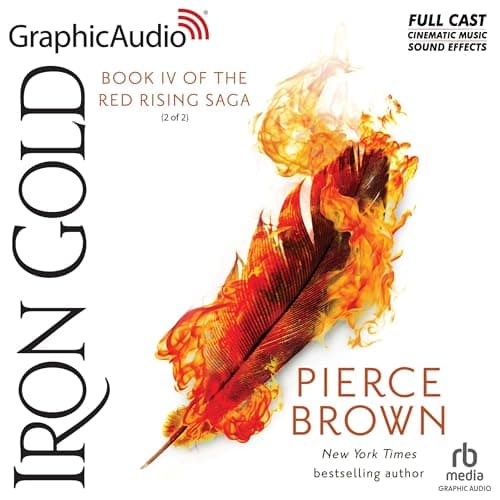

I started this one on the Link light rail just after sunset, one hearing aid fighting the train squeal and the other trying to hold onto a battlefield mix that clearly did not care about Seattle transit acoustics. Bad test case for a dense dramatized adaptation, honestly. And that told me something useful right away: Iron Gold (Part 2 of 2) is not built for half-listening. It wants your full attention, your character map, maybe your blood pressure too.
If you give it that, this adaptation hits hard.
Darrow dropping toward a war-torn planet in red armor, carrying the weight of ten years of failed peace - that opener has the exact exhausted grandeur this series needs now. He no longer sounds like a young revolutionary trying to kick down the world. He sounds like a man who already did, and now has to live in the rubble. That shift matters. A lot.
And the adaptation gets that this book is not just "more Red Rising." It is a widening fracture. Lyria fleeing catastrophe in a refugee camp has a totally different emotional texture from Darrow's military momentum. Then you get the ex-soldier blackmailed into stealing "the most valuable thing in the galaxy," which pulls in a bruised, grimy desperation that the score and scene transitions underline pretty effectively. Lysander wandering the stars with Cassius adds yet another frequency - aristocratic memory, exile, ego, regret. So yes, the POV jumps are ruthless. They are supposed to feel destabilizing. But in audio, ruthless can turn into disorienting fast.
Which leads me to the actual adaptation choices.
When the mix locks in, it really sings
This narrator ensemble actually performs, not just reads. Big difference. Christopher Tester and the cast understand that Pierce Brown's world runs on hierarchy, pressure, and people trying to sound stronger than they feel. You can hear class, fatigue, and self-mythology in the line delivery, especially around Darrow and Lysander. The emotional layers come through even without perfect sound conditions - and as a hard-of-hearing listener this hit different, because I need performance choices to do more than volume ever can.
The sound design is doing real storytelling work too. Not just "cool sci-fi noises." Armor movement, battle ambience, ship interiors, crowd energy - they create spatial cues that help separate one thread from another. Cinematic music comes in at the right moments to sharpen dread or scale, and for the most part it does not bury the dialogue. Accessibility done right means the effects support the words instead of competing with them. Most of this production understands that.
When Lyria's sections lean into vulnerability, the quieter texture helps. When Darrow's war machine energy kicks up, the production goes broader without turning everything into mush. And Lysander/Cassius material benefits from a more measured dramatic rhythm - you can feel the old-world polish against the violence surrounding it.
But one flat voice can throw sand in the gears
Not every casting choice lands. One of the newer character voices has been called monotone by listeners, and I get the complaint. In a full-cast project this size, one emotionally flat performance stands out more, not less, because everyone around it is calibrating so specifically. Missed opportunity for tone shift here. Instead of creating ambiguity or restraint, the flatter delivery can read as underpowered - especially in a book where allegiance, grief, and pride are constantly colliding.
The other challenge is structural, not performative: this is Part 2 of a split adaptation of an already multi-POV book. If you are new to Iron Gold, or if you took a long break after Part 1, the constant handoff between storylines can feel like being shoved from compartment to compartment on a moving train. Focused listening is almost mandatory. I would not use this as dishes-in-the-sink audio. You miss one political wrinkle, one identity cue, one motive buried in a quiet exchange - suddenly you're replaying ten minutes and muttering at your app.
For me, clarity over speed - always. I would not bump this up beyond normal speed unless you're already very fluent in the series voices and lore. The production is layered enough to feel, but that same layering means compressed listening works against it.
What this version understands about Iron Gold
The smartest thing this dramatized edition does is preserve the book's central discomfort: victory did not clean anything up. Darrow is still mythologized as Reaper, liberator, warlord, Slave King - and the performance lets those titles hang like separate accusations. Lyria's path makes the cost of revolution personal and humiliating, not abstract. Lysander's scenes with Cassius refuse to let the old regime become simple cartoon villainy. Even the heist pressure around the broken ex-soldier thread injects a different kind of instability - less banner-waving, more survival and coercion.
That mix of political fallout and intimate wreckage is why this adaptation works better for me than many "cinematic" audio productions. It's not just louder. It's more contrast-aware. The best moments understand that empire is heard in tone before it is explained in exposition.
Do I think this format will convert every listener who prefers a traditional single-narrator read? No. I ran into something similar reviewing Match: The Day the Game of Golf Changed Forever — productions that swing hard toward spectacle tend to polarize exactly this way, and the people who bounce off rarely come back. Some listeners are always going to hear GraphicAudio-style production as too guided, too scored, too externalized. Fair. But listeners who already wanted Iron Gold to feel more immediate, more embodied, more dangerous than a straight read? This version gets there.
You just have to meet it halfway.
Who gets the full signal (and who should mute)
Pick this up if you want a war-heavy space opera that sounds like collapsing institutions and tired heroes lying to themselves. Skip it if you mostly listen while distracted, or if multiple POVs plus cinematic production already make your brain tense. Also probably not your format if you need clean single-voice narration for processing reasons - the layered mix demands more from your ears than it gives back in accessibility shortcuts.
For me, this is a strong credit pick - not flawless, not the easiest entry in the saga, but absolutely alive.