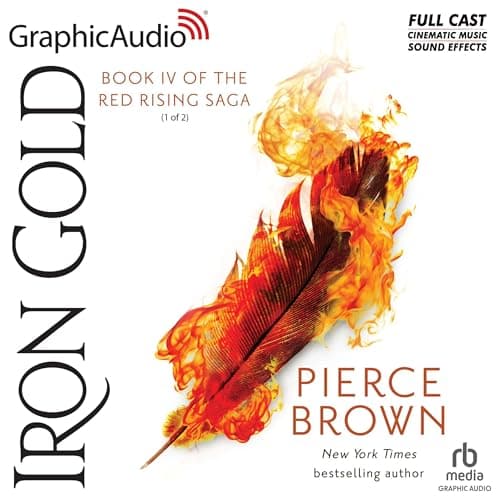

This is the audiobook equivalent of a AAA video game cutscene that you can't skip — and you wouldn't want to.
I was three hours deep into Iron Gold's dramatized adaptation, sprawled on my apartment floor surrounded by a half-assembled Gloomhaven board (don't judge, I organize components when I'm stressed), and I realized I'd completely forgotten about my thesis meeting the next morning. Dr. Patel's "concerns about my progress" were going to get a lot more concerned. But Pierce Brown had just introduced Lyria's refugee camp perspective — this desperate Red girl navigating the wreckage of Darrow's revolution — and I physically could not hit pause.
Four POVs Walk Into a Solar System
Here's the thing about Iron Gold that makes it fundamentally different from the first Red Rising trilogy: it doesn't trust Darrow anymore. And it shouldn't. Brown splits the narrative across four POV characters — Darrow, Lysander au Lune, Lyria, and Ephraim — and each one basically argues that the other three are wrong about everything. It's brilliant structural work. Darrow's still doing his Reaper thing, falling toward a war-torn planet in red armor, believing he can save everyone if he just fights one more battle. But now you're also hearing from Lyria, who's living in the rubble of what Darrow's revolution actually created on the ground. The "hero" of the first trilogy becomes one man's liberator and another girl's catastrophe. That tension is where this book lives and breathes. That same uncomfortable moral reckoning — where the 'right' side of history destroys real people just trying to survive — is something Feast of the Mother does in a completely different register, and it wrecked me in similar ways.
Lysander au Lune wandering the stars with Cassius — the heir in exile dreaming of restoring Gold supremacy — gives you this eerie mirror-image of Darrow's own journey. And Ephraim, the broken ex-soldier forced into a heist, is basically the rogue your D&D party didn't ask for but desperately needed. My D&D group would love this guy. He's morally compromised, grief-wrecked, and operating on pure survival instinct. Brown writes him like a noir character dropped into space opera.
The Full Cast Goes Harder Than It Has Any Right To
So — the cast. Stewart Crank as Darrow carries the weight of a character who's been fighting for a decade and sounds like it. There's this exhaustion threaded through his delivery that the original Tim Gerard Reynolds narration captured differently. This is a different animal entirely. Alex Hill-Knight's Lysander has this aristocratic precision that immediately codes him as Gold without anyone having to explain the Color hierarchy. Elena Anderson as Lyria brings raw desperation — her voice cracks in places that feel earned, not performed. And I mean that as the highest compliment.
The sound design is where Graphic Audio earns its reputation. Explosions have actual bass. Ship corridors echo. Crowd scenes sound populated, not like three people in a booth pretending. The cinematic music swells at moments that would be chapter breaks in the novel, and it works the way a good film score works — you stop noticing it consciously but you'd absolutely notice if it disappeared. This is not "audiobook with sound effects bolted on." This is a produced experience closer to an audio drama.
But here's my one gripe: with 40+ credited performers and immersive production, there are moments — especially in the early chapters when you're still mapping voices to characters — where a new scene transition hits and you genuinely don't know whose POV you're in for fifteen seconds. The music usually cues you eventually, but if you're listening while doing literally anything else, you'll miss the context switch. This demands focus.
Why "Part 1 of 2" Is Both Annoying and Honest
Let's address the elephant: this is half a book. Iron Gold the novel is already book four of a series, and they've split it into two parts. At 11 hours for part one, you're getting substantial content — this isn't a cash grab slice. But it does mean you're committing to a cliffhanger that won't resolve until Part 2. If you've been following the dramatized adaptations from Red Rising onward, you already know this is how they roll. If you're jumping in here — don't. Go back to Red Rising Part 1. This is Sanderson-level world-building with a Color-based caste system, ten years of in-universe political fallout, and character relationships that only land if you've lived through the first trilogy.
The progression is satisfying even within this half-book structure. Each POV thread advances meaningfully. Lyria's arc from refugee to something unexpected is the standout for me — she's the character Brown uses to interrogate whether Darrow's revolution was actually worth the cost, and she doesn't let him off easy.
Who Should Listen (And Who Should Skip)
If you've listened to the first three dramatized Red Rising adaptations and want the story to keep expanding with the same production quality — this is an instant grab. If you love multi-POV political sci-fi where nobody's cleanly heroic, you'll eat this up. If you're a Graphic Audio skeptic, this might convert you.
Skip this if you need standalone stories — this is book four, part one, of an ongoing saga. If you mostly listen while distracted or multitasking, the production density and POV shifts will lose you. And if you don't like info-dumps, this isn't for you (but you're wrong).
I Read This Instead of Writing My Thesis (Again)
I've now spent two days listening to this instead of working on my procedural generation chapter. Dr. Patel sent a follow-up email. I haven't opened it. But I have thought more about political systems and the consequences of revolution in the last 11 hours than I have in my entire grad school career. Pierce Brown's universe keeps getting more complicated, more morally gray, and more worth the time investment. Yes, it's 11 hours for half a book. Yes, it's worth it.









