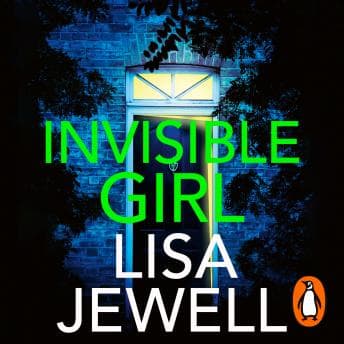

Everyone kept telling me Lisa Jewell writes "twisty thrillers" and honestly I went in a little skeptical. The research actually shows that "twisty" is one of the most overused descriptors in thriller marketing - it's basically meaningless at this point. But here's the thing. Invisible Girl earned it. Not because the plot does backflips, but because Jewell understands something fundamental about how people construct narratives around the wrong person.
I started this one while making chana masala on a Sunday evening - the kind of elaborate cooking project where you're standing over the stove for an hour and your brain needs something to chew on. By the time the cumin was crackling in the oil, I was already deep in Saffyre Maddox's head, and honestly? The kitchen smelled amazing but I'd stopped noticing.
The Psychology of Who We Choose to Suspect
This is a fascinating case study in scapegoating. Owen Pick is the kind of character most thrillers would use as a cheap red herring - socially isolated, awkward, recently accused (and cleared) of sexual misconduct at work. He's got "suspect" practically tattooed on his forehead. And Jewell knows it. She knows you know it. The protagonist exhibits classic features of what we'd call the fundamental attribution error in social psychology: everyone around Owen assumes his awkwardness signals something sinister, while ignoring the actual predator operating in plain sight.
What makes this character compelling is that Jewell doesn't let Owen off easy either. He's not some saintly misunderstood loner. He's frustrating. He makes bad decisions. He watches porn. He's the kind of person you'd cross the street to avoid at night - and Jewell forces you to sit with the discomfort of why you'd do that and what it says about you. Bone: A Short Horror Story does something similarly uncomfortable with the way fear and disgust get projected onto the wrong target - shorter, sharper, but the same mechanism at work.
Saffyre, meanwhile, is doing her own surveillance. A seventeen-year-old who was failed by the adults supposed to protect her, now stalking her former therapist because she's trying to make sense of what happened to her. My therapist would have thoughts about this character - specifically about the way Saffyre's hypervigilance gets reframed as agency. She's not passive. She's watching. And the fact that she's invisible - to the neighborhood, to the institutions that should've caught what happened to her - is the entire point.
Four Narrators, One Dark Neighborhood
The audiobook uses a full cast - Rebekah Staton, Donna Banya, Katherine Kelly, and Connor Swindells - and the multi-narrator format works here because each perspective genuinely sounds like a different person's interiority. This isn't one narrator doing slightly different voices. Each character's worldview comes through in the vocal performance: the Fours' middle-class anxiety, Owen's flat affect, Saffyre's guarded intensity. I found myself asking: why does Roan Fours really insert himself into the investigation? The narration helped me sit with that question because his sections had this undercurrent of self-righteousness that felt very, very specific.
The pacing runs tight for a ten-hour listen. No bloated middle section. The Valentine's Day disappearance happens early enough that you're spending most of the book watching the neighborhood implode around a void - Saffyre's absence functions like a Rorschach test for every character's guilt.
I do need to flag something: there's transphobic content in this book. It's tied to a character's backstory and while I think Jewell was trying to depict prejudice rather than endorse it, the execution is clumsy enough that some listeners will find it genuinely hurtful. Worth knowing going in.
Where the Credibility Cracks
Here's where I push back. The final act asks you to accept a series of coincidences and reveals that - psychologically, this doesn't track as cleanly as the first two-thirds. The careful character work starts bending toward plot machinery. People show up where they need to be. Motivations that were carefully layered suddenly flatten into thriller-convenient explanations. I didn't hate the ending, but I noticed the shift from "character study" to "plot resolution" and it felt like two different books shaking hands.
Some readers loved the denouement. I get it - it's satisfying in a popcorn way. But the first 70% of this book is doing something smarter than its ending allows it to be.
Who This Is For (And Who Should Bail)
If you're interested in how communities construct guilt narratives around easy targets - genuinely interested, not just "ooh who's the bad guy" interested - this is your book. If you liked Jewell's The Family Upstairs, this has the same DNA: multiple perspectives, a specific London neighborhood rendered with uncomfortable precision, and characters who are all slightly complicit in something.
Skip it if you need your thriller mechanics airtight through the final chapter. Or if you're sensitive to content involving child exploitation - it's handled with restraint but it's central to the story.
My Case File Note
Invisible Girl is 80% excellent psychological study, 20% thriller concession. That first 80% - the way Jewell builds a neighborhood where everyone's watching everyone and nobody's seeing anything real - that's the good stuff. I ate my chana masala cold because I forgot about it. Take that as the compliment it is.