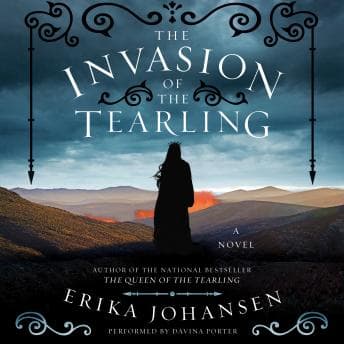
"The fate of the Tearling—and that of Kelsea's own soul—may rest with Lily and her story."
That line hit me around hour six, and I had to pause the audiobook. Not because I was scared—though this book has its moments—but because Johansen had just pulled off something I genuinely didn't see coming. She'd taken what I thought was a straightforward fantasy sequel and cracked it open into something stranger. Something with teeth.
I was reorganizing the horror section at the library (midnight inventory, don't ask) when Kelsea's consciousness started bleeding into Lily's pre-Crossing timeline. Shirley was perched on a stack of Shirley Jackson first editions, judging me as I stood there with a cart of Stephen King paperbacks, completely forgetting I had a job to do. That's when I knew this book understood something crucial about horror that most fantasy refuses to acknowledge: the scariest thing isn't the monster at the gate. It's the slow realization that the monster might be inside you.
Two Women, Two Hells, One Narrator Holding It Together
Davina Porter earned her AudioFile Earphones Award here. Full stop. The way she distinguishes between Kelsea's growing desperation and Lily's quiet, suffocating terror in a pre-Crossing world where being female is essentially a crime—it's not flashy voice work. It's psychological excavation.
Kelsea sounds younger, fiercer, a queen learning that idealism has consequences. When the Mort army closes in and she starts making choices that horrified me, Porter's voice carries that transformation without ever losing the thread of who Kelsea was. Lily, meanwhile, gets this careful, controlled tone—a woman who's learned that survival means making herself small. The contrast between them creates constant tension, even when nothing overtly threatening is happening.
Some listeners have complained about Porter's pacing being slow, and I'll be honest—if you're coming from a faster narrator, the adjustment period is real. There were moments in the first few hours where I bumped it to 1.25x. But once the dual timeline kicks in fully? That measured pace becomes a feature, not a bug. You need the breathing room to track which woman you're with, which world you're in, which horror you're supposed to be dreading.
The Red Queen Problem (And Why It Works)
Here's my controversial take: the Red Queen is scarier than most horror villains I've covered on the podcast. Not because of what she does—though the dark magic stuff is genuinely unsettling—but because of what she represents. She's what happens when survival becomes the only value. When you've been alive so long that cruelty stops feeling like cruelty and starts feeling like efficiency.
Johansen doesn't give us easy answers about power. Kelsea stopped the slave shipments in book one, and this entire novel is about the consequences of that moral stand. The Mort army isn't coming because Kelsea did something wrong. They're coming because she did something right, and the world punishes that.
(My podcast listeners are going to lose their minds over this. Finally, fantasy that respects the genre.)
Where The Seams Show
I won't pretend this is flawless. The narrator switch from book one bothers some listeners, and I get it—there's an adjustment period. Porter occasionally drops in and out of character during rapid dialogue exchanges, and around hour twelve, I lost track of who was speaking during a tense council scene. Had to rewind twice.
The Lily sections, while thematically essential, can feel like interruptions when you're desperate to know what's happening with the invasion. Johansen is playing a long game here, and if you need immediate payoff, this will frustrate you. The 18-hour runtime demands commitment. This isn't background listening while you shelve books—I learned that the hard way.
But here's the thing: the structural ambition is part of what makes this work. Johansen is building toward something, connecting a dystopian past to a fantasy present in ways that feel genuinely earned rather than gimmicky. Shift pulls off a similar structural gambit, weaving timelines together until the architecture of the whole thing finally reveals itself. By the final hours, when the connections start clicking into place, I understood why she needed all that time.
Who Gets The Key, Who Gets Turned Away
If you scare easily, skip. If you don't, you need this—but only if you're willing to commit. This is for readers who want their fantasy to hurt a little. Who appreciate that Shirley Jackson walked so authors like Johansen could run. That same understanding of psychological dread drives Femicide, where the real terror comes from institutional rot rather than jump scares. Who understand that the best horror isn't about gore—it's about dread.
Skip if you need a standalone, you hated book one, or you want your fantasy uncomplicated. Lean in if you love dual timelines, morally complex queens, and narrators who commit to the psychological work.
Stamped and Shelved
I finished at 3 AM, library dark around me, Shirley asleep on my lap. The invasion is coming, Kelsea is changing in ways that terrify me, and I'm already queuing up book three. Porter's narration transformed what could have been a bloated middle book into something that haunts. Not perfectly—but memorably.
Mistake to listen in the dark? Maybe. Worth it? Absolutely.