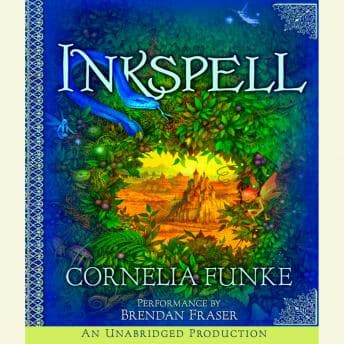

I was sitting in the back row of a professional development seminar on "data-driven instruction" — my third this semester — when I started Inkspell. Principal Martinez was clicking through slides about benchmark assessments and I had my earbuds in, one ear covered by my hand like I was thinking deeply about standardized testing. Worth pausing the faculty meeting for? Well, that's where it gets complicated.
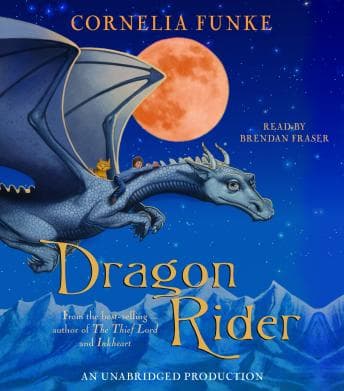
Let me say this first: Cornelia Funke's Inkheart trilogy is one of those rare YA fantasy series I genuinely recommend to my students AND mean it. A story about stories — about what happens when the boundary between reader and text dissolves — is basically my entire professional life described in fantasy terms. Inkspell takes that premise and deepens it. Meggie and Farid get pulled into the Inkworld, where Fenoglio, the original author, is now living inside his own creation and watching it mutate beyond his control. That's a staggeringly good metaphor. Every writer loses ownership of their story eventually. Funke understands that, and she's writing it for twelve-year-olds, which makes it even more impressive.
But we need to talk about Brendan Fraser.
The Elephant in the Inkworld
I wanted to love this narration. I really did. Fraser played Mo in the film adaptation, so there's a logic to casting him. And his baseline reading voice — this quiet, earnest, almost hushed tone — actually works beautifully for the meta-literary framing of the story. When he's narrating passages about books and reading and the magic of words, you can hear that he believes in the material. That sincerity matters.
But then the character voices start, and things go sideways fast.
Dustfinger gets a Scottish burr that wanders in and out like a drunk uncle at Thanksgiving. Fenoglio — an Italian author living in a medieval fantasy world — gets a Brooklyn accent. Brooklyn. I teach in Chicago and even I know that's a weird choice. Orpheus, the crooked storyteller, gets a Southern drawl that made me check if I'd accidentally switched to a different audiobook. None of these accents are subtle. They're broad, they're committed, and they don't always match the characters Funke wrote on the page. I ran into a similar accent-commitment problem in Prince of Wolves, where the narrator's enthusiasm for character voices eventually started working against the story rather than for it.
The real problem, though, isn't the accents themselves — it's the volume dynamics. Fraser whispers when characters are conspiring, then lurches into near-screeching for villains. I was adjusting the volume on my phone every few minutes during that PD session, which is not great for maintaining the illusion that you're deeply engaged with assessment rubrics. At 1.0x speed (because the author chose those words), those whisper-to-shout swings are genuinely hard to manage.
When the Story Outpaces Its Narrator
Here's what frustrates me most: this is an 18-hour-and-50-minute audiobook, and the source material deserves a narrator who understands that Funke writes like someone building a cathedral — slowly, with ornate detail, trusting that the architecture will reward patience. The prose deserves to be savored. Lynn Redgrave narrated the first book, Inkheart, with what people describe as exquisite subtlety, and the contrast is jarring. Redgrave treated the text like literature. Fraser treats it like a one-man show.
This reminds me of what Hemingway said about prose being architecture — and Fraser is doing interpretive dance in front of the building. He's earnest. He's trying. But earnestness without restraint becomes overacting, and at nearly 19 hours, the overacting accumulates.
That said — and I want to be fair here — some listeners genuinely love his performance. He won an AudioFile Earphones Award for this narration, which isn't nothing. Kids especially seem to respond to the broad character work. My students would probably enjoy it more than I did, because they haven't spent twenty years thinking about the relationship between text and performance. They just want the fire-eater to sound cool.
Who Gets an A, Who Gets a Referral
If you loved Inkheart in print and you're bringing your kids into the series, this audiobook can work — especially if they respond to theatrical narration and you don't mind managing the volume. If you're coming from Redgrave's first audiobook expecting the same restraint, brace yourself. The tonal shift is significant.
For solo adult listening? I'd say try a sample chapter first. If Fraser's Fenoglio-from-Flatbush doesn't bother you, the story underneath is genuinely worth the 19-hour commitment. Funke's exploration of what happens when an author enters his own creation — and finds it's become something he never intended — that's real literary territory. It's the kind of premise I'd build a whole podcast episode around. (Episode 34 of The Annotated Life, coming never, because I still haven't finished the Middlemarch series.)
The narrator understands that pause is punctuation — sometimes. Other times he bulldozes right through moments that needed air. It's an uneven performance attached to a genuinely inventive story, and whether that trade-off works for you depends entirely on your tolerance for accent roulette.
The Grade on the Report Card
I can't fail this audiobook because the story is too good and Fraser's sincerity is real. But I can't give it honors, either. It's a solid B-minus — the kind of grade I give students who clearly did the reading but missed the thesis. The book itself? That's an A. Find the version that lets Funke's architecture speak for itself, whether that's print, a different edition, or this one with your expectations properly calibrated.