
"Save 20 percent of your money."
That's it. That's the advice. And honestly? It's worth more than the $50,000 MBA supplement I've been building through audiobooks for the past decade.
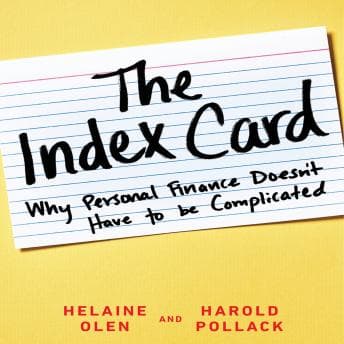
Look, I've listened to probably 200 business and finance books at this point. Most of them could be a blog post. The worst offenders feel like they're deliberately padding runtime—Science of Getting Rich comes to mind as one that could've been an email. Harold Pollack and Helaine Olen apparently had the same realization, because they literally started with an index card and then—somewhat ironically—wrote a whole book about it. But here's the thing: at 3 hours and 44 minutes, this is one of the few finance books that actually respects your time.
What My Parents Knew Without the Index Card
I grew up watching my mom and dad run a dry cleaning business in Koreatown. Fourteen-hour days. No financial advisor. No 401(k) match because there was no 401(k). They saved what they could, avoided debt like it was a disease, and never bought anything they couldn't pay for in cash. That was their index card, except it was written in Korean and stored somewhere in my mom's head.
Pollack and Olen basically codified immigrant parent financial wisdom for people who didn't get it at the dinner table. Max out your 401(k). Buy index funds. Don't try to beat the market. Avoid high-fee financial products. Pay off your credit cards every month.
I've seen McKinsey partners with seven-figure incomes who don't follow these rules. I've watched startups burn through funding because founders confused revenue with profit. This stuff isn't complicated, but apparently it needs to be said. Repeatedly. In audiobook form.
Two Academics, One Microphone
Pollack and Olen narrate their own book, which—let's be real—is always a gamble. Some authors shouldn't be allowed near a microphone. These two are fine. Not electric. Not the kind of narration that makes you forget you're listening to an audiobook. But clear, confident, and they sound like they actually believe what they're saying.
There's something authentic about hearing the guy who scribbled on an index card explain why he scribbled on an index card. You're not getting a performance. You're getting a conversation with two smart people who are mildly annoyed that the financial services industry has been overcomplicating things for decades. That annoyance comes through. I appreciated it.
The production is clean. No weird audio issues. I listened at 2.0x while prepping a client deck and didn't miss anything. That's the benchmark for business audiobooks as far as I'm concerned.
The One Rule That Gets Political
Here's where I have to be honest. The last rule on the index card—about supporting social safety nets—veers into territory that's more policy than personal finance. Some listeners apparently got annoyed by this. I get it. You came for budgeting tips, not a political science lecture.
But I'll say this: my parents' dry cleaning business survived the '92 riots and the 2008 recession. They didn't have a safety net. They were the safety net for about fifteen extended family members. So when Pollack and Olen talk about the broader systems that make individual financial security possible, I don't entirely disagree. I just think it's a different book.
Skip that chapter if it bugs you. The other nine rules are worth the listen.
The ROI Breakdown
If you've been reading finance books for years, you probably know all of this already. This is Finance 101, not an advanced seminar. But that's exactly why it's useful—it's the book I wish I could hand to every 25-year-old who asks me for career advice and then glazes over when I mention compound interest.
Best for: People just starting to take their finances seriously. Anyone who's been intimidated by the complexity of financial advice. Commuters who want something useful in under four hours. My wife Jenny, who I'm definitely going to make listen to this.
Skip if: You already max out your 401(k), own index funds, and have an emergency fund. You won't learn anything new. But you might feel validated, which—honestly—has its own value.
The key takeaway is worth the listen. The other 2.5 hours? Actually also pretty solid. That's rare for this genre. A business book that respects your time.