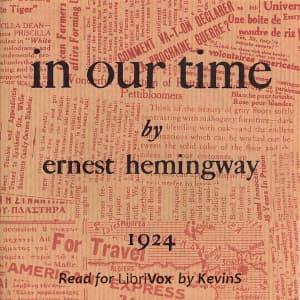

What do you do with twenty-six minutes of Hemingway?
I'm serious. Twenty-six minutes. That's shorter than my commute. Shorter than most podcast episodes. Shorter than the time I spend every Sunday arguing with Denise about whether we need a new coffeemaker. (We do. She's wrong about the old one still working.) And yet those twenty-six minutes hit me somewhere behind the sternum in a way that six-hundred-page novels sometimes don't.
I pressed play on this during a Saturday lakefront walk - just me, no Denise, no dog, just the wind off Lake Michigan and Hemingway's earliest published prose in my ears. And something about that context felt exactly right. These vignettes are stripped down to the bone. No fat. No sentimentality. Just images and moments and violence rendered so cleanly they feel like photographs you stumbled across in someone's attic.
The 1924 Edition Nobody Reads (But Should)
Let me give you the context my students would roll their eyes at. This isn't the In Our Time most people know - the 1925 American edition with the Nick Adams stories like "Indian Camp" and "The Battler" and "The Three Day Blow." This is the original 1924 Paris edition, published by Three Mountains Press in a run of about 170 copies. Eighteen vignettes - some barely a paragraph long - that read like dispatches from the edge of the world. Bullfighting. War. Execution. A cop shooting two Hungarians. The prose is so lean it's practically skeletal, and that's the whole point.
This reminds me of what Hemingway said about the iceberg theory - that the dignity of movement of an iceberg is due to only one-eighth of it being above water. These vignettes are all tip. The seven-eighths underneath? That's your job. And at twenty-six minutes, you feel every one of those silences.
Kevin R. Gets Out of Hemingway's Way
Here's what I respect about Kevin R.'s narration: he doesn't perform. He reads. And for this particular text, that's exactly right. Hemingway's early prose doesn't want an actor - it wants a clear voice that trusts the rhythm of those short declarative sentences. Kevin has an ear for the colloquial, for the way Hemingway's characters talk like real people caught mid-thought, and he delivers the lean syntax without trying to dress it up.
The narrator understands that pause is punctuation. When you get to the vignette about the evacuation at Adrianople - the carts and the rain and the women having babies - Kevin lets the flatness of Hemingway's tone do the emotional work. No vocal trembling. No dramatic emphasis. Just the facts, which makes the horror land harder. That's interpretation through restraint, and it's harder than most people think.
I wouldn't call it a virtuoso performance - at twenty-six minutes, there isn't room for that. But it's honest work. Clean audio, steady pacing, no distracting quirks. For a text this spare, you don't want the narrator competing with the prose.
Twenty-Six Minutes That Teach You How to Read
I use Hemingway with my sophomores every year, and every year they tell me his writing is "too simple." I tell them simple and easy aren't the same thing. This little collection proves it. Each vignette is maybe a minute or two, and every single one leaves you with a feeling you can't quite name. That's craft. That's a twenty-four-year-old writer figuring out how to make silence louder than noise.
My students would hate this. I love it. The last time I felt this particular combination of admiration and mild defensiveness about a short book was with Brief Wondrous Life of Oscar Wao — different century, different continent, same stubborn refusal to make things easy for the reader.
But honestly? I think some of my students might actually benefit from this specific audiobook, precisely because it's twenty-six minutes. You can't claim you don't have time. You can't say it's too long or too hard. It's shorter than a sitcom episode, and it'll teach you more about prose rhythm than most creative writing courses.
Who Gets the Most Out of This
If you're a Hemingway completist, this is essential - the embryonic form of everything he became. If you teach literature, it's a perfect classroom tool. If you're curious about Hemingway but intimidated by the novels, start here. Twenty-six minutes. No excuses.
Who should skip it? Anyone wanting a full narrative experience. These aren't stories in the traditional sense - they're flash fiction before flash fiction had a name. And if you need plot and character arcs, this will feel like reading someone's notebook. (Which, in some ways, it is.)
Worth Pausing the Faculty Meeting For
The prose deserves to be savored, and at 1.0x speed - yes, I listened at 1.0x, because the author chose those words - this is a twenty-six-minute masterclass in less-is-more. It's not an audiobook you "enjoy" exactly. It's one that recalibrates your ear. I finished it before I even reached North Avenue Beach, stood there looking at the water for a minute, and then played it again.
At this length and price point, it's hard to justify a full credit. But it's absolutely worth streaming, worth finding at your library, worth those twenty-six minutes of your life. This is why we still read the classics - even the ones nobody knows are classics.