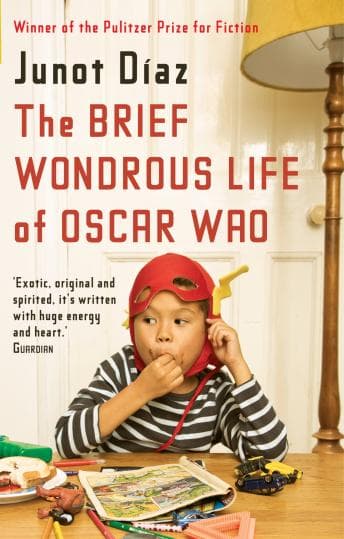

Lin-Manuel Miranda understands something about Junot Díaz's prose that I've been trying to explain to my AP Lit students for years: the footnotes aren't interruptions. They're the whole point.
I finished this one at 2 AM, grading forgotten, red pen dried out somewhere in the stack of sophomore essays on my desk. Denise had gone to bed hours ago. I was supposed to be marking comma splices, but instead I was standing in my kitchen, listening to Miranda tear through Oscar's final chapters with this breathless, almost desperate energy that made me forget I was a 52-year-old man who has to teach Gatsby again tomorrow.
The Narrator as Cultural Translator
Here's what makes this audiobook essential rather than optional: Miranda doesn't just read the Spanglish. He lives in it. The way he shifts between street-smart Jersey delivery and the more formal historical passages about Trujillo's Dominican Republic—it's code-switching as performance art. I heard that same kind of authentic linguistic navigation in The Trial, where the narrator moves between bureaucratic absurdity and Kafka's more intimate moments without ever breaking character. When he drops into Dominican slang, there's no hesitation, no performative emphasis that screams "look, I'm being authentic." He just... talks. The way actual Dominican-Americans talk.
Is his Spanish pronunciation perfect? No. Some purists might wince. But here's the thing—Oscar's Spanish wouldn't be perfect either. Oscar is a nerd from Jersey who dreams in Tolkien and Star Trek. The slight imperfection actually serves the character.
Karen Olivo handles Lola's sections with this fierce warmth that shifts the whole register. When she takes over, you feel the narrative literally change hands. Her chapters hit different—more grounded, less manic, but no less intense. It's like Díaz wrote the book knowing these two specific voices would eventually find it.
Why English Teachers Should Assign This Version
I've taught this novel three times. Read it twice. But hearing it? That's when I finally understood why Díaz structured it the way he did.
The footnotes—those sprawling, digressive, sometimes pages-long interruptions that my students always complain about—become something else entirely when Miranda delivers them. They're not academic intrusions. They're the narrator's obsessive need to make you understand. The history of the Dominican Republic, the weight of the Trujillo era, the way generational trauma doesn't just haunt a family but possesses it—Miranda reads these passages like he's trying to save your life with information.
This is why we still read the classics. Or in this case, the soon-to-be classics. The prose deserves to be savored, and at 1.0x (yes, I'm that person), the rhythm of Díaz's sentences becomes almost musical. The run-ons aren't sloppy. They're breathless. They're a kid who has so much to tell you he can't slow down.
The Fukú Gets Under Your Skin
Oscar Wao himself is a character I would've dismissed in my twenties. Overweight, obsessive, romantically hopeless, drowning in sci-fi references. But Díaz—and Miranda's delivery—finds something universal in his specific tragedy. The curse that haunts Oscar's family isn't supernatural. It's historical. It's political. It's the kind of inherited wound that immigrants carry without knowing they're bleeding.
My students would hate parts of this. The Trujillo sections. The density of it. But they'd love Oscar, because Oscar is every kid who ever felt too much and knew too little about how to be in the world.
The emotional high points hit without warning. I won't spoil the ending, but I'll say this: I had to pause and pretend I was checking my phone when Denise came down for water. Fifty-two years old, crying over a book about a Dominican nerd from Jersey. This is my life now.
Who Should Listen (And Who Should Skip)
If you loved Middlesex or The House of the Spirits—books that braid family saga with national trauma—this is their spiritual successor. A Gentleman in Moscow does something similar, though it trades generational curse for personal exile—same weight, different cage. If you're a Díaz fan who only knows his short stories, prepare for something bigger and messier and more ambitious.
Skip it if you need linear narrative, if code-switching frustrates you, if you're looking for easy background listening. This demands attention. The cultural references come fast. The timeline jumps. You have to be present.
But if you're willing to sit with it—or stand in your kitchen at 2 AM with it—Oscar Wao will break your heart in ways you didn't know you needed.
Worth Pausing the Faculty Meeting For
I'm adding this to my personal canon of audiobooks that transcend their source material. Not because Díaz needed help—the Pulitzer speaks for itself—but because Miranda and Olivo found something in the text that even close reading misses. The voice. The actual human voice behind the words.
Principal Martinez, if you're somehow reading this: I was definitely not listening to this during your budget presentation last Thursday. But if I had been, it would've been worth it.