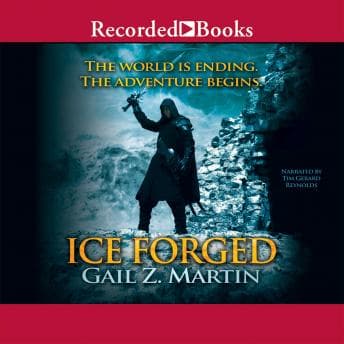

So I was up at 2 AM supposedly debugging a procedural terrain generator for my thesis when I realized I'd been listening to Ice Forged for three straight hours and hadn't written a single line of code. Dr. Patel, if you're reading this — I was doing research. Penal colonies in frozen wastelands are basically procedural generation of suffering. It counts.
Here's the thing about Ice Forged: it's doing something I genuinely respect even when it doesn't always land. Blaine McFadden kills a nobleman for dishonoring his sister, gets shipped off to Velant — a penal colony so far north it makes Icewind Dale look like a beach resort — and then the entire magical infrastructure of the world just... breaks. Supply ships stop coming. Magic goes wild. And you've got this convicted murderer who might be one of the only people who can fix it. That's a killer setup. That's the kind of premise I'd pitch at a D&D session zero and my group would immediately say yes.
When the Magic System Breaks (Literally)
What Gail Z. Martin is doing here is essentially post-apocalyptic fantasy, and I mean that as high praise. The conceit is that magic was this structured, institutional thing — bound to the monarchy, to noble bloodlines, to specific rituals — and then it all collapses. Wild magic surges. The social order that depended on controlled magic fractures. It's not Sanderson-level hard magic system detail (nobody's drawing allomantic tables here), but the consequences of the magic failing are where the world-building shines. You feel the political vacuum. You feel how a penal colony suddenly becomes the freest place in the world because nobody's enforcing anything anymore.
Where it stumbles is pacing. Martin juggles multiple POV threads — Blaine in Velant, his old friends back in Donderath dealing with the collapse — and the Donderath sections drag compared to the survival stuff up north. There's a stretch somewhere around the middle where we're getting court intrigue and political maneuvering that feels like it belongs in a different, slower book. I caught myself zoning out during some of the noble house politics, which — look, I love political fantasy, but these particular threads needed more teeth.
Also, some of Martin's word choices are just... odd. There are moments where a character will use a phrase that feels anachronistic or slightly off for the setting, and it yanks you out of the frozen wasteland and back into your apartment at 2 AM. It's not frequent enough to ruin anything, but it's noticeable.
Tim Gerard Reynolds: The Reliable Party Member Who Never Crits
Okay. Tim Gerard Reynolds. I know this guy from the Riyria books where he's genuinely fantastic, so I came in with expectations. And he's... fine? He's solid? His delivery is clean, his pacing is consistent, and I never once got confused about who was talking. That matters — in a multi-POV epic fantasy, clarity is not nothing.
But compared to what he does with Royce and Hadrian in Sullivan's books, this feels like Reynolds on autopilot. There's no moment where his voice made me feel the cold of Velant, no scene where his delivery elevated a fight sequence beyond what was on the page. If Steven Pacey is the bard who rolls a natural 20 on every performance check, Reynolds here is the bard who takes 10 every single time. You won't fail, but you won't get those transcendent moments either. It's the difference between a narrator who serves the text and one who transforms it.
For a nearly 20-hour listen, though? Consistency matters. I never got fatigued by his voice, never needed a break from a grating character voice. That's worth something on a long haul like this.
Who Rolls Initiative on This One
If you're into epic fantasy with a post-apocalyptic twist — think The Faithful and the Fallen meets a frozen survival story — this is worth your time. Fans of Mark Lawrence's Prince of Thorns who want something less grimdark but with similar "convicted man rebuilds in a broken world" energy will find a lot to like. My D&D group would love the premise of a world where the Weave just snapped and everyone's scrambling.
But if you need your fantasy narration to be a performance — distinct accents, emotional peaks, the full theater experience — you might find this one a little flat on audio. And if slow middle-book pacing in a series opener makes you bounce, be warned: this is clearly setup for a larger saga, and it sometimes prioritizes positioning pieces over payoff.
I read this instead of writing my thesis, and I don't regret it. That "glad I did it, not sure what's next" feeling also hit me with Cat's Cradle — another book that builds a genuinely interesting world-collapse premise and then leaves you weirdly satisfied but not desperate for a sequel. But I'm also not rushing to grab book two tonight. More of a "yeah, I'll get to it" than a "give it to me NOW." Kind of like my thesis defense, honestly.
The Campaign Continues (Eventually)
Solid session one of a longer campaign. The world-building hooks are strong, Blaine is a protagonist worth following, and the broken-magic premise has legs. It just needs tighter pacing and a narrator willing to push beyond reliable into remarkable. Worth streaming on a long coding session — just maybe bump it to 1.25x through the Donderath chapters.