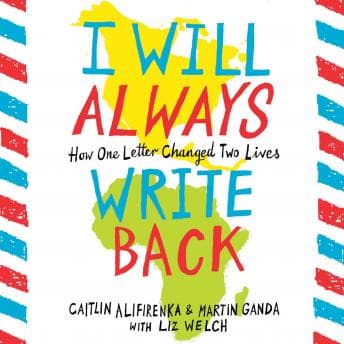

Look, I assign pen pal letters to my freshmen every year. It's basically a throwaway activity to fill a week in March when everyone's checked out. So when I started this audiobook expecting some feel-good fluff about kids exchanging stickers and favorite colors, I was ready to be mildly charmed and move on.
I was not ready for Martin Ganda's Zimbabwe.
This book wrecked me. In the best possible way. But also in the "I had to pause while walking the lakefront because I couldn't see through the tears" way. Denise thought something was wrong. Something *was* wrong—I was listening to a teenager describe not eating for days while his American pen pal worried about which jeans to buy.
Two Voices, Two Worlds, One Gut-Punch
The dual narration here is everything. Chukwudi Iwuji reads Martin's sections, and Emily Bauer handles Caitlin's—and the contrast between their worlds becomes visceral through their voices. Iwuji brings this quiet dignity to Martin's story. There's no pity-seeking in his delivery, just... honesty. When Martin describes walking miles to school with no shoes, or his family's desperate hunger, Iwuji doesn't oversell it. He doesn't need to. The sincerity is devastating enough.
Bauer does something clever with Caitlin's sections—she starts with that slightly whiny, self-absorbed tween energy (you know the one, I hear it in my classroom daily), and gradually matures her voice as Caitlin grows up. It's subtle, but it works. You actually hear Caitlin becoming a more thoughtful person through her friendship with Martin.
The switching between Pennsylvania suburbs and rural Zimbabwe creates this rhythm that keeps slapping you awake. Just when you're settling into Caitlin's world of malls and sleepovers, you're back in Martin's reality where a single letter means everything because paper and stamps cost money his family doesn't have.
What Hemingway Would've Called "The True Thing"
This reminds me of what Hemingway said about writing one true sentence and then another true sentence. Alifirenka and Ganda don't try to be literary. They're not crafting metaphors or building symbolic frameworks. They're just telling the truth about what happened—a middle school assignment that became a lifeline, a friendship that became a family.
And honestly? That's what makes it hit so hard.
I've taught The Great Gatsby for two decades. I've analyzed the green light until my students want to throw things at me. But sometimes the most powerful stories aren't the ones with perfect prose—they're the ones where you can feel the authors still processing what they lived through. That same raw honesty is what makes I Know Why the Caged Bird Sings so devastating—Angelou writing about her own survival without literary distance. Martin's sections especially have this quality. He's not just recounting events; he's still marveling at the improbability of his own survival.
My students would probably groan at the earnestness here. No irony, no distance, no cool detachment. It's the same unguarded sincerity that makes Self-Reliance feel so urgent even now—Emerson just saying what he believes without hedging. Just two people saying "this happened to us and it changed everything." I love it. (Don't tell my juniors I said that. They think I only respect books where everyone dies tragically.)
Worth Pausing the Faculty Meeting For
The production is clean—no weird audio glitches, no jarring transitions between narrators. At just under nine hours, it's a solid weekend listen or about two weeks of commuting. I did it over a week of evening walks and one very long grading session where I kept forgetting to actually grade papers.
Here's the thing though—this is marketed as young adult, and yes, it started as a school assignment and features teenagers. But the themes here are bigger than that. Privilege. Obligation. What we owe each other across borders and circumstances. How friendship can be an act of survival for both people, not just one.
If you loved works like "A Long Way Gone" or "Born a Crime"—stories that use personal narrative to illuminate massive cultural divides—this is in that lineage. Smaller in scope, maybe, but no less affecting.
Who This Is (and Isn't) For
If you're looking for something light, keep scrolling. There's joy here, absolutely—the friendship is genuinely beautiful. But there's also real suffering, real hunger, real fear. Martin's family's struggles are not sanitized for a young audience. They're presented with the same matter-of-fact honesty that Iwuji brings to his narration. Skip this if you need escapism right now. But if you want something that'll rearrange how you think about connection across impossible distances? This is it.
Class Dismissed (But I'm Still Thinking About This)
I finished this three days ago and I'm still thinking about my pen pal assignment differently. Twenty years of teaching, and a book for teenagers made me reconsider what I'm actually asking my students to do when I hand them that letter template. That's the mark of something worth your time.