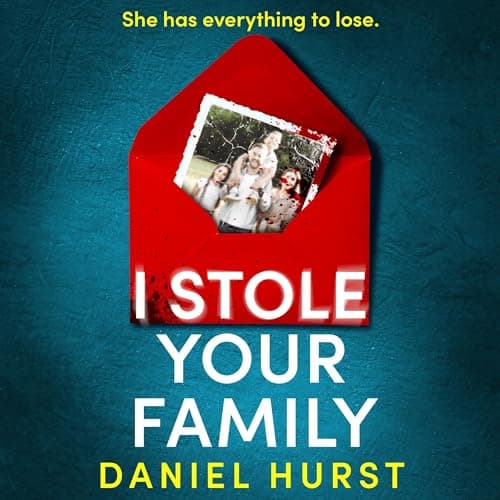

Look, I have a complaint. I was making chana masala at 10 PM — the kind of elaborate weeknight cooking that my mother would call "unnecessary for one person" — and I needed something to keep my hands busy and my brain occupied. So I put on I Stole Your Family expecting a tight little domestic thriller I could half-listen to while tempering spices. Instead, Daniel Hurst handed me a premise so psychologically brazen that I burned the cumin. Twice.
The setup is this: a woman is living another woman's life. Not metaphorically. She has the husband, the children, the house — and the original wife is out there, watching. And our protagonist? She's not apologetic. She's territorial. She's rationalized the whole thing into a survival narrative, which — and I say this as someone who has written actual papers on self-deception mechanisms — is a fascinating case study in motivated reasoning. The way she frames her theft as earned, as something she "worked hard for," is textbook cognitive dissonance dressed up in cozy domesticity.
When the Villain Thinks She's the Hero
What makes this character psychology work (mostly) is that Hurst commits to her perspective. This isn't a book where the protagonist winks at the reader and says "I know I'm awful." She genuinely believes she deserves this life more than the woman she took it from. The research actually shows that people who commit moral transgressions almost always construct elaborate internal justifications — and this book leans into that hard. Every time she kisses the husband or watches the kids play, there's this undercurrent of "I'm better for them." It's delusional and it's recognizable, which is the uncomfortable part.
The three-narrator setup — Clare Corbett, Helen Keeley, and Nathaniel Priestley — makes sense structurally. You've got competing perspectives, competing claims on the same family, and giving each voice its own narrator keeps the listener from accidentally sympathizing with the wrong person. Or maybe that's the point — you're supposed to get confused about who deserves sympathy. I found myself asking: why does the "victim" wife feel less compelling than the woman who stole her life? Is it because we instinctively root for the person who's fighting harder? That's a troubling psychological impulse, and I wish the book had dug into it more. The moral ambiguity around victimhood is something Girl Who Was Taken handles with more patience — the way it lets you sit uncomfortably with competing sympathies before it tips its hand is exactly what I wanted more of here.
The Six-Hour Problem
At 6 hours and 43 minutes, this is a sprint. And sprints in psychological thrillers can go one of two ways: either the pacing is relentless and you feel like you're being dragged behind a car (complimentary), or the characters don't get enough room to breathe and their motivations start feeling like plot mechanisms rather than human decisions.
I Stole Your Family lands somewhere in between. The first half builds tension effectively — the paranoia of the protagonist, the sense that her constructed life is a house of cards. But when the twists start coming (and Hurst is known for his twists the way some chefs are known for their signature dish — you know it's coming, you just don't know the flavor), the character psychology gets sacrificed for momentum. The protagonist who felt psychologically real in hour two starts making decisions in hour five that serve the plot rather than her established personality. Psychologically, this doesn't track. If you've built someone who is calculating and patient enough to steal an entire family, she wouldn't suddenly become reckless just because the author needs a climax.
My therapist would have thoughts about this character. Specifically about how her attachment style shifts from anxious-avoidant to something entirely different in the final act, without any triggering event that would justify that kind of behavioral change. People don't just flip switches. Hurst understands the surface of human nature — the jealousy, the possessiveness, the fear of losing what you've taken — but the deeper architecture wobbles when it needs to hold the most weight.
The Audio Experience Without the Receipts
I'll be honest: I couldn't find much specific commentary on how Corbett, Keeley, and Priestley differentiate their performances in this particular audiobook. Clare Corbett has a reputation for strong character work in other projects, and nothing here contradicted that — the narration is competent and the multi-narrator format prevents the kind of "wait, who's talking?" confusion that plagues some thrillers. But I can't point to a specific vocal choice that elevated the material the way a great narrator can. It's solid. It's professional. It doesn't get in its own way, which in audiobook terms is actually a compliment.
Who Should Listen (And Who Should Skip)
If you burn through Freida McFadden novels and want the same domestic-thriller dopamine hit with a slightly more unusual premise, this will scratch that itch. Skip it if you need your thriller protagonists to maintain psychological consistency through the final act — the way, say, a T.M. Logan character might — because you'll feel the seams showing by the end.
The premise is genuinely strong. A woman defending a life she stole, refusing to feel guilty, watching the real wife circle closer — that's a setup that could power a much longer, much darker book. At this length, it's a satisfying afternoon listen that doesn't quite earn its ending.
Case Notes
I finished the audiobook, rescued my chana masala (barely), and sat with this thought: the most interesting version of this story is the one where nobody is clearly wrong. Where the thief and the victim are both sympathetic enough to make you uncomfortable. Hurst gets halfway there, which is more than most domestic thrillers manage. But halfway is still halfway. The twist lands, the story closes, and you move on — which is fine for a Wednesday night, but not the kind of book that rearranges your understanding of people.