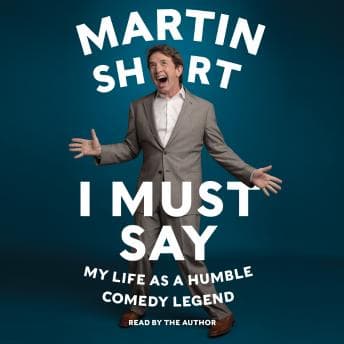

I have a confession that will probably get my English teacher credentials revoked: I spent eight and a half hours listening to a comedian's memoir while I should've been rereading Middlemarch for the fourth time. And I don't regret a single minute of it.
My wife Denise and I were walking the lakefront on Saturday morning - one of those October days where the wind off the lake is doing its absolute worst - and I had this queued up as a solo listen for the return trip. By the time I hit the Michigan Avenue bridge, I was standing still in the cold, laughing out loud at Ed Grimley doing his little triangle dance, and three separate joggers gave me the look. You know the look. The one that says sir, are you having an episode?
I was not having an episode. I was having the time of my life.
When the Author IS the Performance
Here's what nobody tells you about this audiobook: the physical book doesn't exist, not really. Or rather, it exists the way a screenplay exists - technically complete, but missing its entire reason for being. Martin Short narrates this himself, which sounds like a standard celebrity-memoir move, but it isn't. When he slides into Ed Grimley - that manic, M-shaped-hair man-child from SCTV - mid-sentence, mid-thought, as if the character just arrived, it's not a clip from an old show. It's Short demonstrating, in real time, how a character lives in his body. The voice doesn't come from his throat. It comes from somewhere else entirely.
The Jiminy Glick sections are even stranger and better. Short does Glick interviewing himself - past-Short being interviewed by Glick-Short - and the cognitive dissonance of one man doing two voices in conversation with each other, one of whom is a grotesque parody of celebrity journalism, is the kind of thing that makes you stop and think: this is actually a virtuoso performance happening inside my earbuds right now. The narrator understands that pause is punctuation. Short knows exactly when to let a joke breathe and when to bulldoze through one for effect. Twenty years of watching students fake-laugh at things they don't understand has made me very sensitive to the difference between someone performing comedy and someone being funny. Short is the latter.
That said - and I'll be honest because my podcast audience of 47 people expects it - the middle section drags. There's a long stretch where Short is cataloguing career ups and downs with the kind of detail that matters enormously if you're a Broadway historian and somewhat less if you're a person walking into a headwind at Montrose Harbor. The name-dropping accumulates. At some point I started mentally keeping score: Steve Martin, Tom Hanks, Gilda Radner, Mel Brooks, Nora Ephron - it's like the Hollywood Walk of Fame read aloud. Charming for a while. Eventually a little numbing.
The Thing He's Actually Saying Underneath the Jokes
Let's talk about what Short is really saying, because this is where the book surprised me and where I think the comedy-memoir label undersells it.
Short lost his oldest brother and both parents before he turned twenty. He lost his wife of thirty years to cancer. And the book's argument - not stated directly, but built into every anecdote, every impersonation, every moment of performed joy - is that choosing happiness isn't denial. It's discipline. It's a practice. He talks about his "default setting" being optimism, and coming from someone who has absorbed that much loss by fifty, that's not a punchline. That's a philosophy that's been stress-tested.
Hemingway said the world breaks everyone, and afterward many are strong at the broken places. Short never quotes Hemingway. But he's living the argument. The comedy isn't armor. It's the actual thing - the real response to a world that keeps taking people from you. When he gets to his wife Nancy's illness and death, his voice changes. Not to sadness exactly. To something quieter. The performance drops away and you're just hearing a man talk about his person. I was not prepared. My students would hate this book - too many old names, not enough plot. I loved it. The memoir that gave me a similar feeling of loving something my students would absolutely dismiss is Shoe Dog — another book where the real subject isn't the career, it's what a person decides to do with the losses along the way.
Who This Is For (And One Honest Warning)
If you're under forty and the name Ed Grimley means nothing to you, you'll still enjoy this - but you'll enjoy it the way you enjoy a great concert from a band you've just discovered. The people who'll be absolutely undone by it are anyone who grew up watching SCTV, anyone who thinks comedy is a serious art form, and anyone who's ever had to figure out how to stay upright after loss.
Do not listen to this as background. It won't work. Short's timing requires your actual attention - the same way you can't half-listen to stand-up and catch the real jokes. This is a performance piece disguised as a memoir, and it rewards the listener who shows up fully.
Worth every minute of the lakefront cold.




![Steve Jobs [unabridged audiobook] audiobook cover](/_next/image?url=https%3A%2F%2Fcovers.audiobooks.com%2Fimages%2Fcovers%2Ffull%2F9788499923406.jpg&w=1920&q=75)