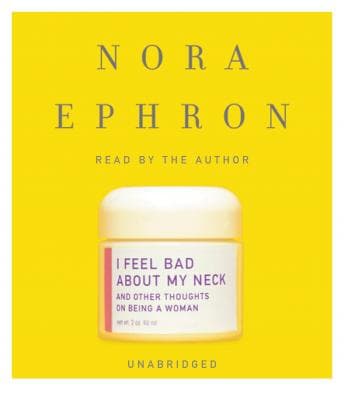

Nora Ephron is the friend you wish you had at dinner parties - the one who says the thing everyone's thinking but nobody will say out loud, and who makes you laugh so hard you almost knock over your wine.
I started this on a Saturday morning walk along the lakefront with Denise, which turned out to be perfect because Ephron's essays land like conversation. Not the stilted kind you have at parent-teacher conferences. The real kind. The kind where someone looks you dead in the eye and says, "I feel bad about my neck," and you understand she's talking about mortality, vanity, the whole impossible negotiation women make with time - but she's also literally just talking about her neck. That double register is Ephron's genius.
When the Writer IS the Performance
Here's the thing about author-narrated audiobooks: most of them are terrible. Writers are not actors. They mumble. They lose their place. They read their own sentences like they're encountering them for the first time and aren't quite sure they agree with themselves.
Nora Ephron is the exception that proves every rule I have about narration. Her delivery has this quality I can only describe as... deliberate casualness? She reads the essay about her apartment - the one where she catalogs her obsessive relationship with New York real estate and admits she basically chose her home the way some people choose spouses - with this timing that no hired narrator could replicate. The pauses aren't dramatic. They're the pauses of a woman who knows exactly where the laugh is and trusts you to find it.
At four hours, this is practically a long lunch with a brilliant woman. And the brevity works. Each essay is tight - the one about purses, the one about maintenance (where she breaks down exactly how many hours per week women spend on upkeep, and the number is genuinely horrifying), the piece about cooking. None of them overstay their welcome. This reminds me of what Hemingway said about writing - the dignity of movement of an iceberg is due to only one-eighth of it being above water. Ephron shows you the funny eighth. The grief, the fear, the reckoning with age - that's all below the surface, and you feel every bit of it.
The Dated Parts Are Actually the Point
Some listeners flag that the book feels dated. It was published in 2006. Ephron references specific products, specific cultural moments, a specific version of New York that's already half-gone. And yes, some of her references land differently now.
But here's what I'd say to that - and this is the English teacher in me talking, I can't help it - the specificity is what makes it last. When Ephron writes about the exact ritual of dyeing her hair, naming actual products, describing the precise anxiety of seeing her roots in a certain light, she's doing what all good essayists do: she's being so particular that she becomes universal. My students would hate this comparison, but it's the same thing Montaigne was doing four hundred years ago. Writing about kidney stones and finding the human condition.
The essay that hit me hardest was the one about her apartment. Not because I care about Manhattan real estate - I'm a Chicago public school teacher, I can barely afford to look at real estate listings - but because Ephron captures something true about the spaces we build our lives inside. How a home becomes a story we tell ourselves. How losing one feels like losing a version of who we were. Falling Home circles that same idea - the way a place holds a version of you that nowhere else can.
(Denise caught me getting quiet during that one. She asked if the book was sad. I said no. It was. A little.)
Who Gets an A, Who Gets an Incomplete
This is basically required listening if you love personal essays, if you've ever stood in front of a mirror and had a complicated feeling about what looked back, or if you just want to spend four hours with someone smarter and funnier than most people you know. Fans of David Sedaris, Sloane Crosley, or Samantha Irby will recognize the DNA here - Ephron walked so they could run.
Skip it if you need plot. There is no plot. Skip it if you want a highly produced audio experience with sound effects and musical transitions. This is one woman, one microphone, and zero pretension. And skip it if you're looking for a contemporary take on gender - Ephron was writing from a specific generation, and she'd be the first to tell you that.
The prose deserves to be savored. I listened at 1.0x, obviously, because Ephron's comic timing is the whole experience. Speed this up and you lose the rhythm, which is the same as losing the joke.
Worth Pausing the Faculty Meeting For
Nora Ephron died in 2012. This audiobook is - and I don't use this word lightly - a gift. Not because the content is earth-shattering, but because hearing her voice, her actual voice, delivering these sharp, self-aware, deeply human essays about the absurdity of being alive and getting older and caring too much about your neck... it's the closest thing to sitting across from her at dinner. Four hours isn't enough. But she'd probably say that's exactly the right amount - leave them wanting more, and for God's sake, don't let them see your neck on the way out.









