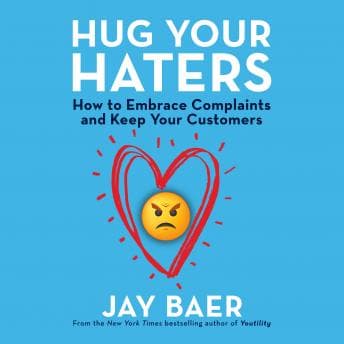

This book could've been a blog post. There, I said it.
But here's the thing - it's a really good blog post stretched into 5.5 hours, and honestly? For my commute purposes, that worked fine. Jay Baer's core thesis is dead simple: answer your complainers. All of them. Even the angry Twitter trolls. Especially the angry Twitter trolls. The ROI math he lays out is actually compelling - ignored complaints become amplified complaints, and answered complaints (even negative ones) can boost customer advocacy.
The "Hatrix" Is Basically a Decision Tree for Your Support Team
So Baer breaks down complainers into two camps: Offstage Haters (email, phone, private channels) and Onstage Haters (social media, review sites, anywhere with an audience). The key insight? They want different things. Offstage folks want solutions. Onstage folks want acknowledgment - and they're watching to see how you handle it publicly.
This framework is genuinely useful. I've already forwarded the basic concept to our customer success team at work. (Yes, even FAANG companies have customers who yell at us on Twitter. Shocking, I know.) The data from the Edison Research study gives it credibility - we're not just talking vibes here, there's actual methodology behind the recommendations.
But - and this is where I got frustrated - Baer repeats the core concepts maybe four or five times throughout the book. I get it. Hug your haters. Respond quickly. Be human. I GOT IT after hour two. By hour four I was at 1.75x speed just to push through.
Author-Narrated: A Double-Edged Sword
Jay Baer narrates his own book, and look, I have mixed feelings. On one hand, the guy clearly knows his material and sounds genuinely enthusiastic about customer service (which is... a personality type, I guess). His delivery is conversational and easy to follow at 6AM on the train when I'm barely conscious.
On the other hand, he's not Ray Porter. He's not a professional narrator. There's a certain flatness to the performance that made some sections feel like a really long webinar. Some listeners apparently found it unbearable - I wouldn't go that far, but I definitely noticed it. The examples he shares are entertaining enough to carry the narration, though. Real stories from real companies dealing with real angry customers. Those parts kept me engaged.
Perfect For: Train, Gym. Skip For: Deep Work
This is quintessential commute material. You don't need to take notes. You don't need to rewind. The concepts are simple enough that you'll absorb them even while half-asleep and surrounded by other tech workers staring at their phones.
The actionable stuff is solid: respond to every complaint, do it quickly (the data on response time expectations is eye-opening), and match your tone to the channel. Onstage complaints need one response - take it private. Offstage complaints need actual solutions. Simple framework, easy to implement.
What's missing? Any real depth on organizational change. Baer touches on the idea that you need to train your whole team to think this way, but he doesn't really dig into how. For a book aimed at business professionals, that felt like a gap. You'll walk away knowing what to do but not necessarily how to get buy-in from leadership or scale it across a company.
Would I Listen Again?
Nope. Once was enough. But I don't regret the three commutes I spent on it.
Who Should Listen (And Who Should Skip)
If you're a small business owner or social media manager who hasn't thought systematically about complaint management, this is worth your time. The framework is practical, the examples are entertaining, and you'll probably pick up at least a few tactics you can use immediately.
For a different kind of practical framework—one focused on financial systems rather than customer complaints—Debt-Free Spending Plan delivers similar straightforward tactics you can implement right away.
Skip it if you already have a decent customer service operation and you're looking for advanced strategies - this might feel too basic. And if you're sensitive to author-narrated audiobooks that sound a bit like podcasts? Sample first.
Bottom Line: Worth your commute if you need a customer service framework. Just bump it to 1.5x minimum - you'll thank me.