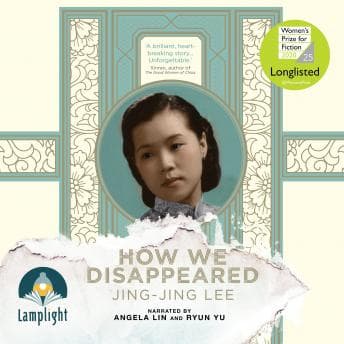

Some books you finish and immediately want to assign to your AP students. Others you finish and think: no. Not yet. Maybe not ever. This one falls into the second category—not because it lacks literary merit, but because some truths require a certain readiness to receive them.
I started How We Disappeared during a late faculty meeting about standardized testing metrics. (Sorry, Martinez. But also, not sorry.) By the time the meeting ended, I'd barely registered a word spoken in that room. Wang Di's story had me completely.
The Weight History Carries
Here's what I didn't know before this book: during World War II, the Japanese military systematically abducted thousands of women across Asia—Korean, Chinese, Filipino, Indonesian, Singaporean—and forced them into sexual slavery at so-called "comfort stations." The euphemism itself is an obscenity. Jing-Jing Lee's debut novel doesn't let you hide behind euphemisms. She puts you inside those rooms with seventeen-year-old Wang Di, and you stay there, and you understand why sixty years of silence followed.
This is why we still read the classics, why we need historical fiction that refuses to look away. Textbooks give you numbers. Fiction gives you a girl who remembers the exact pattern of cracks in a ceiling.
The dual timeline structure works beautifully here. Wang Di's past unfolds alongside twelve-year-old Kevin's present-day investigation in 2000s Singapore, after his grandmother's deathbed confession sends him searching for answers. If I'm being honest—and I always am, even when it costs me—Kevin's sections don't carry the same devastating power. Some readers apparently skimmed through them. I understand the impulse, though I didn't give in to it. His narrative provides necessary breath between Wang Di's chapters. You need those moments to surface.
Angela Lin Understands That Pause Is Punctuation
The dual narration splits cleanly: Angela Lin handles Wang Di's story, Ryun Yu takes Kevin's perspective. Lin's performance is the revelation here. There's a theatrical quality to some passages that I've heard other listeners found jarring at first—but I'd argue that's intentional. Wang Di is performing survival. She's been performing it for six decades. The slight formality in Lin's delivery captures something essential about a woman who learned to wall off parts of herself just to keep breathing.
Yu's work with Kevin is solid if less remarkable. The boy's earnestness comes through clearly. But this is Lin's show, and she knows it.
I listened at 1.0x because the author chose those words. Lee's prose deserves to be savored, even—especially—when what she's describing makes you want to look away. There's a particular scene involving a photograph that I had to pause after. Just sat there in my car in the school parking lot, grading papers forgotten on the passenger seat, thinking about what it means to bear witness.
Who Should Walk This Path (And Who Should Wait)
Let me be direct: this is not background listening. This is not your commute companion unless you're prepared to arrive at work emotionally wrecked. The content warnings are serious—violence, rape, sexual slavery, sustained abuse. Lee doesn't exploit these horrors, but she doesn't spare you either. Skip this if you need lighter fare right now, or if you're not in a place to sit with sustained darkness. There's no shame in that.
If you loved Pachinko—and if you haven't listened to it, what are you doing with your life—this is its spiritual successor in some ways. Light We Lost also explores how women carry the weight of choices made decades earlier, though tonally different. Both novels center Asian women whose stories history tried to erase. Both demand you sit with discomfort.
My students would hate this. Not because it's bad—because it's too real, too heavy, too much like the parts of history we'd rather forget. I love it. I think it's essential. But I also think you need to be ready for it. This isn't a book you put on while doing dishes. This is a book you commit to, the way you commit to understanding something painful and necessary.
Worth Pausing the Faculty Meeting For
Jing-Jing Lee drew partly on her great-grandfather's experiences for this novel. That personal connection shows in every carefully chosen detail, every moment where she could have flinched and didn't. The book was longlisted for the Women's Prize for Fiction, which feels like an understatement.
At nearly twelve hours, it's a commitment. The pacing in Kevin's sections occasionally drags—he's a kid playing detective, and sometimes that feels like exactly what it is. But Wang Di's story carries enough weight to anchor everything else.
This reminds me of what Toni Morrison said about the function of racism being distraction. The function of forgetting is similar. We forget because remembering is hard. Lee's novel is an act of remembrance, performed by two narrators who understand the assignment.
I finished it last night around midnight, papers still ungraded, Denise already asleep. Sat there in the dark for a while. Some books don't let you go easily. This is one of them.