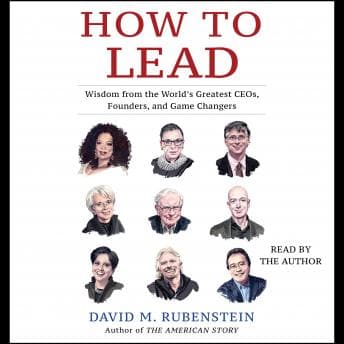

Thirteen hours. Thirteen hours of a billionaire private equity founder interviewing other billionaires and famous people about how they got successful. I started this on a Saturday morning while reorganizing my home office - Jenny was out with friends, I had the whole day, and I figured I'd knock out some leadership wisdom between filing old client decks and throwing away business cards from people I'll never call again.
Here's the thing that kept nagging me the entire listen: David Rubenstein is a genuinely smart guy. Cofounder of Carlyle Group. Worth billions. But this book is essentially his interview show transcribed into audio form, and the difference between a great TV interview and a great audiobook is... significant.
The Rolodex Is Impressive. The Depth Isn't.
The lineup is absurd. Bezos, Buffett, Gates, Oprah, RBG, both Presidents Bush and Clinton, Tim Cook, Phil Knight, Coach K. If you made a fantasy draft of "people whose brains you'd want to pick for an hour," this is pretty much the roster. And there are genuinely good moments - Phil Knight talking about Nike being a marketing company first, product second? That's the kind of reframe that makes you sit up. Bezos on intuition over analysis for his best decisions? Coming from the most data-obsessed CEO on the planet, that lands differently.
But here's where it falls apart: most of these conversations stay at cocktail party depth. Rubenstein asks a question, the leader gives a polished answer they've probably given 200 times before, and we move on. There's very little follow-up. Very little "wait, that doesn't add up" or "but what about the 10,000 people you laid off that quarter." These are the conversations you'd have at Davos between sessions - pleasant, surface-level, everyone performing their best selves.
My parents worked 14-hour days pressing other people's suits. They never had the luxury of "harnessing the power of wandering." When Marillyn Hewson talks about growing up in a fatherless home and learning self-reliance - okay, that's real. That I felt. But too many of these interviews read like LinkedIn posts with better production value.
The Live Recordings Are Either a Feature or a Bug
The audiobook includes actual live interview recordings, which is an interesting choice. On one hand, you get authenticity - the actual voices of these leaders, their pauses, their laughs, the way Buffett sort of meanders into his points. On the other hand, the audio quality shifts noticeably between Rubenstein's studio narration and the live segments. It's not terrible, but at 2.0x speed the transitions can be jarring. You go from clean, controlled narration to what sounds like a hotel ballroom recording, and your brain has to recalibrate.
Rubenstein himself narrates with the authority you'd expect from someone who's spent decades in boardrooms. He's not a professional voice actor and he doesn't pretend to be - it's straight, clear delivery. No vocal fireworks. Which honestly works for this kind of content. You're not here for performance art, you're here for the substance.
The problem is there's about 4-5 hours of genuine substance stretched across 13.
What My Parents Would Say About This Book
They'd say what they always say when I describe some CEO's "leadership philosophy": "So... work hard?" And they wouldn't be wrong. Strip away the prestige and the name recognition, and a shocking number of these leaders essentially say the same things: work harder than everyone else, take calculated risks, hire great people, don't be afraid to fail. Patrick Lencioni actually builds a real framework around that last one in Five Dysfunctions of a Team — same truisms, but with enough structural rigor that you walk away knowing what to do Monday morning instead of just feeling vaguely inspired. This is what my parents did instinctively. Now it has a TED talk.
The book is organized by theme - Visionaries, Builders, Transformers, etc. - which sounds smart but actually makes it harder to track. You're bouncing between a tech CEO and a Supreme Court justice and a golfer within the same section, and the connective tissue is thin. I kept wishing Rubenstein would just pick five people and go deep instead of giving us thirty people at surface level.
That said - skip to the Jeff Bezos section and the Phil Knight section. Thank me later. Those two alone have enough actionable insight to justify the listen if you catch them on sale.
Who Gets ROI Here (And Who Doesn't)
If you're early in your career and haven't read much business biography, this is actually a decent sampler platter. You get exposure to a lot of different leadership styles and can figure out whose full biography to read next. If you've already read Shoe Dog, The Everything Store, and Buffett's shareholder letters? You're going to feel like you're rewatching the movie after reading the book. Less detail, fewer surprises.
I've seen this fail at three different companies - the idea that you can extract leadership principles from interviews with people operating at a completely different scale and somehow apply them to your Series A startup. Context matters. What works when you have Bezos money doesn't work when you're making payroll on a credit card.
The Engagement Letter
Bottom line: decent airport listen, mediocre deep study. Rubenstein's access is unmatched - nobody else is getting these people in a room together - but access without depth is just name-dropping with better production. My 2.0x speed couldn't save this one from feeling padded. Jenny would say I'm being harsh. Jenny is right. But she'd also agree that a 13-hour audiobook with maybe 5 hours of real insight needs a better editor, not a kinder reviewer.