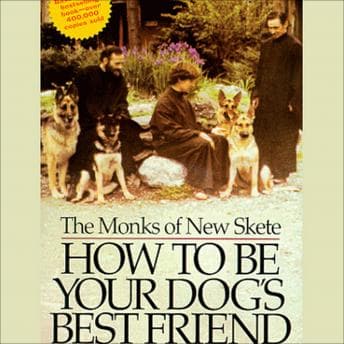

What's the debug equivalent for a dog that won't stop barking at the mailman? Turns out, monks have figured it out — and they've been running this particular algorithm for over thirty years.
I don't have a dog. Kevin and I have been circling the "should we get a dog" conversation for about six months now, which in engineering terms means we're stuck in a planning sprint that never ships. So when I saw this pop up on a recommendation thread — monks who breed and train German Shepherds at a monastery in upstate New York wrote a training manual — my brain immediately went: "That's the weirdest tech stack I've ever heard of, I'm in."
Monks, Dogs, and Surprisingly Good Systems Design
Here's what I didn't expect: this is basically a systems architecture book disguised as a dog training manual. The Monks of New Skete approach dogs the way a good SRE approaches a complex system — you don't just patch symptoms, you understand the underlying behavior. They spend serious time on why dogs do things before they ever tell you how to fix them. The section on how poor or inconsistent discipline cascades into increasingly unruly behavior? That's literally a distributed systems failure mode. One bad signal propagates, and suddenly your golden retriever is running the household.
The book builds on their earlier work, The Art of Raising a Puppy, but honestly, this stands alone fine. It covers the full lifecycle — feeding, care, training philosophy, the actual mechanics of commands. At 4 hours 19 minutes, it's lean. No bloat. I finished it in two commutes, which for a non-fiction book means the ROI on this audiobook is excellent. There's no chapter where I thought "this could've been a blog post" because the whole thing already reads like a well-edited blog post that respects your time. The last time I felt that same respect for my attention was reading Demon-Haunted World: Science as a Candle in the Dark — Sagan also writes like someone who has thought deeply about something for decades and refuses to waste your time getting to it.
Michael Wager Sounds Like Your Favorite Uncle Who Actually Knows Things
Michael Wager's narration has this warm, no-nonsense quality — think the uncle at Thanksgiving who gives you actually useful life advice instead of just opinions. He sounds like someone who's been around dogs his whole life and genuinely enjoys explaining things. Not performative, not overly enthusiastic. Just... competent and calm. Which, for a book about training animals, is exactly the vibe you want. You wouldn't trust a narrator who sounds frantic telling you how to establish calm authority with your dog.
The pacing matches too. He doesn't rush through the practical tips, which matters because if you're listening on a train at 6AM — which I was — you need time to actually absorb "here's how to correct a behavior" before he moves to the next one. At 1.5x, this flows perfectly. I wouldn't go higher because some of the training sequences are genuinely instructional and you want them to land.
The Monk Factor: Weird, But It Works
Okay, the elephant in the room. Monks wrote a dog training book. And honestly? The monastic angle is what makes this different from the twelve thousand other dog books on Audible. These guys live with their dogs. All day, every day, in a monastery. Their observation time is basically unlimited — it's the equivalent of having 24/7 monitoring on your production system versus checking dashboards once a day. The depth of behavioral insight comes from that kind of sustained attention, and you can feel it.
They're compassionate but firm. Not the "your dog is your baby" school, and not the "dominate your animal" school either. It's more like — understand the relationship, set clear expectations, be consistent. (Honestly, also good advice for managing engineers, but I digress.)
What I will flag: this book is from 2002, and some of the training philosophy has been debated in modern dog training circles. The monks have a more correction-based approach than pure positive reinforcement trainers prefer. Not harsh — nothing that made me uncomfortable — but if you're deep in the R+ only camp, some of it might rub you wrong. Worth knowing going in.
Perfect For: Pre-Dog Research. Skip For: Deep Training Reference.
If you're in the "thinking about getting a dog" phase like me, this is a fantastic orientation to what responsible dog ownership actually looks like. It's also solid for current dog owners who want to understand their dog's behavior better rather than just memorize commands.
Where it falls short: because it's audio-only, you lose the visual training demonstrations that apparently exist in the print edition. For actual hands-on training, you'll probably want the physical book open in front of you. The audiobook is the philosophy and framework; the print version is the implementation guide.
Kevin, if you're reading this: I'm ready to ship the dog sprint. Let's do it.
TL;DR: Commit the Pull Request, Get the Dog
Solid, efficient, surprisingly deep for 4 hours. The Monks of New Skete bring thirty years of dog observation into a framework that'll make any systems thinker nod along. Michael Wager's narration is warm and steady. At this length and quality, there's basically zero risk — it's shorter than most meetings I sit through in a week. Perfect for: train, weekend errands. Skip for: anything requiring visual demonstration.







![Steve Jobs [unabridged audiobook] audiobook cover](/_next/image?url=https%3A%2F%2Fcovers.audiobooks.com%2Fimages%2Fcovers%2Ffull%2F9788499923406.jpg&w=1920&q=75)