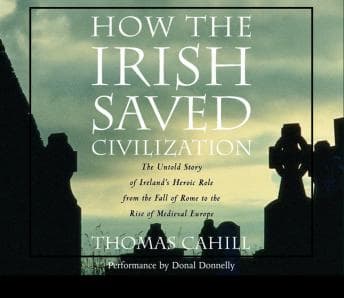

Let me cut to the chase: calling this book "How the Irish Saved Civilization" is like calling the Battle of Thermopylae "How 300 Guys Held a Doorway." Technically accurate, wildly underselling the complexity. I spent a good chunk of this eight-hour listen wanting to argue with Thomas Cahill through my truck's dashboard. And honestly? That's exactly why I kept listening.
Driving back from a client site in Houston—four hours of I-10 that feels like twelve—I needed something meaty. Something that would make me think instead of just cataloging all the terrible lane changes happening around me. Cahill delivered, though not always in the ways I expected.
The Thesis That Got Under My Skin
Here's Cahill's argument in tactical terms: Rome falls, Europe descends into chaos, and while everyone else is busy burning libraries and forgetting how to read, a bunch of Irish monks on a soggy island are copying every manuscript they can get their hands on. Then they export that knowledge back to the continent. Mission accomplished, Western civilization preserved.
Now, I've seen this scenario play out in real life—small, dedicated units preserving critical infrastructure while larger forces collapse around them. It happens. But Cahill's so in love with his thesis that he glosses over some serious strategic questions. Who else was doing similar work? The Byzantines? Islamic scholars? He mentions them, then waves them away like they're minor players. That's intellectually sloppy, and it bugged me throughout.
But here's the thing—when he stops trying to prove his grand theory and just tells stories, the man can write. His section on St. Patrick is genuinely compelling. Not the sanitized version we get on greeting cards, but the actual historical figure: a Romano-British kid kidnapped by Irish raiders, enslaved for six years, who escapes and then—inexplicably—goes back to convert his captors. That's the kind of psychological complexity that makes history worth studying. I found that same kind of raw, unflinching look at moral complexity in Permanent Record—different subject entirely, but both authors refuse to simplify their protagonists into heroes or villains.
Donnelly's Voice: Tactical Asset or Liability?
Donal Donnelly narrates with an Irish lilt that some listeners apparently hate with the fire of a thousand suns. I get it. When he slips into what I'd call "stage Irish"—that exaggerated brogue you hear in bad Hollywood productions—it can feel like he's performing rather than reading. There's this slightly querulous quality to his voice that sometimes sounds ironic when Cahill's being dead serious.
But for this particular book? It mostly works. You're listening to a story about Irish monks saving Western culture—having an actual Irish voice in your ear reinforces the material. It's like having a native guide. When Donnelly reads passages about the monks' marginalia—those weird little notes and doodles they'd leave in manuscripts—his delivery captures that winking Irish wit Cahill keeps referencing. The monks weren't just preserving texts; they were having fun with them. Donnelly gets that.
I listened at 1.25x, my standard speed, and it handled the acceleration well. His pacing is deliberate but not plodding—at least until the final chapters.
Where the Mission Loses Momentum
After Patrick's story wraps up, something happens. The book loses its narrative drive. Cahill starts cataloging facts—this monastery, that manuscript, these missionaries—and it becomes more textbook than tale. I found myself checking my GPS more often, calculating how much longer until Austin. That's never a good sign.
The last two chapters feel like Cahill realized he needed to actually prove his "saved civilization" thesis and started cramming in evidence. It's the historical equivalent of a PowerPoint deck when you really needed a story. Ranger was asleep in the back seat by then, which tells you something.
Cahill's Homework (Mostly Done)
Cahill's clearly read the primary sources. He quotes from Patrick's own writings, pulls from contemporary accounts, and paints a vivid picture of late Roman Britain collapsing into chaos. His description of what it meant for literacy to simply... disappear... from a society is genuinely chilling. One generation can read Latin, the next can't recognize the alphabet. That's how fast civilization can fall. Redeeming Love explores a different kind of transformation—personal rather than civilizational—but the same theme runs through it: how quickly people can lose themselves, and how hard the work of redemption really is.
What I appreciated most was his willingness to show the Irish as they actually were—violent, tribal, practicing human sacrifice—before Christianity arrived. He doesn't sanitize them into noble savages or demonize them into barbarians. They were complex people in a complex time. That's honest history.
Who Should Saddle Up (And Who Should Stand Down)
If you want a rigorous academic treatment of the early medieval period, this ain't it. Cahill's a popularizer, and he's got an agenda. But if you want an engaging introduction that might make you curious enough to dig deeper? Worth your time.
History buffs who can tolerate some rhetorical overreach will find plenty to chew on. Irish-Americans looking for something more substantial than leprechaun mythology will appreciate the actual cultural history. Anyone interested in how knowledge survives catastrophe—and brother, that's a relevant question these days—should give it a listen.
Skip it if you need strict academic rigor, you can't handle accented narration, or you're expecting a comprehensive survey of the period. This is one man's passionate argument, not an encyclopedia.
Mission Debrief
Did the Irish save civilization? Cahill makes a case, even if he overstates it. Did this audiobook make four hours of Texas highway disappear? Mostly, until those final chapters. Is Donnelly's narration worth the occasional stage Irish moment? For me, yes. For listeners with less tolerance for accent work, maybe stream a sample first.
Ranger approved this one, at least until he fell asleep. I'd call that a qualified success.







![Steve Jobs [unabridged audiobook] audiobook cover](/_next/image?url=https%3A%2F%2Fcovers.audiobooks.com%2Fimages%2Fcovers%2Ffull%2F9788499923406.jpg&w=1920&q=75)