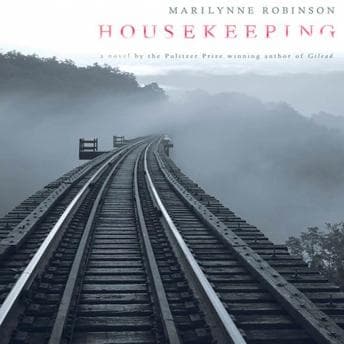

People kept telling me this book is slow. That it's quiet. That nothing really happens.
I want to be clear: those people are not wrong. And they are also completely missing the point.
I picked up Housekeeping on a Thursday morning, post-shift, driving home through that weird pink Phoenix dawn when the city looks almost beautiful if you squint. I was exhausted - twelve hours in the trauma bay, two codes, one patient who kept calling me "mama" - and I needed something that wasn't adrenaline. Something that would bring my heart rate down before I walked through my front door smelling like hand sanitizer and bad coffee.
This book did that. And then it quietly wrecked me.
The Lake Takes Everything and Gives Nothing Back
Robinson writes about water the way I think about the trauma bay at 4 AM - as this indifferent force that just keeps moving through, carrying things away. The grandfather's train goes into the glacial lake. The mother drives her car off a cliff into the same lake. And Ruth and Lucille just... grow up around all that absence, raised by whoever's left. First the grandmother. Then two great-aunts who are so out of their depth it'd be funny if it weren't so sad. Then Sylvie, their mother's sister, who drifts into Fingerbone like weather.
Sylvie is the character I can't stop thinking about. She's not neglectful exactly - she's just operating on a different frequency than the rest of the world. She collects newspapers and tin cans. She sits in the dark. She takes Ruth out on the lake in a stolen rowboat. She's the kind of person who, in my ER, would get a social work consult. But Robinson makes you understand her. You don't pity Sylvie. You almost envy her.
And Ruth - Ruth is watching all of this and narrating it with this eerie calm that reminded me of patients who've been through something terrible and talk about it like they're describing the weather. That flat affect that means the feelings are so big they went underground.
Becket Royce Gets It Mostly Right (With One Catch)
So here's where I have to be honest, because I've seen wildly different takes on this narration and I land somewhere in the middle. Royce has this low, friendly voice that works for Ruth's long interior passages - those stretches where Robinson is basically writing prose poetry about light on water and the weight of an empty house. There's a cool, almost clinical quality to the reading that fits. When Sylvie speaks, you hear someone slightly untethered. When Lucille speaks, you hear someone trying desperately to be normal. The differentiation is subtle. It works.
But - and this is the catch - Royce sometimes moves through Robinson's sentences too fast. Robinson writes these long, winding sentences where the meaning lives in the rhythm, in the way the clauses stack up like water against a dam. When Royce clips through them, occasionally losing the thread of where a sentence is going, you lose that rhythm. I caught myself rewinding a few times on my drive, not because I wasn't paying attention but because the pacing skipped past something I needed to sit with.
At 5 hours and 33 minutes, the book is short enough that this doesn't ruin the experience. But I'd have loved a narrator who trusted the silences more. Robinson's writing earns its pauses.
This Is Not How You Process Grief (Except It Is)
Here's what got me. This book doesn't do grief the way we're taught to expect it. Nobody cries into their pillow. Nobody has a dramatic breakdown. Instead, grief in Fingerbone looks like a house slowly filling with newspapers and darkness. It looks like a woman who can't keep the curtains open. It looks like two sisters splitting apart because one wants to be normal and the other wants to follow the current wherever it goes.
As someone who watches families fall apart in waiting rooms on a regular basis - who has handed belongings in clear plastic bags to people whose whole world just changed - I recognized something true in this book. Grief doesn't always look like grief. Sometimes it looks like housekeeping. Or the absence of it. That same slow accumulation of loss without a single dramatic turning point is what Dickens does across hundreds of pages in Bleak House — different era, different scale, same truth about how quietly a life can be buried under the weight of systems and silences that don't care about you.
Carlos asked why I was crying in the car. I blamed allergies. But it was that scene near the end, Ruth choosing to go with Sylvie, choosing the drift over the anchor. I sat in my driveway for ten minutes with the engine running.
Who This Is For (and Who Should Walk Away)
If you want plot, skip this. If you want things to happen in the traditional sense - twists, reveals, resolution - this will frustrate you. But if you've ever sat in a quiet room at 3 AM and felt the weight of all the people who used to be in it, this book already knows you.
Perfect for that post-shift decompression. Not background listening. Not multitasking material. This one needs your full attention or it'll wash right past you.
My mom would love this (she still thinks I should've been a doctor). It's the kind of book she'd call "sad but beautiful" and then tell me to read something happy next time.
Night Shift Prescription
Keep this one at 1x speed. Don't rush it. Let Fingerbone and its lake and its strange, motherless girls settle into you. The narration isn't perfect, but the book underneath is the real thing - quiet and devastating and true in a way that doesn't announce itself. It just arrives, like Sylvie, and rearranges everything when you're not looking.