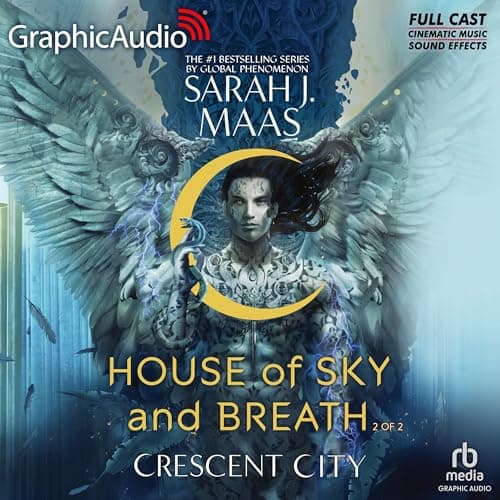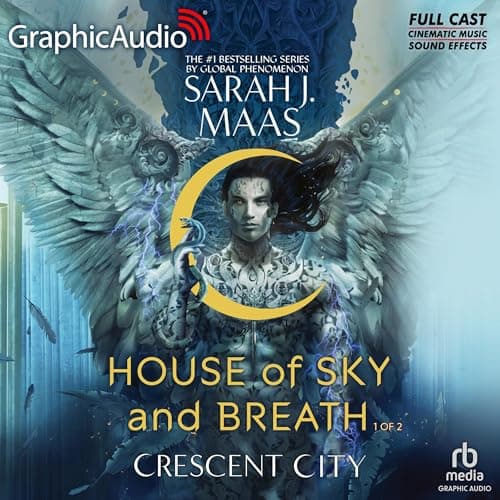

"Stay silent while others are oppressed, or fight for what's right." Somewhere around hour three, that line landed while I was sitting in the dark on my back patio, Ranger sprawled across my boots, both of us staring at nothing while Crescent City went to war in my earbuds. And I thought — okay, Maas. You've got my attention.
Let me cut to the chase: I am not the target demographic for this book. I'm a 55-year-old retired infantry officer who reads Tom Clancy for comfort. Sarah J. Maas writes romantasy with enough spice to make my wife raise an eyebrow. But this GraphicAudio dramatized adaptation? It's a different animal entirely. The full-cast treatment with sound effects and cinematic scoring turns what could've been a tough sell for someone like me into something closer to a radio play — or honestly, a movie you listen to with your eyes closed.
When Forty Actors Show Up and Actually Earn Their Pay
This production has a cast list longer than a battalion roster. Over forty voice actors, and somehow it doesn't turn into chaos. Colleen Delany anchors the narration with the kind of steady authority that keeps you oriented when the worldbuilding gets dense — and it gets dense. The Crescent City universe stacks fae, angels, shifters, and something called the Asteri on top of each other with the enthusiasm of someone who never met a mythology they didn't want to borrow from. I ran into similarly crowded supernatural real estate in Undead Next Door, though that one keeps its mythology tighter and its tone considerably lighter.
What surprised me was how well the ensemble differentiates the characters purely through voice. Bryce has this sharp, defiant energy in her delivery that's distinct from Hunt's lower, more measured tone. You can track who's talking without the narrator having to tag every line. That's not easy with this many speaking parts. I've sat through military briefings with three colonels where I couldn't tell who was saying what — so credit where it's due.
The sound design is where opinions split, and I get both sides. Sword clashes, atmospheric hums, crowd noise, weather — it's all there. During action sequences, the layering works. You feel surrounded. But during quieter dialogue scenes, the background music sometimes competes with the voices. I caught myself rewinding a couple times because a character's line got buried under what sounded like generic orchestral tension. It's like when someone puts a dramatic soundtrack under a PowerPoint briefing — sometimes the content doesn't need the help.
The Rebellion Plot That Actually Has Stakes
Here's what kept me listening: the political architecture. Bryce and Hunt are living under the thumb of the Asteri — basically divine tyrants who've consolidated power through fear and control of resources. The rebel factions chipping away at that power structure aren't romanticized freedom fighters. They're messy, fractured, and operating with incomplete intelligence. I've seen this scenario play out in real life, and Maas captures something true about insurgencies — they're driven as much by personal grievance as ideology.
The book takes its time building the conspiracy. This is Part 1 of 2, and it feels like it. You're getting setup, alliances forming, loyalties tested. If you need a resolution by the end, you won't find it here. The pacing runs hot and cold — bursts of action separated by chapters of relationship dynamics and political maneuvering. The romance elements aren't my lane (the sex scenes feel like they're written for a different reader than me, and that's fine), but I respect that Maas uses them to reveal character rather than just fill pages.
This is where it lost me occasionally: at 12 hours for just the first half, there's padding. Some conversations circle the same emotional ground two or three times. Linda would probably tell me that's called "processing feelings," and she'd be right, but my patience for characters talking about their feelings when there's a literal rebellion happening has limits.
The Split-Book Problem
I need to flag this because it matters for your wallet: this is half a book. You're buying Part 1 of 2 of a dramatized adaptation of the second book in a series. That's a lot of qualifiers. If you haven't read or listened to House of Earth and Blood, you'll be lost within twenty minutes. The worldbuilding doesn't pause to catch you up — it assumes you know what a Drop is, who the Autumn King is, and why Danika matters.
And when Part 1 ends, it just... stops. Not a cliffhanger exactly, but clearly mid-story. You'll need Part 2. Budget accordingly.
Who Should Listen (And Who Should Skip)
If you're already invested in Crescent City and want a production that turns the story into a cinematic experience, this is worth the price of admission. Fans of full-cast audio dramas who don't mind romantasy heat will eat this up. Skip it if you haven't listened to House of Earth and Blood first — you'll be lost — or if incomplete stories with no resolution drive you up a wall.
SITREP
The GraphicAudio treatment elevates this from a book I probably wouldn't have finished to one I'm genuinely planning to continue. The production quality is high even when the sound mixing occasionally stumbles. The cast earns their roles. The story has real political teeth underneath the romance and fantasy trappings. Is it my usual fare? Not remotely. Did Ranger and I listen to the whole thing across three evenings on the patio? We did. And I'm not mad about it.
Just turn it up a couple notches during the dialogue scenes. Trust me on that one.