
The Case Study I Didn't Expect
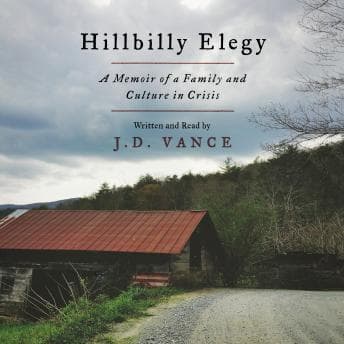
I started this one on a gray Tuesday morning, jogging along the Charles River, and I have to say - I almost didn't finish it. Not because it's bad. Because it's uncomfortable. And look, as someone who studies why people do what they do, I don't say that lightly. I've read case files that would make your stomach turn. But there's something about listening to J.D. Vance narrate his own chaos that hits different.
The protagonist - and yes, I'm calling him that, because memoir or not, he's constructed a narrative self here - exhibits classic hypervigilance patterns. The kind you develop when you grow up never knowing which version of your mother is coming home. Vance describes scanning rooms for exits, reading adult emotions like his survival depends on it. Because it did. My therapist would have thoughts about this character. Many thoughts.
Why Author-Narration Works Here (Mostly)
Here's the thing about author-narrated audiobooks: they can go spectacularly wrong. Writers aren't performers. But Vance? He's not trying to perform. He reads his own story with this almost clinical detachment that - and I found myself asking: why does this actually work? - mirrors the psychological distance survivors often need to discuss trauma.
His delivery is flat. I'm not gonna sugarcoat it. Monotone in places. There's no dramatic flair when he describes his mother chasing him with a car (yes, that happens). No theatrical quiver when recounting the cycles of addiction and recovery and relapse. But psychologically, this tracks. This is how people who've lived through sustained chaos often recount it. Matter-of-fact. Almost dissociative. The research shows that emotional flattening is a common trauma response - and whether intentional or not, Vance's narration embodies it.
Does this make for riveting listening? Eh. Sometimes I zoned out during my runs, had to rewind. The pacing drags in the middle chapters when he's cataloging statistics about Appalachian decline. But when he's in the weeds of family dynamics - Mamaw threatening to kill Papaw (and meaning it), his mother's parade of boyfriends, the constant relocations - I was locked in.
Generational Patterns Under the Microscope
What makes Vance compelling is that he doesn't let himself off the hook. He's not writing a "poor me" narrative. He's genuinely trying to understand the behavioral patterns he inherited - the explosive anger, the learned helplessness, the chaos addiction. There's a moment where he describes almost sabotaging his relationship with his now-wife because stability felt foreign. Too quiet. Suspicious.
I found myself nodding along (probably looked unhinged to other joggers, but whatever). This is textbook attachment theory playing out in real time. Children raised in unpredictable environments often struggle with secure attachment as adults. They're waiting for the other shoe to drop. Vance articulates this without the clinical language, which honestly makes it more accessible than half the self-help books I've reviewed. How To Win Friends And Influence People also strips away clinical jargon to explain human behavior, though Carnegie's Depression-era optimism feels almost quaint compared to Vance's unflinching look at dysfunction.
The grandparents - Mamaw and Papaw - are the most vividly drawn figures here. Mamaw in particular. She's violent, foul-mouthed, fiercely protective, and probably the reason Vance survived at all. He presents her contradictions without trying to resolve them. She's not a saint. She's not a villain. She's a complicated woman shaped by poverty and violence who somehow managed to give her grandson enough stability to escape. That's not a redemption arc. That's just... life. I've seen similar complexity in family dynamics explored in Untethered Soul: The Journey Beyond Yourself, though from a more spiritual angle - same messy human patterns, different framework for understanding them.
The Political Elephant (Briefly)
Okay, so. I need to address this. The book has become politically charged since its publication, given Vance's subsequent career. I'm not here to review his politics - I'm here to review the audiobook as a psychological document. And as that? It's genuinely insightful.
But if you're expecting a policy prescription or a clear thesis about "what's wrong with America," you'll be frustrated. Vance meanders. He contradicts himself. He acknowledges his own blind spots and then sometimes demonstrates new ones. This is a memoir, not a manifesto, and the messiness is part of its honesty.
Content warning for those who need it: abuse, addiction, poverty, family trauma. It's not gratuitous, but it's not sanitized either.
Who Should Listen (And Who Shouldn't)
Best for: Anyone interested in how family systems perpetuate dysfunction across generations. Fans of memoirs that don't tie everything up neatly. People who want to understand a specific American subculture from the inside.
Skip if: You need dynamic narration to stay engaged. Monotone delivery is a dealbreaker for you. You're looking for solutions rather than observations.
I listened at 1.25x speed during the slower middle section and it helped considerably. The audio quality is clean - no production issues to speak of.
At just under seven hours, it's a manageable listen. I finished it over four runs and one very long cooking session (butter chicken, if you're curious - seemed thematically appropriate, comfort food for uncomfortable content).
Is it a polished audiobook performance? No. But it's an authentic document of one man trying to understand his own psychology, and sometimes that's more valuable than theatrical delivery.