
I have read exactly four hundred creative writing assignments this semester where two characters who despise each other end up making out in a rainstorm. My students seem to think they invented the "enemies-to-lovers" trope. They didn't. Shakespeare did it. Austen perfected it. And Monica McCarty? Well, she put it in a kilt and handed it a broadsword.
I started this audiobook in the parking lot of a Michael's craft store. Denise swore she only needed "five minutes" to pick up yarn for a baby blanket. I knew that meant I had forty-five minutes of solitude. So, I ignored the stack of Great Gatsby essays in the backseat and hit play.
The "Campbell" Problem
As a history teacher, asking me to root for a Campbell is like asking a Cubs fan to cheer for the Cardinals. It goes against nature. The Campbells were the politicians, the manipulators of Scottish history. But McCarty does something clever here—she leans into it. Jamie Campbell isn't just a brute; he's the "enforcer." He's the guy the politicians call to clean up their messes.
McCarty's other Highland novel Chief follows a similarly layered protagonist—less enforcer, more chief-in-crisis, but that same tension between duty and desire runs straight through it.It's basically a spy novel wrapped in a bodice ripper. You have Jamie infiltrating the Lamont clan, and Caitriona Lamont, who is smart enough to smell a rat. The tension isn't just sexual; it's political. I appreciate that. It gives the inevitable romance some actual stakes beyond just "will they/won't they."
Roger Hampton's Shakespearean Approach
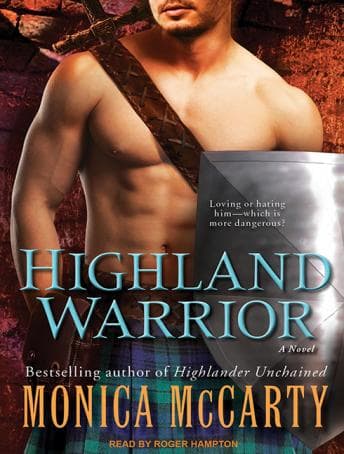
Let's talk about Roger Hampton. If you look at the cover art—torso rippling, sword gleaming—you expect a narrator who sounds like he gargles gravel and whiskey. Hampton isn't that. He sounds... theatrical. Almost Shakespearean.
At first, it threw me off. But then I heard how he handles the hierarchy. When he voices Jamie, he drops into a grounded baritone—solid, authoritative. But when he switches to Argyll, the clan chief, he adopts this nasal, slightly higher pitch. It's perfect. It instantly characterizes Argyll as the scheming bureaucrat versus Jamie's man of action. No author tags needed; the pitch tells you who holds the power and who holds the sword.
His female voices are a mixed bag, though—and this is where I might lose the romance purists. He doesn't do the falsetto thing (thank God), but he softens his tone in a way that sometimes feels a bit breathless. During the arguments, it works. During the... intimate scenes? It can feel a little bit like watching a one-man play in a very quiet library. You become acutely aware that this is one guy in a recording booth talking to himself.
Class Dismissed
Is it high literature? No. My AP English students would roll their eyes at the adjectives. But is it a well-constructed narrative with actual historical texture? Absolutely. It kept me entertained long enough that I didn't notice Denise knocking on the car window with three bags of yarn.
The same thing happened with Thick as Thieves—I told myself one chapter and then suddenly the parking lot was dark.Who should listen: Fans of Scottish historical romance who want their love stories with a side of clan politics and espionage. Who should skip: Anyone expecting straight-up action—this is romance first, history second, and the intimate scenes are frequent.
If you want a history lesson, read a textbook. If you want to hear a classically trained actor navigate Scottish clan politics while people slowly undress each other, this works. Just don't expect Braveheart. Expect Macbeth if everyone was better looking and slightly less murder-y.