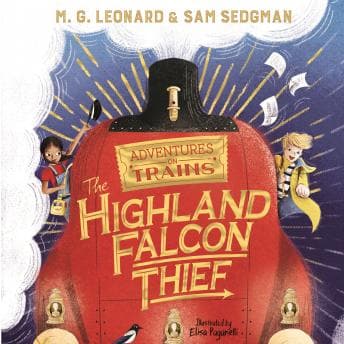

Everyone kept comparing this to Murder on the Orient Express for kids, and I went in expecting a watered-down Christie knockoff with a steam engine gimmick. I was wrong. What M.G. Leonard and Sam Sedgman have done here is something far more interesting from a developmental psychology perspective—they've created a mystery that actually respects how children think.
I was cooking biryani on a Sunday afternoon—the kind of elaborate project that requires stirring at intervals but leaves your brain free to wander—when Harrison Beck started noticing things the adults around him missed. That's when I sat down at my kitchen counter, wooden spoon forgotten, genuinely curious about where this was going.
The Psychology of the Child Detective Done Right
Here's what most children's mysteries get wrong: they either make the kid protagonist impossibly brilliant (the research shows children can spot this inauthenticity immediately) or they dumb down the mystery until there's nothing left to solve. Harrison—Hal—exhibits neither pattern. He's observant in the way actual eleven-year-olds are observant. He notices social dynamics, catches adults in small lies, picks up on emotional undercurrents. The authors understand that children are often better at reading people than adults give them credit for—they just lack the context to interpret what they're seeing.
His friendship with Lenny (short for Marlene, daughter of a baroness, wonderfully prickly) develops with the kind of initial suspicion and gradual alliance that mirrors real childhood social negotiation. My therapist would have thoughts about Lenny's character—there's clearly some attachment stuff happening with her absent parents that the book touches on lightly without making it A Thing. Good instinct. That same restraint in handling family dysfunction shows up in Little Fires Everywhere, though obviously aimed at a very different audience.
Jot Davies and the Art of Holding Back
I found myself asking: why does this narration work so well when it's technically... restrained? Davies doesn't do vocal gymnastics. He doesn't give every character a wildly distinct accent or theatrical delivery. What he does is maintain this steady, almost conspiratorial tone—like he's letting you in on a secret. His pacing fits the narrative's rhythm perfectly, slowing during the moments when Hal is sketching in his notebook (a lovely character detail—the boy processes through drawing), quickening when something's amiss in the dining car.
The production is clean but minimal—no sound effects, no music, no full cast. Just Davies, the words, and your imagination. For a book about one of Britain's most famous steam trains on its final journey, I initially thought this was a missed opportunity. But actually? The restraint works. The text itself is so richly atmospheric—whispers in corridors, the rattle of carriages, the smell of coal smoke—that sound design might have been overkill.
A Fascinating Case Study in Children's Literature
The mystery itself is clever without being convoluted. A precious brooch goes missing. Suspects abound. Red herrings are planted with care. The structure reminded me of T Is for Trespass—both mysteries that trust their readers to follow careful clue placement without hand-holding. But what elevates this above standard middle-grade fare is the setting as character. The Highland Falcon isn't just a backdrop—it's a closed system, a social ecosystem with its own hierarchy and rules. The train staff, the wealthy passengers, the royal connection (yes, there's royalty involved, handled with surprising subtlety)—it's a microcosm of British class dynamics that children will absorb without realizing they're learning something about how society stratifies.
Sam Sedgman's background creating murder mystery treasure hunts shows. The clues aren't arbitrary—they're the kind of details a child might actually notice and piece together. There's a respect for young readers' intelligence here that I found genuinely refreshing.
Who Should Climb Aboard (And Who Should Stay on the Platform)
This is ideal for middle-grade listeners—roughly 8 to 12—who want to feel smart while being entertained. Parents looking for audiobooks to share during car rides: this is your book. The 6h 48m runtime is perfect for a road trip, and there's nothing here that requires content warnings or awkward conversations afterward.
Adults without children? Look, I listened to this alone in my kitchen and enjoyed it thoroughly. But I'm also someone who analyzes fictional characters like case studies. If you're not interested in children's literature as a genre, this probably isn't for you. It does what it does exceptionally well, but it's not trying to be crossover literary fiction.
One caveat: if your child needs constant action to stay engaged, the first hour is a slow build. The mystery doesn't kick in immediately—there's world-building, character establishment, the setting of the scene. Psychologically, this is good storytelling practice. Practically, some kids might get antsy.
Case Closed
The British Book Awards got this one right. The Highland Falcon Thief understands something fundamental about why children love mysteries: it's not about the crime, it's about the agency. Hal gets to be competent. He gets to matter. He gets to solve what the adults cannot. For a child navigating a world where they have so little control, that fantasy is powerful.
Davies delivers it with exactly the right touch—present but not intrusive, guiding without condescending. The first book in a series that apparently spans trains across the world, and I'm genuinely curious where they'll go next.
My biryani burned, by the way. Worth it.