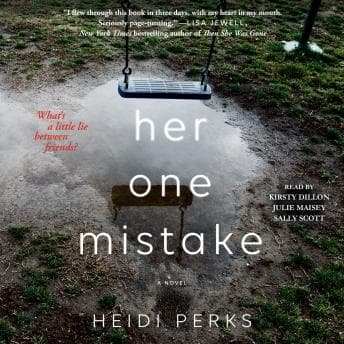

So everyone told me this was Big Little Lies meets Gone Girl meets every other domestic thriller comparison publishers love to slap on covers. And honestly? I went in ready to be underwhelmed because that's what happens when the hype machine overpromises. But here's the thing - Her One Mistake got under my skin in ways I didn't expect, not because of the mystery itself, but because Heidi Perks understands something fundamental about female friendship: the guilt is always worse than the crime.
I started this one at like 2 AM because I couldn't sleep - Frida had knocked my water glass off the nightstand (thanks, gata) and once I was awake, I figured why not. And a thriller about a missing child at 2 AM in a dark apartment? Yeah. That hit different.
The Weight of Charlotte's Silence
Here's what got me. Charlotte loses her best friend's daughter at a school fair. That's the premise, sure, but it's the way the guilt spirals that Perks writes so well. Charlotte doesn't just feel bad - she dismantles herself. She replays the moment she looked away, and then the moment before that, and the moment before that, until she's basically rewritten the entire day as evidence of her own failure. As someone who once accidentally let a client's dog out of their yard during a home visit and spiraled for three days? I FELT that in my chest.
And Harriet - oh, Harriet. Her sections are suffocating in the best way. She's trapped in this marriage with Brian that gave me full-body chills, not the fun kind. The way Perks slowly reveals the dynamics of that relationship, peeling back what Harriet presents to the world versus what's actually happening behind closed doors - it's the part of this book that'll stay with me. The mystery of where Alice went is almost secondary to the mystery of who Harriet really is when no one's watching.
Three Narrators, Three Temperatures
Kirsty Dillon and Julie Maisey handle Charlotte and Harriet's first-person chapters, and what I love is how different the emotional temperatures are. Dillon gives Charlotte this breathless, panicked energy that never lets up - you can hear the guilt sitting right at the back of her throat. Maisey's Harriet is quieter, more contained, which makes the moments she cracks absolutely devastating. There's a scene where Harriet finally confronts what her marriage actually looks like, and Maisey's voice just... breaks open. Not dramatically. Just enough. I had to pause my design work and stare at my screen for a minute.
Sally Scott handles the third-person chapters with this detached, almost clinical tone that works as a palate cleanser between the two women's emotional chaos. It's a smart structural choice - three narrators could've been a mess, but the alternating perspectives create this push-and-pull that kept me pressing play through an entire rebrand project I was supposed to be focused on. (Sorry, client. Your color palette can wait.)
Where it didn't fully work for me: none of the three narrators are doing anything wildly memorable with the supporting characters. Brian, the detective, the other school moms - they're functional but flat in the audio. Julia Whelan would've given Brian's controlling undertone something extra, something you'd catch on a relisten. These narrators are solid, professional, but not the kind of performances I'll be thinking about in six months.
The Twist I Saw Coming (and the One I Didn't)
Look, I've listened to enough domestic thrillers to clock certain patterns. The big reveal about Harriet's situation? I called it around hour four. But Perks is smart enough to layer a second turn underneath - one involving Charlotte's own secrets - that genuinely surprised me. It reframes everything you thought you understood about both women's choices, and I respect a book that trusts its readers enough to play that long game.
Did I ugly-cry? Not quite. But my eyes burned during the last hour, and I had that tight feeling in my throat that means I'm holding it together by a thread. This book felt like sitting across from a friend who's finally telling you the real version of her life, not the Instagram version. The vibes aren't cozy. They're raw and uncomfortable and a little too real.
Abuela would've been GLUED to this one. She loved a good "la esposa se venga" story, and while this isn't exactly that, the energy is adjacent.
Who This Book Is Actually For
If you want a thriller that's more about the emotional wreckage than the crime itself - yes. If alternating narrators annoy you or you need constant plot twists every chapter - probably skip. This is a slow-reveal book disguised as a fast-paced one. The pacing moves, but it's the character revelations doing the heavy lifting, not action sequences. Gamble operates the same way — the plot technically moves, but what you're really reading for is the slow excavation of who these women actually are underneath all the performance. Perfect for a rainy afternoon listen when you want something that'll make you text your best friend "I love you" unprompted.
Give It to the Moms Who Know Too Much
Not a must-listen, but a genuinely good one. The kind of audiobook I'd recommend to anyone who's ever smiled through a terrible situation because they didn't know what else to do. My heart didn't shatter, but it bruised. And sometimes a good bruise is enough.