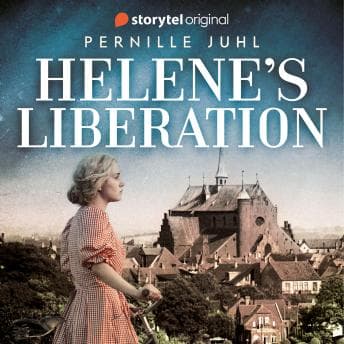

Danish resistance, a forbidden romance with a German soldier, and a mole hunt in the summer of 1944. That's a setup I'd normally sprint toward. And honestly, Helene's Liberation gets more right than wrong - but it left me wanting more in ways that kept nagging at me long after the final chapter.
I finished this one on a late-night drive back from a client site in San Antonio, Ranger snoring in the back seat, the Hill Country pitch black around me. That kind of isolation actually suited the mood pretty well. Helene's world is claustrophobic in the best sense - she's operating in occupied Denmark where every neighbor could be watching, every casual conversation could be a death sentence, and the man she's fallen for wears the wrong uniform.
The Resistance Got Under My Skin
Let me cut to the chase - the strongest part of this book is the paranoia. The mole hunt within Helene's resistance cell had genuine tension. When you've worked in environments where trust is everything and one bad actor can get people killed, that dynamic hits different. The firsthand account in Narrative of a Revolutionary Soldier reminded me how that same corrosive uncertainty - who's loyal, who's not - runs through every generation of people trying to hold a cause together under pressure. Pernille Juhl captures the way suspicion poisons a group from the inside. People start second-guessing handshakes. Old friends become suspects. Helene herself falls under suspicion, which adds a layer where she's trying to prove her own innocence while simultaneously hunting the real informer. That's a solid structural choice.
The Denmark setting is what separates this from the mountain of WWII fiction out there. Denmark's occupation was - historically speaking - a strange beast. The Danes maintained a functioning government under German oversight for years before things got ugly. Juhl uses that ambiguity well. The line between collaboration and survival is blurry, and Helene lives right on that line. I appreciated that the book didn't reduce everyone to simple heroes and villains. The German soldier isn't a cartoon, which takes guts to write.
But here's where the forbidden romance angle gets complicated for me. The central question - did her German lover betray the cell's bomb attack to the authorities? - should've been the engine driving everything forward. And it does, for stretches. But the pacing wobbles. At 9 hours and 38 minutes, there are sections in the middle where the romantic tension overshadows the operational stakes, and I found myself checking my speed settings. (I was already at 1.25x, which is my default. Bumped it to 1.5x for about an hour before dropping back.)
Zoe Mills Behind the Mic
Zoe Mills narrates solo, and she's competent. Steady, clear, good emotional control during the heavier moments. But I'll be straight with you - I can't tell you she knocked it out of the park because the performance doesn't really distinguish itself. For a story set in Denmark involving Danish and German characters, I wanted more texture in the voices. Some accent work, some differentiation that would let me instantly know who's speaking in a crowded scene. Mills keeps things relatively uniform, which works fine for Helene's internal monologue but flattens the ensemble moments.
This is a translated work - Juhl is Danish - and the English narration sometimes feels like it's skating over cultural specifics that probably land harder in the original language. Not Mills' fault necessarily, but worth noting. The production is clean, no audio issues, no weird edits or background noise. Professional job.
Who's Going to Love This (And Who Won't)
If you're deep into WWII historical fiction and you've already burned through the big names - Hannah, Follett, Morris - this is a solid change of pace. The Danish angle gives it freshness, and the resistance cell dynamics are the real draw. Romance readers who want their love stories set against high stakes will find plenty to work with.
But if you're coming to this expecting a thriller with the pedal down - like I probably was - you'll hit some soft spots. The mystery of the informer could've been tighter. I've read (and lived through) enough intelligence work to know that a mole hunt should feel like a countdown clock, and this one occasionally forgets to tick.
Compared to something like "The Nightingale" by Kristin Hannah, which covers similar occupied-Europe-women-in-the-resistance territory, Helene's Liberation is smaller in scope and more intimate. That's not a knock - sometimes the smaller story is the truer one. But it also means the emotional payoff is quieter.
Mission Debrief
Worth your time? Here's the debrief: Helene's Liberation is a decent historical romance with a genuinely interesting espionage backbone. The Danish resistance setting earns it points for originality, and the central dilemma - loving someone who might be responsible for your friends' deaths - is the kind of impossible situation that makes for good fiction. The narration is serviceable but not memorable. It's the kind of book I'm glad I listened to but probably won't revisit. Ranger slept through it, which I'm choosing not to interpret as a review.