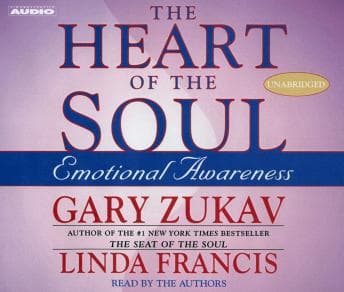

Look. I have a complicated relationship with self-help audiobooks. Most of them are 7 hours of content that could've been a blog post — or honestly, a tweet. So when I queued up Heart of the Soul during a particularly brutal Monday morning commute, I was already mentally preparing my "this could've been an email" rant.
But here's the thing. This one's... weird. Not bad-weird. Just — it sits in this uncanny valley between genuinely useful emotional framework and a book that keeps telling you the same thing in slightly different words for seven hours.
The Emotional Debugging Framework That Almost Works
TL;DR: Zukav and Francis are basically trying to build you a monitoring dashboard for your emotions. Their thesis is that most of us are running around reacting to feelings we haven't even identified yet — like trying to debug a production system with no logging enabled. And honestly? That metaphor held up for me longer than I expected.
The core concept — emotional awareness as the bridge between your personality and your soul's actual intentions — is solid. Zukav talks about how anger, jealousy, fear, and even boredom are essentially signals from your internal system, and instead of suppressing them or acting on them impulsively, you should treat them like log output. Read them. Parse them. Figure out what subsystem is throwing the error.
I was genuinely into this for the first three hours. The section where they break down how physical sensations in your body (tightness in your chest, tension in your throat) map to specific emotional patterns felt practical and concrete. That's the kind of stuff I can actually use sitting in a meeting where someone is proposing a terrible architecture decision and I can feel my jaw clenching.
When the Loop Never Breaks
Here's where it falls apart for me: the repetition. Oh god, the repetition.
By hour four, I started feeling like I was stuck in an infinite loop with no exit condition. Zukav and Francis will introduce a concept — say, the difference between reacting from a "frightened part of your personality" versus an "empowered part" — and then they'll restate it. And restate it. And give you a slightly different angle on the same restatement. I bumped my speed to 1.75x around the halfway mark, which is my universal signal for "I respect your ideas but you are testing my patience."
The complaint that this rehashes The Seat of the Soul is legitimate. If you've read Zukav's earlier work, you'll recognize the vocabulary — authentic power, five-sensory versus multisensory perception, alignment of personality with soul. Heart of the Soul is supposed to be the practical application layer, and to be fair, it does try to get more granular about day-to-day emotional processing. But it often feels like a patch release when they promised a major version upgrade.
Also — and this is a minor thing but it bugged me — the book can get pretty reductionist about complex emotional states. Not every instance of anger is a "frightened part of your personality." Sometimes anger is just... a reasonable response to an unreasonable situation? (Like when someone pushes a breaking change to main on a Friday at 4:59 PM. That's not my soul talking. That's justified rage.)
Author-Narrated: The Double-Edged Sword
Zukav and Francis narrate this themselves, which means you get the authentic energy of the people who actually believe this stuff. Zukav has this calm, deliberate delivery that works for the material — he sounds like a therapist who's genuinely not in a hurry. Francis's sections are warmer, more personal. There's a sincerity there that a professional narrator might not have captured.
But — and I say this as someone spoiled by Ray Porter and the Audible elite — neither of them is a trained narrator. The pacing is sometimes glacial. There are moments where the delivery flattens out and you lose the thread, which is a problem on a 6AM train when you're already fighting consciousness. I caught myself zoning out and rewinding more than usual. This is not a commute-safe listen at normal speed. At 1.5x minimum, it becomes manageable.
Who Should Queue This Up (And Who Should Hard Pass)
If you've never read Zukav and you're looking for a framework to actually notice what you're feeling before you react to it — this has value. The emotional awareness model is genuinely useful, and at 7 hours it's not asking for a massive time commitment.
If you've already read The Seat of the Soul, skip this unless you specifically want the "how to apply it daily" companion piece. And even then, set expectations appropriately.
Perfect for: focused weekend listening, a quiet walk. Skip for: commute (too easy to zone out), anything requiring divided attention.
The ROI Calculation
The ROI on this audiobook is maybe 3 hours of genuine insight stretched across 7 hours of runtime. If you want a self-help audiobook where the ROI actually pencils out cleanly, Making of a Manager is the one I keep recommending — tighter, more concrete, and every chapter earns its runtime. The core framework is worth your time. The delivery mechanism needs optimization. If someone extracted the unique content from this book and published it as a focused 3-hour listen, it'd be a solid recommend. As it stands, it's a borrow — grab it on Libby, listen at 1.75x, and don't feel guilty about skipping ahead when Zukav starts his third pass on a concept you already got.