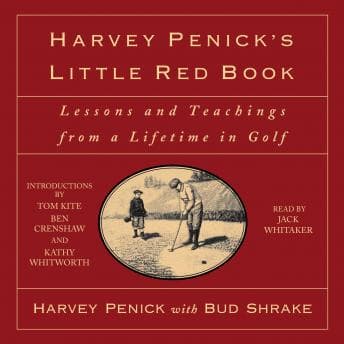

I was sitting in the bleachers at a Saturday morning golf scramble - Denise's work thing, the kind where nobody keeps real score and everybody pretends the beer cart is a surprise - when I started this audiobook. Seemed appropriate. Harvey Penick's Little Red Book has been called the golfer's equivalent of The Elements of Style, and as someone who's made a career out of Strunk and White, that comparison alone was enough to get me to press play.
Here's the thing: they're not wrong.
The Socrates of the Short Game
Penick started caddying at eight years old in Austin, Texas, and spent nearly a century teaching golf. Not selling golf. Not branding golf. Teaching it. And his approach is so stripped-down, so anti-jargon, that it reads less like instruction and more like proverbs. "Take dead aim." That's his most famous piece of advice. Three words. No biomechanical breakdown, no swing plane analysis, no launch monitor data. Just - take dead aim.
This reminds me of what Hemingway said about writing one true sentence. Penick does the same thing with golf. Each lesson in the red notebook - and they really are short, some just a paragraph or two - carries the weight of decades of watching people overthink a fundamentally simple act. He talks about grip and stance and follow-through the way a great writing teacher talks about clarity and rhythm. Cut what doesn't serve the sentence. Cut what doesn't serve the swing.
At 90 minutes, this is basically a long podcast episode. And honestly? The brevity is the point. The book is structured as dozens of small lessons and anecdotes, not a sustained narrative. You could listen to three or four entries, go hit balls, come back, listen to three more. It's modular in a way that suits the format - or should.
Jack Whitaker and the Problem of Pace
Here's where I have to be honest, and it pains me because I genuinely love this book's content. Jack Whitaker's narration is... a challenge. He's got the gravitas of a veteran sports broadcaster, which makes sense - that's what he was. But there's a stiffness to the delivery that fights against Penick's natural warmth. The pauses land in strange places, mid-phrase sometimes, as if he's reading the sentences for the first time and deciding where the commas go as he speaks. For someone like me who believes the narrator understands that pause is punctuation - Whitaker's punctuation is all wrong.
The worst of it is what I'd call the soporific effect. Penick's entries are already brief and meditative. When you layer a monotone, slightly syrupy delivery on top of that, the whole thing starts to drift into white noise territory. I caught myself at that scramble, sitting in the sun, eyes closed, and realized I'd missed two full lessons because Whitaker had lulled me into something between relaxation and unconsciousness. (My students would recognize the look. It's the same one they give me during my Faulkner lectures.)
It's frustrating because the material deserves better. When Penick tells a story about one of his students - Ben Crenshaw, Tom Kite, Davis Love Jr. - you can feel the affection on the page. The generational weight of a man who watched his students become legends and then taught their children. That warmth gets flattened by a delivery that treats every sentence with the same careful, measured tone, whether it's a technical tip about wrist position or a deeply personal memory.
Why English Teachers Should Read Golf Books
I keep coming back to the Strunk and White comparison because it's genuinely apt. Both books are short. Both books are opinionated in a quiet way. Both books trust that simplicity is harder than complexity - and more valuable. I ran into the same philosophy in a completely different arena reading New Sales. Simplified. - Mike Weinberg strips out all the overcomplicated methodology and keeps insisting that the fundamentals, done with intention, beat the fancy stuff every time. Penick doesn't want you to understand swing mechanics the way a physicist would. He wants you to feel the club in your hands and stop thinking so much. "Take dead aim" isn't instruction. It's philosophy.
If you loved Meditations by Marcus Aurelius - and yes, I'm comparing a golf book to Stoic philosophy, fight me - this is its spiritual successor in a very specific way. Short entries. Hard-won wisdom delivered without ego. A life's work distilled into something you can hold in one hand.
The prose deserves to be savored. I just wish this particular audio version let you savor it properly.
Who Should Tee Up - and Who Should Read the Print
Golfers who want to quiet the noise in their heads will love the content. Period. Beginning or experienced, there's something here. But - and I mean this gently - consider the print edition first. The narration doesn't ruin the book, but it doesn't honor it either. If you're committed to audio, listen during focused moments, not while driving or doing dishes. You'll lose the thread. And at 90 minutes, this barely costs you an afternoon.
The Red Notebook Stays on the Shelf
I'll probably listen again before next summer. Maybe while walking the lakefront, when Denise is talking about her putting grip and I can pretend I'm paying attention to both. The book itself is a quiet classic - the kind of thing that gets passed between friends with a "just trust me" and no other explanation needed. The audio version is a decent way in, but it's like hearing a poem read by someone who understands the words but not the music.