
Why does my brain latch onto the one snarky comment in a code review but completely forget the five "LGTM"s? Like, I know intellectually that my team respects my work, but my limbic system apparently didn't get the memo.
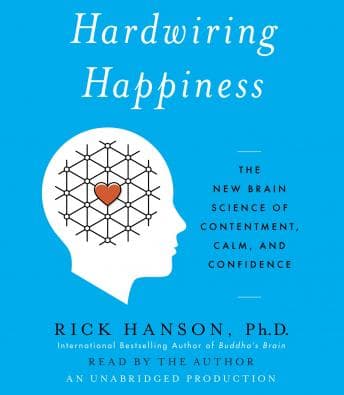
That's basically the premise of Hardwiring Happiness, and honestly, hearing Rick Hanson explain the neuroscience behind it made me feel slightly less broken. I finished this over about four commutes - would've been three but I rewound a couple sections because Hanson's HEAL method (Have a good experience, Enrich it, Absorb it, Link it) is the kind of thing you want to actually internalize, not just passively consume at 6AM.
Your Brain's Negativity Bias Is Basically a Legacy Bug
Hanson's central argument is clean and engineer-friendly: evolution optimized our brains for threat detection, not happiness. Good experiences slide off like water, bad ones stick like tar. He calls it the brain's "negativity bias" and frames the fix as literally rewiring neural pathways by spending 10-30 seconds actively soaking in positive experiences. That's it. That's the core loop.
And look - I'm inherently skeptical of any self-help book that promises brain changes "in just minutes a day." But Hanson is a neuropsychologist, not a LinkedIn influencer, and he actually walks through the research on experience-dependent neuroplasticity without dumbing it down to uselessness. The science holds up, or at least it held up to my 1.5x-speed scrutiny. He references specific studies on how repeated mental activation strengthens neural connections, and he's careful about distinguishing correlation from causation in the research he cites. Refreshing for this genre.
The HEAL framework is genuinely useful - it's basically a design pattern for emotional regulation. Have the experience, enrich it by staying with it and feeling it in your body, absorb it by visualizing it sinking in, and optionally link the positive feeling to a negative one to start overwriting old pain. It's simple enough to actually do on a Caltrain platform while waiting for a delayed baby bullet.
The Repetition Problem (a.k.a. This Book Has a Loop It Can't Break Out Of)
Here's where it gets tricky. The core concept - stop, notice good things, sit with them for a beat - could genuinely be a long blog post. Maybe a really good one. Hanson stretches it across 7 hours and 40 minutes by applying the same framework to confidence, then calm, then intimacy, then motivation, and... you feel the padding. By hour five I was getting the same advice repackaged with slightly different examples and I'd bumped my speed to 1.75x.
It's not that the later chapters are bad - some of the specific applications, like using the method to address childhood attachment wounds, go deeper than I expected. But the repetitive structure means your attention drifts, and this is a book that really doesn't want your attention to drift. It's asking you to practice presence while simultaneously testing your patience with redundancy. The irony is not lost on me.
Author-as-Narrator: Calming, But With Rough Edges
Hanson narrates his own book, and his delivery is... interesting. There's this boyish sincerity to his voice that genuinely works - it sounds like a really kind therapist explaining something to you over tea. Calming in a way that almost functions as a meditation app. I caught myself actually relaxing during certain passages, which on a packed morning train is basically a superpower.
But. There are noticeable timing glitches - weird pauses that feel like editing artifacts rather than intentional beats. And the audiobook has zero useful chapter markers or track names, which is maddening for a book structured around a specific methodology. I wanted to jump back to the HEAL framework explanation multiple times and had to scrub around blindly. For a book about building positive neural habits, the audio production doesn't exactly make it easy to build the habit of re-listening to key sections.
Perfect for: commute, bedtime wind-down. Skip for: gym, anything requiring split attention. This one needs more focus than your average self-help listen.
The ROI Calculation
The ROI on this audiobook is... moderate. The core insight is genuinely valuable - I've caught myself doing the 10-second "absorb" thing after good moments at work, and it actually shifts my mood. Kevin even noticed I was less grumpy after on-call rotations, which is saying something. But you're paying 7+ hours for what's really about 3 hours of unique content. If you already meditate or have a mindfulness practice, a lot of this will feel like review.
If you're a skeptic like me who needs the neuroscience rationale before you'll try any woo-adjacent practice, Hanson delivers that rationale clearly and credibly. If you just want the technique, honestly read the summary and save yourself four hours. But that calm, sincere delivery does add something the text version can't - it models the very state the book is trying to teach you. Strangely, I got a similar unexpected emotional grounding from Just After Sunset - not because it's calming, but because King's narrators sit with feeling in a way that ends up doing something to your nervous system whether you want it to or not.