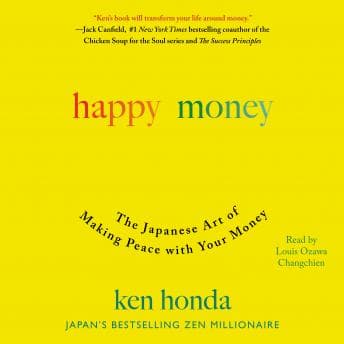

Money has feelings. That's the thesis. And honestly? I expected to roll my eyes through five hours of woo-woo financial advice while chopping onions for a biryani I'd eat alone at 10 PM. Instead, I found myself genuinely reconsidering my entire relationship with my bank account.
Ken Honda isn't trying to teach you budgeting. He's not going to lecture you about index funds or the 50/30/20 rule. This is psychology disguised as personal finance—which is exactly why it landed for me. The central concept of "arigato money" (saying thank you when money comes in AND when it goes out) sounds absurd until Honda explains the underlying mechanism. Research actually shows that our emotional associations with money—formed in childhood, reinforced through decades of experience—shape our financial behavior far more than any spreadsheet ever could.
What Your Parents Taught You About Money (Without Saying a Word)
Honda's framework of "Money EQ" versus financial IQ is where this book becomes genuinely useful. He identifies patterns I've seen in my own research on narrative identity: the way we inherit money stories from our families without ever examining them. Are you a saver who hoards because your parents lived through scarcity? A spender who can't keep cash because abundance felt dangerous in your household? Honda wants you to notice these patterns—to become the observer of your own money story rather than its unwitting protagonist.
Louis Ozawa Changchien's narration carries this material with exactly the right energy. Calm. Unhurried. There's a soothing quality that prevents the more philosophical sections from feeling preachy. His enthusiasm surfaces at strategic moments—when Honda shares anecdotes from Japanese business culture or explains why wealthy people often seem miserable. The pacing matches the book's gentle insistence that you don't need to be fixed.
The Scarcity Myth (And Why Your Brain Believes It Anyway)
Here's where Honda won me over completely. He unpacks the myth of scarcity—the belief that there's never enough—as a psychological construct rather than an economic reality. A textbook case study in how narratives shape behavior. We tell ourselves money is scarce, so we clutch it tightly, which creates anxiety, which makes us spend impulsively to feel better, which confirms our belief that money disappears. The cycle practically diagrams itself.
What makes Honda compelling as a narrator-guide is his willingness to admit his own complicated money history. He's not preaching from a mountain of inherited wealth. The authenticity comes through in his examples, his acknowledgment that changing your money relationship takes years, not a weekend seminar.
My one frustration: the book leans heavily on Japanese cultural context without always bridging to Western financial systems. Some concepts translate beautifully. Others left me asking: how does this apply when I'm staring at American student loan debt? Honda gestures toward universality but doesn't always earn it. POSITIVE THINKING POWER attempts a similar cultural bridge with mixed results—the inner critic concept translates, but the execution feels generic.
The Giving Problem
The section on giving money—not just receiving it—hit differently than I expected. Honda argues that how you give reveals your money wounds. Do you give resentfully? Performatively? With strings attached? My therapist would have thoughts about this chapter. Several thoughts. Possibly an entire session's worth.
At just over five hours, the audiobook doesn't overstay its welcome. It's the kind of listen you can finish in a weekend of cooking and cleaning, then return to specific sections when you need a recalibration. Changchien's delivery makes it easy to absorb without taking notes, though you might want to.
Who This Is (And Isn't) For
If you want tactical financial advice—how to invest, how to budget, how to retire early—this isn't your book. Skip it. You'll be annoyed.
But if you've ever felt anxious checking your bank balance, guilty about spending, or confused about why you can't seem to save despite knowing you should? This is a fascinating reframe. Honda isn't fixing your finances. He's fixing your relationship with the concept of money itself. Psychologically, this tracks.
I found myself asking: why does money really stress us out? Honda's answer—that we've confused our net worth with our self-worth—is simple but not simplistic. Automatic Millionaire takes the opposite approach—pure mechanics, zero psychology—which is exactly why it misses what Honda gets right. It's the kind of insight that seems obvious once someone says it, which is the mark of genuinely useful psychology.
The Biryani Verdict
The rice was perfect, by the way. Sometimes you need a book that reminds you that abundance isn't about accumulation. It's about noticing what's already there.