
This is not my usual lane. Like, at all.
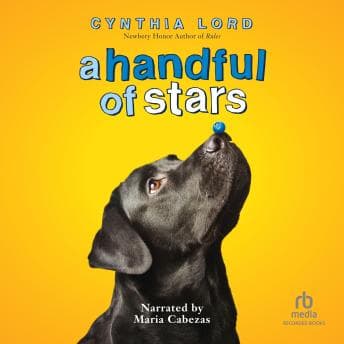
I picked up A Handful of Stars because I'd burned through my queue during a brutal on-call week and needed something short and low-stakes to decompress. At 3 hours 46 minutes, it's basically one round-trip commute from SF to Mountain View with a coffee stop. And honestly? It hit different than I expected a middle-grade novel to hit at 11:30 PM on a Tuesday while I was stress-eating trail mix and waiting for a deploy to finish.
Blueberry Barrens and Class Hierarchies Nobody Talks About
Cynthia Lord - she's the Newbery Honor author behind Rules - sets this during Maine's blueberry harvesting season, and the specificity of that world is what makes it work. Lily is the small-town kid who's always been there; Salma is from a migrant worker family that comes through seasonally. Their friendship forms around Lily's grandmother's struggling blueberry farm and a local dog agility competition (yes, really, and yes, it works). What surprised me is how Lord handles the immigration and class dynamics without ever getting preachy. Lily doesn't understand why Salma's family moves so much. Salma doesn't understand why Lily takes her permanence for granted. Neither kid is wrong, and Lord trusts her young audience enough to sit in that discomfort.
If you've read Rules, you'll recognize Lord's approach - she picks a very specific, almost niche setting (dog agility! blueberry harvesting!) and uses it as the lens for bigger questions about belonging and fairness. It's basically Rules but for labor and immigration instead of disability, and it works just as well.
The dog stuff, by the way, is genuinely charming. Lily training Lucky for the agility competition gives the book its forward momentum, and the details about how the barrens operate during harvest season - the raking, the economics, the seasonal rhythm of it - feel researched and real. Lord clearly spent time in coastal Maine.
Maria Cabezas Carries the Quiet Parts
Here's where I have to be honest: my research on Cabezas's performance is thinner than I'd like. She's not a narrator I had on my radar (my usual rotation is, uh, Ray Porter and more Ray Porter). But what I can tell you is that she handles the emotional weight of this story - which is considerable for a book this short - without overselling it. There's a scene near the end involving Salma's family having to leave that Cabezas delivers with this quiet restraint that landed harder than if she'd gone full dramatic. She doesn't try to make you cry. She just tells you what happened, and you feel it anyway.
Her Spanish pronunciation sounds natural and unforced, which matters a lot in a book where a character's bilingualism is part of her identity. I've listened to enough audiobooks where an English-primary narrator stumbles through Spanish names like they're parsing a stack trace for the first time - Cabezas doesn't have that problem.
At 3:46, the pacing is tight. No bloat. No chapters that feel like filler. This is a book that knows exactly what it wants to do and does it. At 1.5x it's basically a long podcast episode.
Who This Is Actually For (And It Might Be You)
Look, this is technically a middle-grade novel, ages 8-12. But here's the thing - I'm a 28-year-old software engineer and I got genuinely invested in whether a fictional dog would complete an agility course. The ROI on this audiobook is surprisingly high if you're looking for something emotionally honest that won't require you to track seventeen character arcs and a magic system.
Perfect for: bedtime wind-down, short commute filler, recovery listen after something dark. Skip for: anyone who needs plot complexity or sci-fi worldbuilding to stay engaged. This is a quiet book. It's doing quiet things on purpose.
If you have kids in the 8-12 range who do audiobooks, this is a genuinely great pick. The friendship dynamics are realistic, the immigration themes are handled with care, and it's short enough that they won't lose the thread.
One Commute, Zero Regrets
I wouldn't have picked this up under normal circumstances - my Audible library is like 80% space opera and distributed systems textbooks. But sometimes the best debugging technique is stepping away from the code entirely. A Handful of Stars is a palate cleanser. It's short, it's warm without being saccharine, and it reminded me that not every story needs to be 40 hours long to leave a mark. That same economy of storytelling is something I appreciated in Pride Over Pity, another compact listen that doesn't waste a single chapter. Lord knows how to write kids who feel like actual kids, and Cabezas knows how to let the story breathe.
Would I spend a full Audible credit on it? At under 4 hours, probably not - grab it on sale or through your library app. But I'm glad I listened.