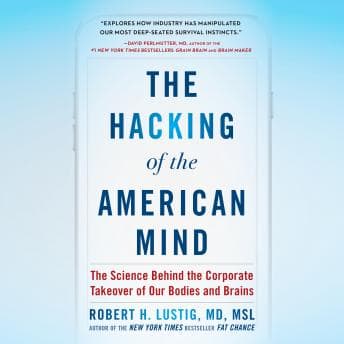

I almost threw my phone across the room during the first hour of this book. Not because Lustig is wrong—he's painfully, frustratingly right—but because he's basically describing the exact dopamine trap I fall into every time I open LinkedIn at 6 AM instead of going for a run. The man spent 10 hours explaining why I can't stop checking my email, and I listened to the whole thing while compulsively checking my email. The irony is not lost on me.
Lustig's central thesis is simple but devastating: corporations have figured out how to hijack your brain's reward system, and they're doing it on purpose. Dopamine (the "I want more" chemical) versus serotonin (the "I'm content" chemical)—that's the whole game. Modern life is basically a dopamine slot machine that never pays out in actual satisfaction. Sugar, social media, porn, processed food—it's all the same neurochemical con job.
What My Parents Knew Without the Neuroscience
Here's what got me. Lustig spends considerable time explaining why constant stimulation destroys your capacity for contentment. My parents worked 14-hour days at their dry cleaning business. No smartphones. No Instagram. No DoorDash. They ate dinner together, went to church, and somehow seemed more at peace than I've ever been with my meditation apps and wellness subscriptions. Lustig would say their serotonin pathways were intact because nobody was engineering their environment to exploit them. My mom would say they were just too tired for nonsense.
The book gets genuinely compelling when Lustig traces the policy decisions that created this mess. Government subsidies for corn (hello, high fructose corn syrup), deregulation of food marketing to children, the pharmaceutical industry's role in normalizing medication for problems that are fundamentally environmental. This isn't conspiracy theory territory—it's documented lobbying and legislation. I've seen similar dynamics play out in three different industries I've consulted for. The playbook is always the same: externalize costs, capture regulators, blame the consumer. Not All Diamonds and Rosé exposes a similar playbook in reality TV—manufactured drama, exploited cast members, and producers who knew exactly what they were doing.
The Author-Narrator Problem (And Why It Works Here)
Lustig reads his own book, which usually makes me nervous. Authors are rarely good narrators. But Lustig is actually engaging—there's a dry humor to his delivery that keeps the dense neuroscience from becoming a slog. When he describes how food companies employ "bliss point" engineers to make products maximally addictive, you can hear the disgust in his voice. It's not polished, but it's authentic.
That said—and Jenny would say I'm being harsh, Jenny is right—this book is about 3 hours too long. The core argument is clear by hour 4. Everything after that is reinforcement, case studies, and policy recommendations that could've been a chapter. I listened at 2.0x and still found myself skipping the occasional tangent about evolutionary biology that felt like padding.
The Actionable Stuff (Skip to Chapter 12 If You're Impatient)
Lustig's solutions are frustratingly simple: Cook your own food. Sleep more. Connect with people face-to-face. Exercise. Limit screen time. Basically, live like it's 1985. The problem is that our entire economy is now built to prevent you from doing any of these things. He acknowledges this, which I appreciate. He's not selling a quick fix.
The "Four C's" framework he offers—Connect, Contribute, Cope, Cook—is actually useful. Not revolutionary, but practical. The science behind why these specific activities boost serotonin rather than dopamine is the value-add here. It's one thing to know you should eat home-cooked meals. It's another to understand exactly how your brain chemistry changes when you do.
Who This Is For (And Who Should Skip It)
If you're already convinced that corporate America is manipulating your behavior, this book will feel validating but not surprising. If you think personal responsibility is the whole story and systemic factors don't matter, this will either change your mind or make you angry. Either way, probably worth your time. Parents should absolutely listen—the sections on how children's brains are particularly vulnerable to dopamine hijacking are genuinely alarming. Not fear-mongering, just "here's the science, here's what you can do."
Skip it if you need tight editing. The core 7 hours are excellent; the other 3 are repetitive.
The ROI Calculation
The first 7 hours are worth the listen. The other 3? Not so much. Lustig has done the research, he's not afraid to name names, and he's offering something more substantive than the usual wellness platitudes. Is it going to change your life? Probably not. But it might change how you think about that third scroll through Instagram at midnight. And honestly, that's worth something.
I finished this at 1 AM on a Tuesday, which is exactly the kind of sleep-deprived, dopamine-chasing behavior Lustig warns against. The man would be disappointed in me. But at least now I understand why I can't stop.







![Steve Jobs [unabridged audiobook] audiobook cover](/_next/image?url=https%3A%2F%2Fcovers.audiobooks.com%2Fimages%2Fcovers%2Ffull%2F9788499923406.jpg&w=1920&q=75)