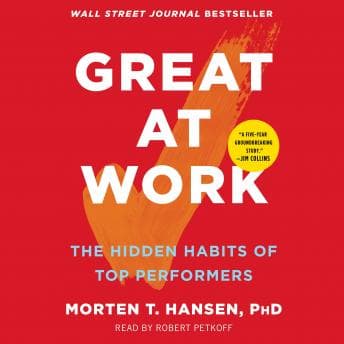

What if the thing holding you back at work isn't that you're not working hard enough, but that you're working on too many things, too broadly, with too little intensity?
That's basically the thesis of Morten Hansen's Great at Work, and honestly, as someone who juggles distributed systems debugging across multiple services simultaneously while context-switching between Slack threads, on-call rotations, and sprint planning — it hit uncomfortably close to home. I started this one on a Monday morning commute, half-asleep per usual, and by Wednesday evening I'd finished it. Three commutes. And I spent the rest of that week quietly auditing how I actually spend my time at work. Kevin caught me making a spreadsheet at 10 PM on Thursday titled "Do Less Framework - SC" and just slowly backed out of the room.
The "Do Less, Then Obsess" Framework Actually Has Data Behind It
Here's where Hansen earns his keep compared to the fifty other productivity books I've burned through at 1.75x. The guy ran a five-year study across 5,000 people. That's not a blog post masquerading as a book — there's genuine statistical rigor here, which my engineer brain appreciates. His seven practices boil down to a pretty elegant core loop: ruthlessly select a few priorities, apply intense targeted effort, redesign your work to maximize value, and then — and this is where it gets interesting — learn to "forceful champion" your ideas internally without being a political shark.
The examples are what keep this from being dry. There's a sushi chef working under a Tokyo subway overpass who has three Michelin stars because he obsessively narrowed his craft. There's a high school principal who turned around a failing school not by adding programs but by cutting them and going deep on what remained. Hansen also pulls in Hitchcock filming Psycho on a shoestring budget as a case study in doing less but better, and the Amundsen vs. Scott race to the South Pole (which — nice callback to Great by Choice, his book with Jim Collins). These aren't throwaway anecdotes; they're mapped back to specific practices with data points. That's rare.
The core insight I keep coming back to: the top performers in his study didn't work more hours. They scored high on what he calls "do less, then obsess" — picking a small number of priorities and going absurdly deep. This is basically the Unix philosophy applied to knowledge work. Do one thing and do it well.
Robert Petkoff Does the Job (But Won't Make You Forget Ray Porter)
Petkoff is an Audie Award winner and AudioFile Golden Voice, and you can tell — his delivery is clean, professional, well-paced. He handles the transition between research discussion, storytelling examples, and practical frameworks without ever sounding like he's reading a textbook. That said, there's nothing distinctive here that makes me go "oh, I need to hear Petkoff narrate everything now." It's competent. It's good. It's not a performance that becomes part of the book's identity the way, say, Ray Porter makes the Bobiverse feel like hanging out with your wittiest friend. (Sorry, I have a problem.)
For a business book, though? Clean narration with good pacing is exactly what you need. No complaints.
The 1.75x Tax and the Blog Post Question
Okay, the mandatory question for every business book: could this have been a blog post? Verdict: no, but it could've been a tighter book. At 7.5 hours, it's not egregiously padded, but there are stretches in the middle — particularly around the "learning loop" and "passion and purpose" chapters — where I felt the framework getting restated with slightly different examples rather than building on itself. I bumped up to 1.75x during those sections and didn't miss anything critical.
The ROI on this audiobook is solid if you're in knowledge work and you've ever felt the pull of saying yes to everything, spreading yourself across too many projects, or confusing busyness with productivity. (So... every engineer I know, including me.) The self-assessment questions at the end of each chapter are actually useful, which is not something I say about most business books. I genuinely paused the audio twice to think through my answers, which on a 6 AM Caltrain is saying something.
Perfect For: Your Commute. Skip For: Anyone Already Reading Cal Newport.
If you've already internalized Deep Work and Essentialism, you'll find overlap here — maybe 40% of the concepts will feel familiar. But Hansen's data-driven approach and the breadth of his study (it's not just tech workers or CEOs) adds genuine new signal. If you haven't read those books, start here — it's the most complete version of the argument.
Skip if: you want a book that will change how you feel about work. This is mechanics, not mindset. It's a systems optimization manual disguised as a management book. The Best of Les Brown Audio Collection is the opposite end of that spectrum — pure fuel for how you feel, zero systems — which honestly makes it a useful companion if the Hansen framework starts feeling cold.
Perfect for: train, gym. Skip for: deep work, bedtime. The irony of optimizing your commute time by listening to a book about optimization is not lost on me.