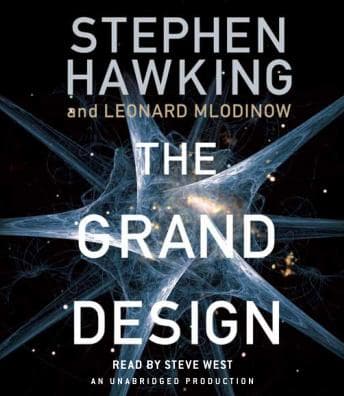

Look, I have a bone to pick with this book. Not because it's bad — it's genuinely great — but because Hawking and Mlodinow spend the first chapter casually dismantling philosophy as a discipline and then proceed to do philosophy for the next four hours. They literally declare "philosophy is dead" and then argue about the nature of reality, free will, and why anything exists at all. That's... that's philosophy, Stephen. You're doing philosophy right now.
Okay. Rant over. Let me tell you why this is still absolutely worth your time.
4.5 Hours to Rethink Everything You Thought You Knew
I finished this in exactly three commutes — two mornings and one evening — and the ROI on this audiobook is absurd. At under five hours, Hawking and Mlodinow cover quantum mechanics, general relativity, the multiverse, model-dependent realism, M-theory, and why the universe doesn't need a creator to exist. That's a staggering density of ideas packed into what amounts to a long afternoon.
The killer move here is "model-dependent realism" — their argument that asking whether a model is "real" is meaningless, only whether it agrees with observation. They illustrate this with a thought experiment about goldfish living in a curved bowl who develop physics laws that account for the curvature and successfully predict their world. Is the goldfish model "wrong" because the bowl distorts their view? Or is our view just a different bowl? I was on the 7:12 Caltrain staring at nothing for a solid two minutes after that section. The guy next to me probably thought I was broken.
The Feynman sum-over-histories stuff is where it gets wild. The idea that a particle doesn't take a single path but every possible path simultaneously — and that this applies to the universe itself having every possible history — is the kind of concept that makes you want to pause and just... sit with it. Steve West's pacing actually helps here. He reads with this measured, almost professorial cadence that gives your brain the microseconds it needs to process before the next concept hits. It's not exciting narration by any stretch, but it's appropriate. You're not listening for drama. You're listening to have your mental model of reality quietly replaced.
The Blog Post Problem (But Make It Physics)
Here's my usual complaint with popular science books: could've been a blog post. And honestly? Parts of this could have been. The early chapters rehashing ancient Greek philosophy and basic Newtonian mechanics feel like warm-up laps when you already know the track. If you've read A Brief History of Time or taken even one college physics course, you'll be tapping your steering wheel through the first hour.
But then they hit you with M-theory and the 10^500 possible universes permitted by string theory, and suddenly you understand why they spent all that time building the foundation. The argument is essentially: the laws of physics aren't unique, our universe is one of an incomprehensibly vast number of possible universes, and the ones that produce conscious observers are the ones where someone's around to ask "why these laws?" It's the anthropic principle on steroids, and whether you buy it or not, the logical chain they build is tight.
The science actually holds up — or at least, it holds up as well as theoretical physics at the bleeding edge can. They're honest about M-theory being unproven, which I respect. They don't oversell it as settled science. They call it the only viable candidate for a unified theory, which is a very specific and defensible claim.
Steve West Isn't Ray Porter (But He's Right for This)
Ray Porter narrates this. Need I say more? Just kidding — he doesn't. Steve West does, and while he's no Ray Porter (who is?), his delivery is exactly what this material needs. Flat, clear, unhurried. When Hawking drops a line like "Because there is a law such as gravity, the universe can and will create itself from nothing" — a sentence that's doing an enormous amount of philosophical heavy lifting — West lets it land without theatrics. No dramatic pauses. No vocal underlining. Just the words, which are dramatic enough on their own.
The downside: at 1.5x, some of the denser passages start to blur. I actually dropped to 1.25x for the M-theory chapter, which I almost never do. If you're listening at 6AM surrounded by other commuter zombies, you might want to save those sections for when you're more alert. This is not a background listen. This is a "put your phone down and actually pay attention" listen.
Who Gets the Most Out of This
Perfect for: anyone who wants a compressed, accessible overview of modern theoretical physics without the math. If you're a software engineer or have any technical background, you'll be able to follow the logic chains without much strain. It's basically a well-designed API documentation for the universe — clean interface, complex implementation hidden underneath.
Skip for: anyone wanting depth on any single topic. This is wide, not deep. I ran into the same tradeoff with Ten Lessons for a Post-Pandemic World — big ideas, breezy pace, satisfying on the commute but you finish it knowing you've been given the map, not the territory. If you've already read Brian Greene or Sean Carroll extensively, you'll find this covers familiar ground at a higher altitude. Also skip if you want a longer listen — at 4.5 hours this is barely a round trip to LA.
Worth Burning a Credit on a 4-Hour Book?
Here's the thing. I usually hesitate on anything under 6 hours for a full credit. The cost-per-hour math doesn't work out. But this is Hawking's second-to-last major work, it's dense enough to warrant a relisten, and at this length you can actually finish it and immediately start processing. I've already relistened to the Feynman histories chapter twice. For a book this short to earn a credit recommendation from me, it has to be dense. This is dense.





![Steve Jobs [unabridged audiobook] audiobook cover](/_next/image?url=https%3A%2F%2Fcovers.audiobooks.com%2Fimages%2Fcovers%2Ffull%2F9788499923406.jpg&w=1920&q=75)