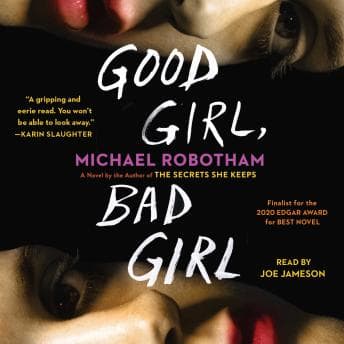

Eleven PM. Papers half-graded, red pen running dry, and Denise already asleep. I should have been finishing sophomore essays on The Great Gatsby - the ones where they all discover, independently and with great originality, that the green light represents hope. Instead, I was three hours deep into Good Girl, Bad Girl, and my coffee had gone cold two hours ago.
I didn't notice.
The Girl Who Reads You Back
Evie Cormac is the kind of character you don't forget. Found hiding in a secret room after a crime scene - half-starved, filthy, refusing to give her name. Six years later, still no identity, no DNA match, no past. Just this unsettling ability to know when someone is lying. Not guess. Know.
This reminds me of what Hemingway said about writing - that the dignity of movement of an iceberg is due to only one-eighth of it being above water. Robotham understands this. Evie's past lurks beneath every scene, and he never overexplains. We get fragments. Implications. The horror of what happened to her exists in negative space, which makes it far more disturbing than any explicit description could.
Cyrus Haven is our way into this world - a forensic psychologist with his own tragic history, called in to determine if Evie is ready for release. But here's where Robotham does something clever. Cyrus thinks he's evaluating Evie. He's wrong. She's evaluating him right back. Their dynamic crackles with tension because neither one is entirely in control.
My students would hate this. I love it.
Joe Jameson Does the Impossible
Let me be direct: Joe Jameson's narration is the reason this audiobook works as well as it does. The man does at least eight distinct voices - male, female, children, adults, suave politicians, emotionally chaotic teenagers - and every single one lands.
His Evie is particularly striking. There's this edge to her voice, this controlled flatness that occasionally cracks into something vulnerable. When she shifts from defensive teenager to the damaged child underneath, Jameson doesn't telegraph it with dramatic flourishes. He trusts the listener to catch the subtle register change. He understands that pause is punctuation.
His regional accents are sharp enough that you can place characters geographically before they're described. The contrast between his rendering of official voices - social workers, police - and the raw, unpolished speech of Evie creates an instant class divide that reinforces the novel's themes about institutional power and the people who fall through its cracks.
I listen at 1.0x because the author chose those words. Jameson's pacing rewards that choice.
Two Cases, One Darkness
The parallel storyline - the murder of figure skater Jodie Sheehan - initially feels like standard thriller territory. Pretty victim. Hidden secrets. But Robotham weaves the two narratives together with real craft. Jodie's story and Evie's story rhyme in ways that become increasingly disturbing.
What Robotham is really getting at is something about how we fail young women. How we create categories - good girl, bad girl - that serve our comfort rather than their truth. Jodie was the "good girl," perfect and beloved. Evie is the "bad girl," dangerous and unknowable. Except neither label holds. The prose rewards close attention when Robotham dismantles these categories, showing us the secret life beneath Jodie's perfect surface and the fierce intelligence beneath Evie's feral exterior.
The pacing is relentless without being breathless. Robotham was an investigative journalist before he turned to fiction, and it shows. He knows how to unspool information, how to make you lean forward.
Fair Warning
This book contains violence, abuse, sexual content, and some genuinely dark material. The description mentions "murder, incest, drugs, abuse, torture" - that's not hyperbole. If you're looking for a cozy mystery, this isn't it. But the darkness serves the story. It never feels exploitative.
Who Gets the Extra Credit
If you loved Tana French's Dublin Murder Squad books, this is their spiritual successor - that same combination of psychological depth, procedural detail, and prose that actually cares about rhythm and word choice. Lord of the Flies does something similar with its refusal to comfort us - both books trust readers to sit with darkness instead of explaining it away.
Skip this if you need constant action or want everything explained and resolved. Evie's mysteries will frustrate you. But if you want a thriller that treats its characters as real people rather than plot devices? If you want narration that elevates already strong material into something genuinely memorable? Pull up a chair.
This is the first book in Robotham's Cyrus Haven series. I finished it at 2 AM, immediately looked up the sequel, and had to physically stop myself from starting it. Those sophomore essays on Gatsby can wait. They'll still be discovering the green light tomorrow.
The irony of choosing this over grading papers about American dreams and self-reinvention isn't lost on me. Evie Cormac reinvented herself out of necessity, out of survival. My students write about it as metaphor. Robotham writes it as lived experience.
That's why we still read - and listen to - the good ones.